


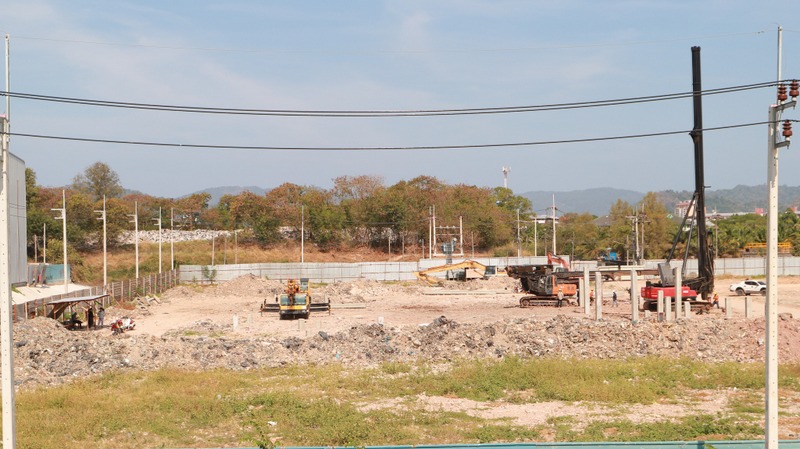
Phuket City Mayor Suppachoke Laongphet said the second incinerator, being built at Saphan Hin, is a long-term solution and will not relieve immediate pressure caused by waste volumes far exceeding disposal capacity.
“Even when this project is completed, it will not solve the problem in the short term,” Mr Suppachoke said. “Until then, waste volumes will continue to exceed what our current system can handle.”
The second incinerator project, with a total government budget of about B65 million, was formally contracted on Oct 31, 2024, with PJT Technology Co Ltd, which will manage and invest in the community solid-waste incineration system, including upgrades to machinery that has been in continuous use for more than 15 years.
“Construction is currently about 30% complete and located next to the Phuket Provincial Waste Disposal Center. Once operational, the new facility is designed to process about 500 tonnes of waste per day,” he said.
However, Mr Suppachoke said authorities cannot yet confirm a completion date, noting only that the incinerator is expected to be finished “next year”, with full operational capacity projected by mid 2027.
The mayor said Saphan Hin was selected as the project site because alternative locations would require lengthy approval procedures and land allocation, which authorities could not afford to delay.
“Saphan Hin was chosen because approvals could be obtained quickly and supporting infrastructure was already in place,” he said. “That allowed construction to proceed immediately.”
Once operational, Phuket’s total incineration capacity will rise to about 1,200 tonnes per day. Until then, officials concede the island’s waste output will continue to overwhelm existing facilities.
At present, Phuket relies primarily on the existing Saphan Hin incinerator, which processes about 700 tonnes of waste daily. The island generates between 1,000 and 1,300 tonnes of garbage each day, leaving an excess of 200–600 tonnes that must be diverted elsewhere.
“Our incineration capacity simply cannot keep up,” Mr Suppachoke said. “That makes landfill disposal unavoidable.”
LANDFILL
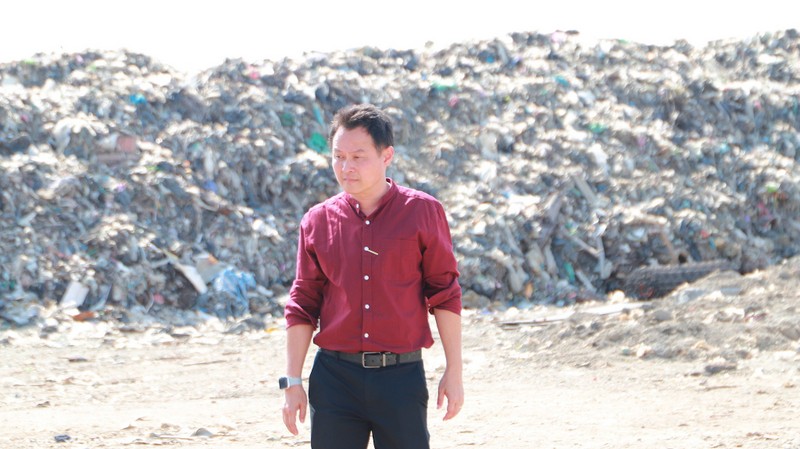
Phuket currently relies on a single landfill area, with the main site at Saphan Hin originally designed to hold about 800,000 tonnes of waste.
“That site now contains roughly 1.2 million tonnes,” Mr Suppachoke said. “It is already far beyond its intended capacity.”
He said the landfill can no longer expand outward and is now limited to stacking waste higher, raising environmental and safety concerns.
According to municipal data, at least 1,200 tonnes of waste enter the Phuket Provincial Integrated Waste Disposal Center each day. About 700 tonnes are incinerated, while more than 500 tonnes are sent directly to landfill.
“The landfill area is effectively full,” Mr Suppachoke said. “To cope in the short term, we have had to accelerate land-levelling to create temporary space for incoming waste.”
Last year, authorities studied the possibility of developing a second landfill in the north of the island, near Bang Khanun Forest Park in Thep Krasattri Tambon Administrative Organisation area. However, the proposal remains at the environmental feasibility and planning stage, with no approval granted.
“The project is still under study, including environmental suitability, green-space allocation and urban planning,” Mr Suppachoke said, adding that preliminary discussions have taken place with a company from Shenzhen, China.
He stressed that relocating or fast-tracking a new landfill would not be feasible due to complex legal and safety requirements, including approvals under the Forestry Act, Navy clearance, public hearings, land-use permits and a full environmental impact assessment.
“That process would take far too long to address the immediate problem,” he said.
As for a third incinerator, officials have surveyed about 40 rai of land near Bang Khanun Forest Park as a possible site. The proposal remains at the study stage, with no construction timeline or budget approved.
SHORT-TERM
To reduce pressure during the 2024-2027 transition period, Phuket City Municipality has begun separating accumulated waste from existing landfill areas.
Initial plans to separate 100,000 tonnes of old waste using a B30 mn budget from the Phuket Provincial Administrative Organisation (PPAO), supported by B10mn from the municipality, were later revised.
Under the revised plan, Phuket Province allocated more than B26mn, with Phuket City Municipality contributing B13mn, to sepoarate an additional 100,000 tonnes.
“In total, around 200,000 tonnes of accumulated waste are expected to be separated,” Mr Suppachoke said.
Additional projects under review include a B70mn waste-management system for new waste, a B10mn budget to hire landfill machinery, and a B79.04mn integrated landfill-cleaning project proposed for the 2026 fiscal year.
Authorities are also consulting the provincial Waste and Refuse Committee on the possible auction of 100,000 tonnes of old waste to further reduce landfill volumes.
LEACHATE
At the provincial level, Phuket is also exploring modern technology to treat landfill leachate more sustainably.
Phuket Governor Nirat Pongsitthithavorn on Feb 4 chaired a meeting with private-sector representatives and experts to discuss new leachate-treatment systems aimed at reducing environmental impacts and enabling water reuse.
One proposal, presented by Portuguese firm AST Ambiente, involved a reverse-osmosis system using high-pressure membranes capable of recycling wastewater for reuse, with an estimated investment of about B30 million.
Mr Suppachoke warned that failure to manage excess waste effectively could have serious consequences.
“If waste is not properly controlled, it will affect the environment, public health, tourism and the wider economy,” he said. “Until the second incinerator is completed, cooperation from all sectors is essential.”