


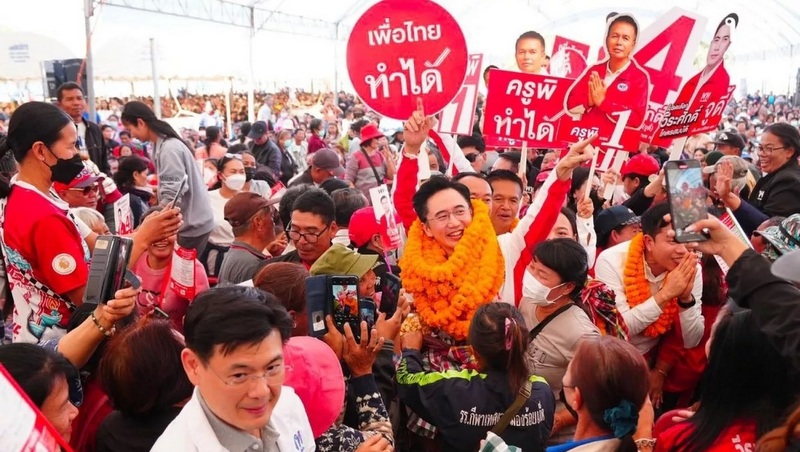
Addressing a campaign rally in Kuchinarai district of Kalasin province, he outlined a “Nine New Millionaires a Day” policy, describing it as part of a large-scale economic data initiative aimed at bringing Thailand’s vast informal economy into the tax system, reports the Bangkok Post.
Mr Yodchanan said the “big picture” digital governance policy would consolidate transaction data to improve price monitoring and targeting of assistance for farmers, the elderly and other vulnerable groups.
He insisted the idea is workable, saying the budgetary framework and legal implications have been carefully studied and would be submitted to the Election Commission for review.
The party proposes to award nine daily prizes of B1 million each through draws. Four prizes a day would be earmarked for four groups: farmers, senior citizens, public service volunteers, and people who file personal income tax.
The remaining five prizes would be drawn from consumer spending receipts, including purchases from small vendors, said Mr Yodchanan.
The scheme would create 3,240 millionaires annually, or about 26,000 over eight years if Pheu Thai remained in office for two terms, he said.
Not a ‘pipe dream’
Responding to criticism by rival parties that the scheme is a “pipe dream”, similar to the Pheu Thai digital wallet project that faced numerous hurdles, Mr Yodchanan insisted the policy should not be viewed as a cash giveaway. He said it must be communicated as part of a full-scale digital government reform.
Two top Democrats - former prime minister Abhisit Vejjajiva and former finance minister Korn Chatikavanij - said the policy would be a wasteful use of taxpayers’ money that failed to address the root causes of poverty.
Sirikanya Tansakun, deputy leader of the People’s Party, said the scheme closely resembles her party’s receipt lottery proposal. But she questioned its impact, noting that only about 2,000 people a year would benefit despite an annual cost of more than B3 billion.
In Kalasin, Mr Yodchanan’s millionaire pitch drew loud cheers from a crowd of 20,000 gathered at the Chao Pho Pu Buakhao shrine in Kuchinarai district. The area is part of Constituency 6, long considered a Pheu Thai stronghold. In the 2023 election its candidate won the seat by a margin of 22,000 votes over the Move Forward contender.
Mr Yodchanan was joined at the rally by local candidate Chanawut Uttho and a number of party heavyweights, including secretary-general Prasert Chanthararuangthong; Nattawut Saikua, assistant campaign director; Sutin Klungsang, party-list MP candidate; and Phanthongtae Shinawatra, son of imprisoned former prime minister and Pheu Thai patriarch Thaksin Shinawatra.
Mr Yodchanan, a nephew of Thaksin, told the crowd he was determined to turn the hopes and aspirations of Kalasin residents into reality after Feb 8 by upgrading Thailand into a high-income country driven by science and technology.
Debt moratorium
He pledged to raise incomes nationwide and address household debt through systematic measures, including a three-year debt moratorium for farmers, solutions for informal debt, and a seniors’ debt relief scheme for non-performing loans of up to B200,000.
Under the plan, debtors who repay just 10% would have the remaining balance written off, restoring financial independence to the public.
The initiative would run alongside cost of living measures, including a B3.70 per unit electricity rate, compared with about B4 now, and a 70:30 economic stimulus model to boost grassroots spending. Pheu Thai touts the latter as an improvement on the most recent half-half programme that subsidised 50% of small-scale consumer purchases.
For Kalasin, Yodchanan said his party planned to elevate the northeastern province as a key hub for tourism and cultural heritage.
The party intended to increase the value and global recognition of local soft power products, such as phrae wa silk and Kalasin sticky rice.
He reaffirmed Pheu Thai’s commitment to decentralisation so provinces can manage their own budgets for infrastructure, electricity and water systems.