


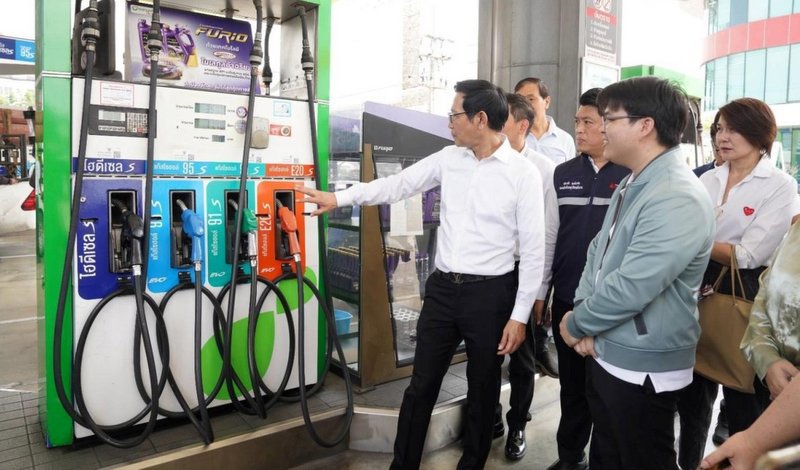
He told the public yesterday (Mar 19) they will be able to buy oil at affordable prices, and the nation will have sufficient fuel for transport and business, reports the Bangkok Post.
“Officials found oil retailers in some areas selling fuel at high prices, claiming they do not receive subsidies from the government,” said Mr Auttapol.
“I want to confirm that every litre of fuel leaving an oil refinery for domestic sales receives subsidies from the state Oil Fuel Fund.”
The government is spending money from the fund to subsidise domestic fuel prices, gradually increasing them to avoid a financial burden for businesses and households.
The pump price of diesel, previously capped at B30 baht a litre, increased by B0.5 on Wednesday (Mar 18) and will continue to rise gradually to B33 to reduce the subsidy burden, said officials.
The price of Gasohol 95 has increased by B1 a litre.
With the subsidies already implemented, Mr Auttapol said retailers who sell oil at prices above the regulated levels will be punished.
He said the Energy and Commerce ministries are working together to establish punitive measures for retailers found guilty of price gouging.
Mr Auttapol spoke while leading an entourage to inspect a major oil depot in Pathum Thani’s Lam Luk Ka district. This depot is a primary hub supplying fuel to roughly 200 service stations across the central region.
“There is no hoarding of oil at this facility, which is operating 24 hours a day in line with the Energy Ministry’s policy,” he said.
A surge in oil demand previously caused fuel delivery trips from the depot to double from 200 to 400 trips per day, increasing the supply from 4 million litres to 8mn litres per day.
Distribution is around 20% higher than average, according to officials. Yet some filling stations still report shortages.
“We expect this shortfall to end later this week because a joint panel of energy and commerce officials are conducting thorough inspections at areas where problems were reported,” said Mr Auttapol.
ETHANOL OUTPUT CRANKED UP
Ethanol manufacturers are increasing production to serve growing demand for Gasohol E20, aligning with the government’s efforts to reduce Thailand’s reliance on oil imports.
Gasohol E20, a mix of gasoline and 20% ethanol, is being promoted by the government as a primary fuel to deal with a surge in global oil prices and shipping constraints via the Strait of Hormuz during the Israeli-US war on Iran, the Bangkok Post noted in a separate report.
“In a period of high global crude oil volatility, E20 will help balance retail prices at service stations,” said Kittisak Wattanavekin, honorary president of the Thai Ethanol Manufacturing Association.
Energy officials aim to encourage wider use of E20 by keeping its price lower than Gasohol 91 and 95, which contain only 10% ethanol.
Caretaker energy minister Mr Auttapol said the government wants to widen the price gap to around B5 per litre to accelerate adoption.
E20 is cheaper than both Gasohol 91 and 95, but officials believe a larger difference will make it more attractive to motorists.
Ethanol consumption in Thailand is roughly 3.5mn litres per day, while total gasoline consumption exceeds 30mn litres per day, according to the association.
If E20 is actively promoted as the primary fuel, ethanol demand is expected to rise to more than 6 million litres per day, significantly reducing oil imports, noted the group.
Ethanol is made from sugar cane-derived molasses and cassava.
Thailand has more than 11mn rai of sugar cane plantations, producing roughly 90mn tonnes of cane and 10mn tonnes of sugar annually. This reflects the industry’s ability to expand into biofuels, said Mr Kittisak.
Sureeyot Khowsurat, chairwoman of the Tapioca Ethanol Association, said ethanol manufacturers are fully prepared to support the E20 policy.
Thailand has an ethanol production capacity of 7.2mn litres per day from 28 plants nationwide, with a surplus capacity of 50-60%, she said.
E20 promotion would increase cassava demand for ethanol to about 6mn tonnes annually. Some 90% of cassava production goes towards starch and chips, with only 10% (about 2-3mn tonnes) entering the ethanol industry.