


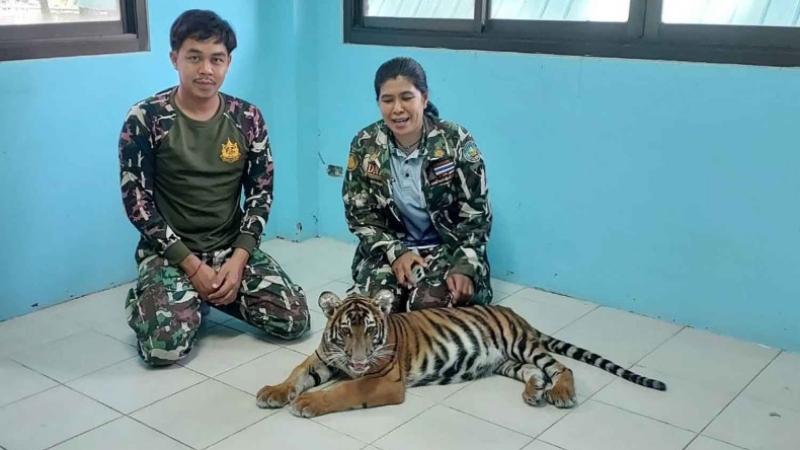
The department’s public relations division said on Sunday (May 19) that it had a regulation which required the owner of an illegally acquired tiger cub to pay B1.39mn for the long-term care of the animal. The department estimated that it would have to take care of the cub for about 10 years.
The statement from the department came after a tiger cub was rescued from a community in tambon Bang Wua of Bang Pakong district in Chachoengsao early Thursday morning last week.
After rescue workers caught it, its owner ‒ identified only as a Mr Yothin – bizarrely claimed it was not a tiger, but another kind of animal painted with stripes for a film shoot. He later admitted it was, in fact, a tiger and he had kept it illegally.
The cub was sent to Bungchawak Wildlife Extension Centre in Suphan Buri province on Saturday morning. Natural Resources and Environment Minister Patcharavat Wongsuwan named it Nina.
According to the DNP, the cub is female, is three to four months old and weighs 20.5kg.
The hind legs of the cub were weak, so it needed calcium pills – made for dogs – and good nutrition.
Staff at the wildlife development centre also served 500ml of milk every three hours and two meals of 500mg of chopped beef per day.
The cub appeared interested in its new environment and wanted to stay close to humans, the staff said. It had a healthy appetite for both the beef and the milk.