


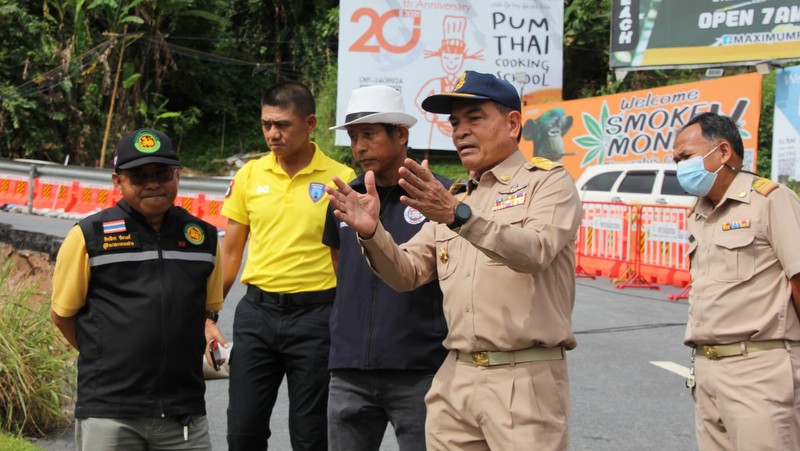

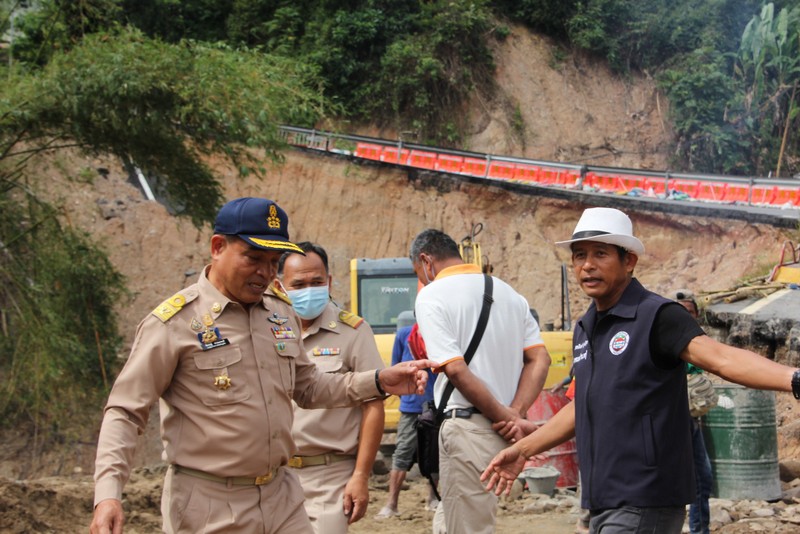

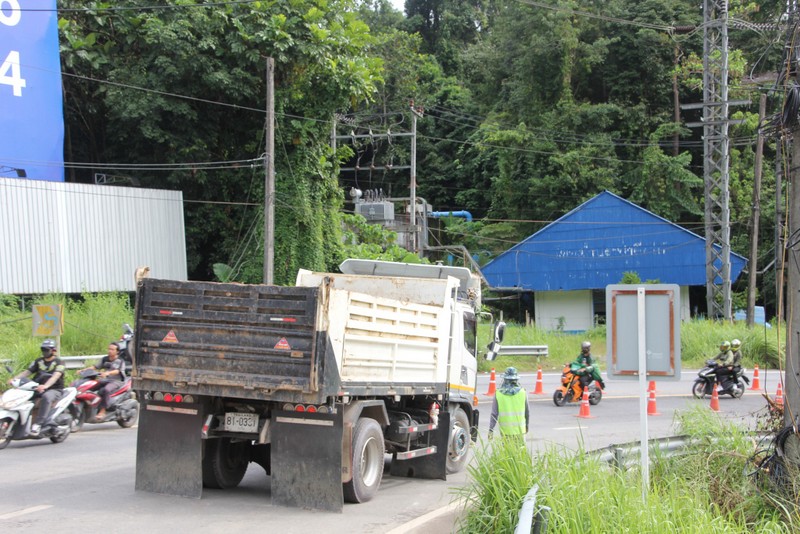
Phuket Vice Governor Pichet Panapong inspected the landslide site yesterday (Nov 14), joined by Kathu Mayor Chai-anan Sutthikul, reported the Phuket Info Center.
“The contractor has accelerated the compacting of the soil to make the foundation strong,” Mr Pichet said
“Within three days we will be able to open the road for cars to use the upward lane again, but if it rains, that may delay the reopening a little more.”
Another “test run” will be held before allowing regular traffic up the hill again, he said.
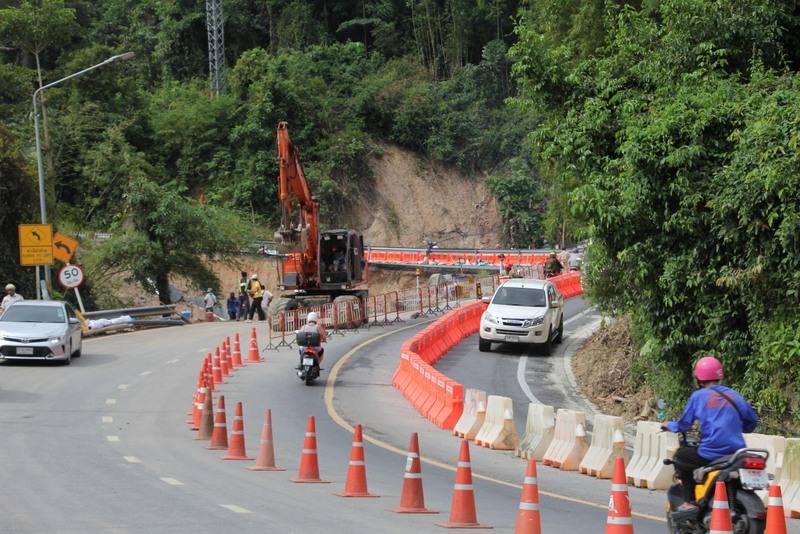
Mr Pichet said that heavy machinery was working on creating “layers” in the embankment.
“Large rocks weighing at least 700 kilogrammes will be used to lock the base of the embankment. The large rocks will be excavated one meter into the embankment and buried by up to three metres of smaller stones to fill the gaps between the large rocks. Then we will use a textile sheet to cover it up,” he said.
“Then a clay-cement mixture will be used and mixed with the soil so that it can solidify and be able to balance and support the relatively steep slope,” he added.
The embankment needs to be strong enough to support the traffic load above, and the machinery needed to repair the damaged road, which is 70m long, he said.
“Therefore, today’s work is trying to accelerate this process to allow the construction work on the embankment to be completed as quickly as possible in order to alleviate the suffering of the people,” Vice Governor Pichet said.
“The Prime Minister [Prayut Chan-o-cha] and the governor [Narong Woonciew] care about this,” Vice Governor Pichet assured.
“I will take care of the technical aspects of construction engineering, which must be strongly adhered to while the work is being accelerated,” he said.
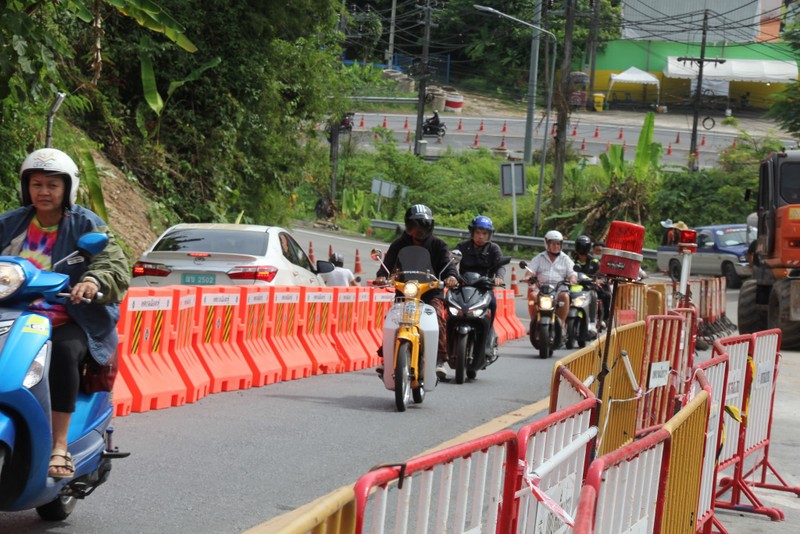
Currently motorbikes are allowed over the hill in both directions while “small vehicles’ ‒ namely cars, pickups and passenger vans ‒ are allowed downhill from Patong to Kathu only.
Small vehicles were banned from travelling uphill past the landslide site at midnight Friday night (00:01am, Nov 12) for safety reasons after officials recognised soil movement at the site.
The vehicles travelling up the hill were using the lane closest to the landslide embankment. The extra weight resulted in the cracks in the road left by the initial landslide widening further.
The ban came into effect hours after “soil movement” occurred at the landslide site. Vehicles were allowed to continue up the hill, within metres of the dangerous edge of the road, even after the “soil movement” had been recognised.
The ban came just 36 hours after the road was deemed safe and small vehicles ‒ cars, pickups and passenger vans ‒ were allowed to travel up the hill on Thursday afternoon.