



Nantapong Chiralerspong, director-general of the TPSO, said a possible decline is anticipated due to a slowdown in the global economy as well as among key trading partners, the impact of US tariffs, price pressures and the baht’s appreciation affecting competitiveness.
Moreover, he said ongoing geopolitical tensions and severe climate conditions are likely to impact agricultural exports, reports the Bangkok Post.
However, if external pressures such as trade wars and regional conflicts ease quickly, there could be a positive shift in export performance, said Mr Nantapong.
Tariff uncertainties are likely to increase negative pressure on exports in 2026. The TPSO’s preliminary forecast indicates a contraction of 3.1%, he added.
However, with a stronger electronics cycle and sustained demand for artificial intelligence and cloud computing products, Thailand could maintain its position in the global supply chain, thereby boosting export values. According to the office, electronics make up about 30% of exports.
Enhanced agricultural exports could provide additional support. For this optimistic scenario, preliminary growth is estimated at 1.1% next year, he said.
This year exports could grow by double digits, according to TPSO, supported by strong demand for digital technology and a significant easing of US trade restrictions against China and other nations compared with earlier in the year.
December exports are expected to reach US$25-26.5 billion, while the full-year export value is projected at $335-337bn, resulting in annual growth of 11.6-12.1%.
Baht appreciation has affected exports in low-margin sectors, particularly agricultural and food products, said Mr Nantapong.
This year, these sectors have recorded a steeper decline in export growth than others. Agricultural products, which account for roughly 8% of total exports, contracted for the first 11 months, highlighting their vulnerability to a stronger baht.
He acknowledged gold trading as one factor driving the baht’s appreciation.
During the first 11 months of this year, gold exports surged by 43.2% to $11.9bn, while imports jumped by 43.9% to $20.3 billion.
Key markets for gold exports include Switzerland, Cambodia, Singapore and Laos, though there were none to Cambodia in November.
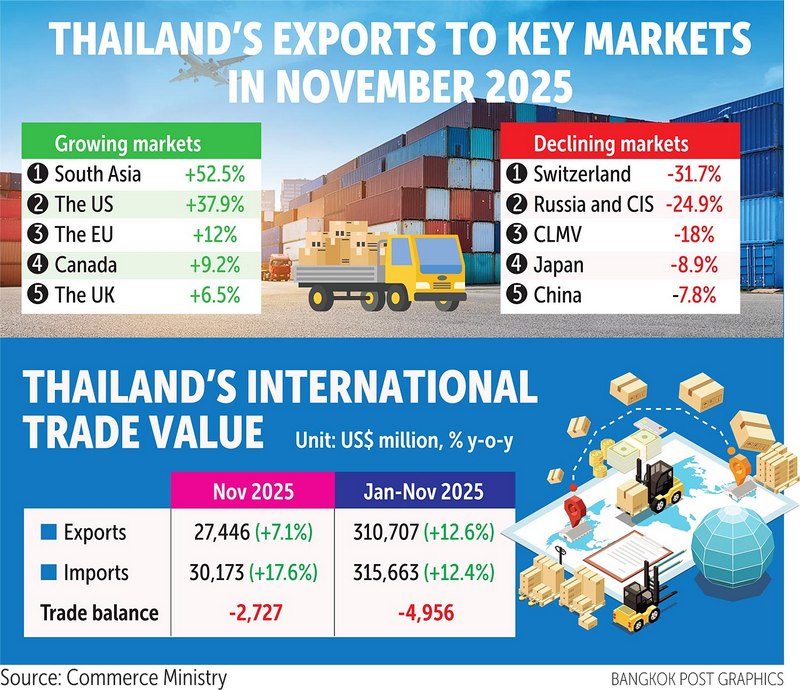
Mr Nantapong said goods exports to the US rose significantly in November by 37.9%, despite US tariffs, with electronics exports a supporting factor.
In November, total exports expanded by 7.1% to $27.4bn, while imports grew by 17.6% to $30.2bn.
For the first 11 months, exports rose by 12.6% to $311bn, while imports grew by 12.4% to $316bn.