



Building on this discussion, we now turn to another area where nominee structures are frequently employed: land ownership. While Thailand’s land laws are designed to limit ownership to Thai nationals, some foreigners attempt to circumvent these rules by forming Thai majority companies using nominee shareholders.
Recently, a high-profile Koh Samui case involving the late French businesswoman Catherine Delacote has brought renewed focus to this issue.
This article examines the legality of using a nominee, the relevant regulations, and the legal alternatives available to foreign investors seeking certainty in Thailand’s property market.
Death Becomes Her (Nominee) Headache
A seven-month investigation following the death of French businesswoman Catherine Delacote in Koh Samui uncovered illegal business operations and nominee shareholding schemes. Madame Catherine, who passed away on April 29, 2024, left her assets, including a luxury villa and adjacent land worth B50 million, to her housekeeper, ‘Pa Tim’, with a French national named as the executor of her will. However, authorities disputed the will after discovering violations of Thai property laws.
The investigation revealed that companies tied to Mme Catherine, GVN.E. Co Ltd and Maxicat Co Ltd, used Thai nominees to circumvent laws prohibiting foreign land ownership. Criminal charges were filed against the companies and two Thai nominees for falsifying official documents, assisting in illegal land acquisition and supporting unauthorised business activities.
This case has triggered a more comprehensive investigation into foreign-owned properties on Koh Samui, with authorities scrutinising companies with questionable corporate structures and nominee arrangements.
Illegally acquiring property under the Land Code
The criminal charges against Ms Delacote’s companies and their Thai nominees stem from violations of Thailand’s Land Code, which are designed to prevent unlawful land acquisition by foreigners or entities acting on their behalf.
Under Sections 94 and 96, individuals found to possess land illegally must dispose of it within a timeframe set by the Land Department, ranging from 180 days to one year. Failure to comply within this period allows the Land Department to enforce the land’s disposal.
In addition to these provisions, fraudulent activities related to land registration or acting as an agent for foreign individuals or entities in acquiring land are serious offenses under Thai law, with penalties outlined in both the Criminal Code and the Land Code. Section 267 of the Criminal Code penalises the act of providing false statements to officials during the land registration process with up to three years’ imprisonment, a fine of up to B6,000, or both.
The Land Code itself imposes further penalties. Section 111 penalises foreigners who acquire land illegally with up to two years’ imprisonment, a fine of up to B20,000, or both. Similarly, Sections 112 and 113 address cases where Thai nationals or juristic persons act as agents for foreign entities, imposing the same penalties.
Owning property vs. the right to use a property
In Thailand, foreigners are generally prohibited from owning land unless explicitly permitted by the Interior Ministry under Section 86 of the Land Code. This permission may be granted under specific circumstances:
- For residential purposes, foreigners can purchase land up to 1,600 square meters (1 rai).
- For agricultural or industrial purposes, foreigners can purchase land up to 16,000 square meters (10 rai).
Foreigners may be permitted to own land in Thailand if they invest at least B40mn in the country. Eligible investments include purchasing government bonds, mutual funds or shares in a Thai company. However, any land acquired through this provision must be used exclusively for residential purposes and be located in Bangkok, Pattaya or other municipalities designated as residential zones.
It is important to note, however, that this provision is rarely exercised and cannot be relied upon as a viable pathway for foreign land ownership. To date, we know of only one anecdotal instance of this right being granted for residential purposes.
While direct land ownership is restricted, foreigners can obtain rights to use land under specific conditions:
- Foreign individuals or entities meeting IEAT requirements may obtain land-use rights.
- Qualified foreign-owned companies approved by the BoI (Board of Investment) can own land anywhere in Thailand, provided it is used strictly for the activities specified in their application.
Foreigners may also acquire rights to land through the following mechanisms:
- Marital Property: While a foreigner cannot directly own land, their Thai spouse can. The land is registered in the spouse’s name.
- Superficies: Under Sections 1410 and 1416 of the Thai Civil and Commercial Code, a superficies allows ownership of structures on another’s land. It must be a written, registered agreement, lasting up to 30 years, the landowner’s lifetime, or renewable. The landowner retains land ownership but cannot interfere with the structures, which can be transferred, sold, or inherited if registered.
- Usufructs: Section 1417 of the CCC provides for usufructs, which allow a beneficiary to possess and use property without owning it. No alterations to the property can be made without the owner’s consent, and the beneficiary cannot sell or transfer the property.
- Leasing Property: Leasing offers another option, typically for a 30-year term, renewable for an additional 30 years. The leaseholder has full use of the property during the lease period but does not gain ownership of the land.
Forming a ‘Thai-majority’ company using a nominee structure
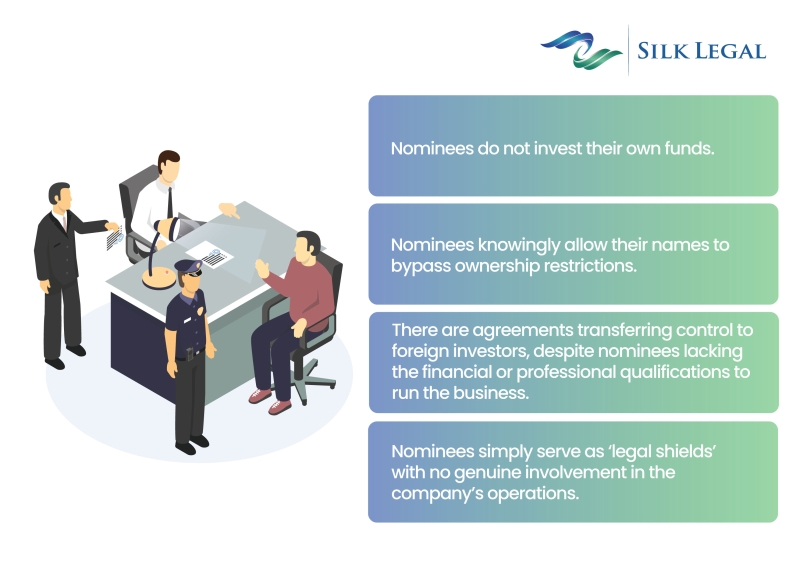
The discovery that Ms Delacote’s companies were formed using nominee structures has drawn significant attention from authorities, compounding the legal issues related to the illegal land acquisition. Nominee shareholding is a common tactic used to circumvent Thailand’s ownership restrictions, where Thai nationals hold majority stakes on paper while foreign investors maintain actual control. These arrangements typically involve the following:

Such practices violate the Foreign Business Act B.E. 2542 (1999) and related laws, carrying severe penalties for both foreign investors and Thai nominees, including:
- fines of up to B1,000,000;
- imprisonment for up to three years;
- dissolution of the company;
- confiscation of land and other property acquired through a nominee-structured company; and
- criminal charges against company directors, foreign investor(s) and nominees.
These schemes often evade taxes by transferring property ownership through share transactions instead of official registration, depriving the government of revenue. They also raise national security concerns by allowing foreigners to control land and resources illegally.
Closing Notes
Skirting the law with nominee arrangements may seem like a shortcut, but getting caught is a sure way to turn an investment into a legal nightmare, as in Ms. Delacote’s estate.
As recent crackdowns demonstrate, authorities have become increasingly vigilant in identifying and prosecuting such schemes. Foreign investors are strongly advised to pursue legitimate pathways and consult with legal professionals to ensure compliance with Thai laws while safeguarding their investments.
Meanwhile, the case is undergoing further investigation, and details may be publicly provided by authorities once they are available. In the meantime, while Pa Tim’s rights to the properties left behind by Ms Delacote may be unlikely, at least she could have access to other assets such as jewellery and bank deposits.
After all, something is better than nothing.
By Dr Paul Crosio
Disclaimer: This article is for information purposes only and does not constitute legal advice. Always consult a qualified legal professional before making business decisions or purchasing property in Thailand. Contact Silk Legal at info@silklegal.com for a free consultation and risk assessment.