


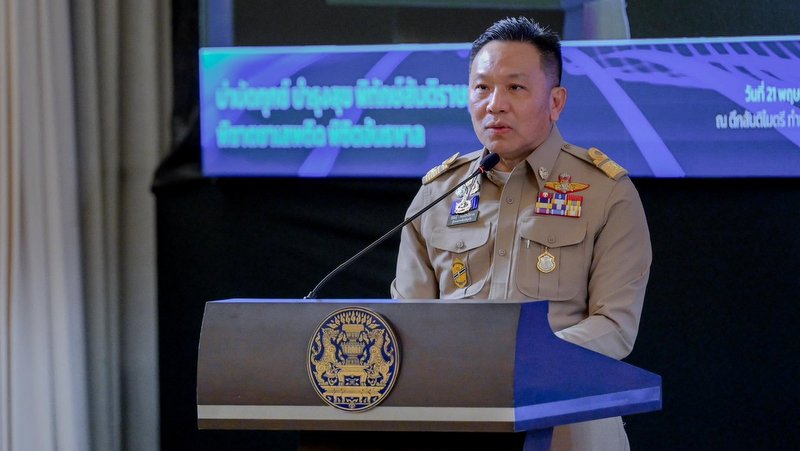
Speaking for the first time since the Cabinet approved his transfer on Tuesday (June 16), Mr Nirat said he fully respected the decision by Prime Minister and Interior Minister Anutin Charnvirakul and Interior Ministry Permanent Secretary Arsit Sampantharat, and would continue serving wherever he was assigned.
"I respect the Prime Minister’s decision," Mr Nirat said.
"I am not discouraged. I will continue to do my best in my duties and uphold what is right. What I achieve will be judged by my superiors. If some things are not successful, then I must accept that."
The Cabinet approved Mr Nirat’s transfer from Phuket Governor to the post of Deputy Permanent Secretary of the Ministry of Interior after just 210 days in office.
His removal came only one day after Phuket Vice Governors Adul Chuthong and Teeraphong Chuaychoo were transferred out of the province, marking the latest step in an unprecedented shake-up that has now seen at least eight senior Phuket officials removed or transferred since May.
The sweeping reshuffle follows weeks of allegations involving corruption, abuse of power, internal conflicts among senior officials and claims of influence by powerful local figures.
Speaking after reporting to PM Anutin in Bangkok, Mr Nirat rejected suggestions that he had become involved in any factional disputes within Phuket’s administration.
"I had no problems with anyone," he said.
"I’m the one who went down to resolve the conflict. If you look back at the news, the conflict already existed before I arrived. I went to resolve it in my capacity as governor, not to align myself with any particular person."
He acknowledged that not everyone accepted his efforts.
"If people believed me, they adjusted. Those who didn’t believe me did not."
Mr Nirat said that if his inability to fully resolve the conflict ultimately led to his transfer, he accepted the decision.
"If I cannot control the situation and the Ministry of Interior decides to transfer me, I respect the decision of the Permanent Secretary and the Prime Minister."
He added that despite the political turmoil, progress had been made in tackling organised crime and illegal activity.
"Many things have progressed significantly," he said. "The foreign mafia has been brought under control."
However, he conceded that long-running conflicts among local officials had proven far more difficult to resolve.
"As for the conflict among people in the area, I may not have been able to resolve it yet. That has become an issue at ministerial level."
Mr Nirat also argued that investigations into the disputes should be led directly by the Ministry of Interior rather than provincial officials.
He said the ministry should appoint a committee chaired by a deputy permanent secretary with authority to summon every department involved.
"That would give the committee sufficient authority to investigate every issue properly," he said.
Asked whether transferring both the governor and deputy governors would solve Phuket’s problems, Mr Nirat replied that the issues needed to be separated.
He said administrative conflicts could disappear once the individuals involved were removed, but broader issues concerning vested interests and influence in the province would remain the responsibility of those now in charge.
Perhaps Mr Nirat’s strongest comments came when reporters suggested he had become the victim of political “hazing” because of his involvement in the disputes.
"Am I anyone’s younger brother?" he replied. "I am a governor, a Level 10 official, and have been one of the most senior provincial officials in Thailand for many years.
“I am not anyone’s younger brother… I see everyone as my younger brother.”
He insisted his role had always been to guide and protect civil servants under his authority. "My duty is to help them do what is right and warn them when they are doing wrong."
Mr Nirat said he had repeatedly instructed officials not to become involved in illegal activities, solicit bribes or abuse their authority.
"I warned them openly in meetings and in public not to break the law, not to ask anyone for bribes and not to oppress anyone."
Asked whether those warnings had upset some officials, he smiled and replied simply: "Of course."
His comments came one day after PM Anutin defended the decision to remove Phuket’s senior leadership, saying the government needed officials who could work together without conflict.
"Whenever something happens there are revelations and accusations. You can’t work like that," PM Anutin said after Tuesday’s Cabinet meeting.
"We need people who do not have conflicts and who can work together."
Interior Ministry Permanent Secretary Arsit Sampantharat later described the reshuffle as necessary to remove obstacles preventing effective administration.
Comparing the situation to sand trapped inside a shoe, he said the ministry had been forced to replace the entire leadership team to restore stability.
Mr Arsit also confirmed that investigations into allegations involving senior Phuket officials would continue despite the transfers.
Mr Nirat’s successor, Chotinrin Kerdsom, is expected to assume office once his appointment receives royal endorsement.
The upheaval means Phuket has now had four governors in less than a year, highlighting the instability affecting one of Thailand’s most economically important provinces.
Although covering just 543 square kilometres, Phuket generates almost B500 billion annually through tourism, making it one of the country’s most valuable economic centres.
Yet behind that prosperity lie persistent problems, including illegal land encroachment, nominee ownership schemes, organised crime, foreign business influence, overflowing landfill, strained infrastructure and rapid urban expansion.
Frequent changes in provincial leadership have inevitably raised concerns over the continuity of policy implementation and long-term development, particularly for projects requiring sustained cooperation between government agencies and the private sector.
While replacing officials may help defuse immediate political conflicts, questions remain over whether deeper structural problems can be resolved if oversight mechanisms and law enforcement are not strengthened.
For many residents, the more pressing question is no longer simply who will become Phuket’s next governor, but whether the province’s long-running problems can finally be addressed consistently and transparently, regardless of who occupies the governor’s office.