


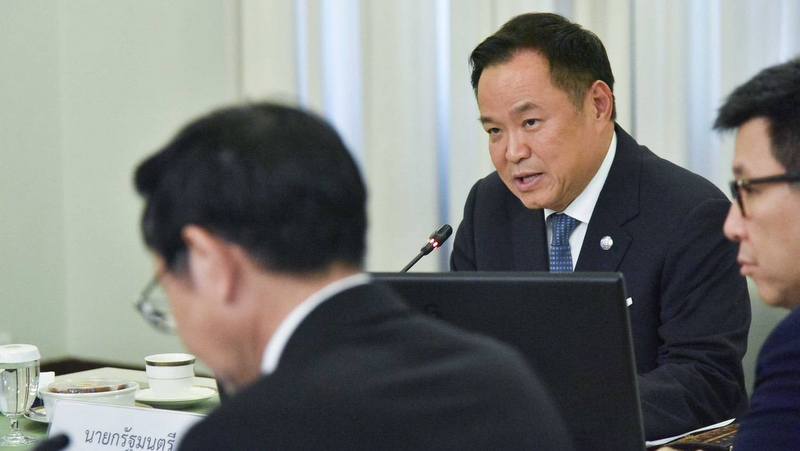
Prime Minister and Interior Minister Anutin Charnvirakul chaired a high-level meeting with key ministers and relevant agencies to review potential impacts on Thailand’s energy security, particularly following disruptions linked to tensions affecting shipping through the Strait of Hormuz.
The meeting included Deputy Prime Minister and Transport Minister Pipat Ratchakitprakarn, Deputy Prime Minister and Finance Minister Ekniti Nitithanprapas, Foreign Minister Sihasak Phuangketkaew and Energy Minister Atthapol Rerkpipibun.
Officials said Thailand’s energy supply for March has not yet been directly affected, but the government is closely monitoring developments as the situation in the Middle East evolves rapidly.
Thailand currently imports roughly half of its crude oil from the Middle East, with the remainder sourced from other regions. Mr Anutin instructed the Ministry of Energy and related agencies to accelerate assessments of additional import sources to diversify supply and reduce risks should the conflict escalate further.
“All agencies must work together to implement comprehensive measures to minimise the impact on Thailand and maintain the country’s energy stability during this uncertain situation,” he said.
Speaking at a joint press conference following the meeting, Energy Minister Atthapol confirmed that Thailand previously maintained oil reserves equivalent to about 60-65 days of domestic consumption.
However, the government has now secured additional supply sources outside the Middle East capable of providing around 30 more days of oil, bringing total reserves to about 95 days, he said.
“This means that even if Thailand were unable to import oil, the country could still rely on existing reserves for about 95 days,” he said, adding that reserve levels are expected to increase gradually through April.
The government has also announced measures to increase the national oil reserve requirement for traders, raising the mandatory reserve ratio from 1% to 3% to strengthen energy security.
Officials also confirmed that a temporary suspension on oil exports remains in place, though exceptions will be made for neighbouring Laos and Myanmar due to existing energy cooperation agreements.
Thailand imports natural gas from Myanmar and purchases electricity from Laos, making continued energy cooperation with both countries essential, officials said.
RESERVES
To help limit the immediate impact on consumers, the government will freeze diesel prices for 15 days until Mar 17. If market pressures continue, further intervention may be considered through the national Fuel Fund.
Authorities said assistance measures for gasoline prices are also being prepared to help reduce the impact on the public.
Additional contingency plans include increasing domestic energy production, expanding the use of locally produced B100 biodiesel, and potentially importing lower-grade refined oil products that can be obtained at lower cost.
Natural gas supplies used for electricity generation are also under review.
Most of Thailand’s gas is delivered through pipelines from Myanmar, while some liquefied natural gas (LNG) is imported from Qatar via shipping routes that pass through the Strait of Hormuz.
The national Energy Policy Committee has therefore accelerated efforts to identify alternative gas sources from other regions. State energy company PTT Public Company Limited has also confirmed it will hold discussions with energy traders to increase gas imports if necessary.
The government is also considering increasing electricity generation from hydropower and coal-fired plants, while sourcing additional electricity from neighbouring countries if required.
Officials stressed that the measures are intended to ensure Thailand will not face shortages of oil, gas or electricity.
The government also addressed reports of panic fuel buying earlier this week, which briefly disrupted fuel distribution at some petrol stations.
Authorities said the situation is now easing as public concern subsides.
The Department of Energy Business has instructed provincial officials nationwide to ensure petrol stations maintain adequate supplies and do not engage in fuel hoarding.
Although some temporary shortages were reported in certain areas, officials said fuel distribution is expected to return to normal within one to two days.
Meanwhile, the government said it may seek additional oil supplies from trading partners including Malaysia, the United States and South Africa if the crisis continues.
With established trading relationships through PTT Public Company Limited, Thailand is in a position to negotiate further supply agreements if required, officials said.
US TALKS
Separately, Foreign Minister Sihasak clarified reports concerning a meeting between the prime minister and the United States ambassador to Thailand on Mar 4.
He said the discussions focused on bilateral relations, trade negotiations and defence cooperation, and did not involve any request to use U-Tapao International Airport in Rayong as a military base.
Thailand’s cooperation with other countries regarding airport use is limited to standard security arrangements such as transit and refuelling, he said.
Using Thai territory as a base for attacks against countries with which Thailand maintains friendly relations is not part of government policy.
The Foreign Ministry is also monitoring the safety of Thai nationals in the region. Officials said about 200 Thai citizens currently in Iran have requested evacuation.
Preparations are underway to move those who are ready to leave from Tehran to Turkey before returning to Thailand, authorities confirmed.
Officials added that Thailand remains neutral in the conflict and supports a peaceful resolution through diplomatic negotiations and international law.