



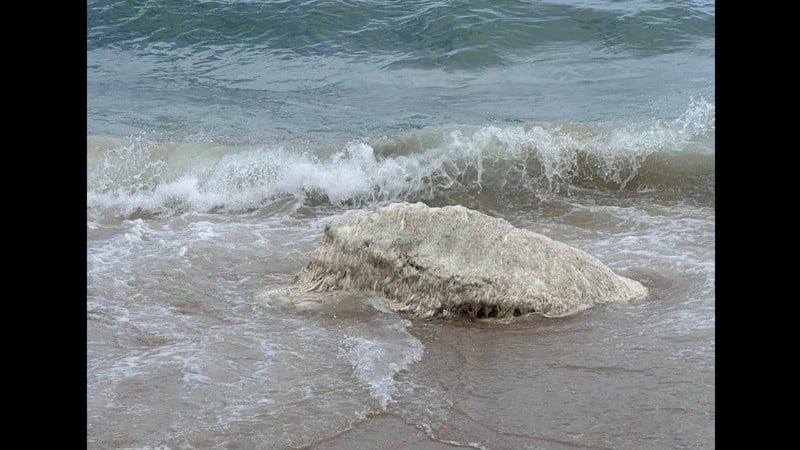
The unusual object was discovered on the beach in front of Trisara resort in Cherng Talay and was first brought to public attention through a post by a Facebook user in the group “What Is This?”, who shared photographs and asked for help identifying it.
The images showed a large white mass covered in fibrous, hair-like material that had been washed ashore by the waves. The post quickly attracted hundreds of comments from social media users speculating about its origin.
According to the poster, the object emitted a strong odour and contained hard fibrous material within it. Many commenters suggested it could be the decomposing remains of a large marine animal, possibly a whale or another large sea creature.
Sirinat National Park was subsequently notified of the discovery and dispatched officials to inspect the site. Kornikar Wongmithae, Assistant Head of Sirinat National Park, led a team to the beach, where they removed the carcass and coordinated with officials from the Upper Andaman Coastal and Marine Resources Research Center.
Specialists from the centre collected samples from the remains for further examination in an effort to determine their origin.
Experts noted that objects of this type are commonly referred to as “globsters”, a term used to describe large masses of organic material washed ashore that cannot be immediately identified based on appearance alone.
Although such remains often fuel speculation about sea monsters, scientific investigations conducted around the world, including DNA analysis, have shown that most globsters are the decomposed remains of large marine animals such as whales or basking sharks.
The distinctive white, hair-like material frequently seen on globsters is typically collagen fibres, connective tissue and muscle that remain after softer tissues have decomposed. This can give the carcasses a bizarre appearance.
Globsters are generally white or grey in colour, have a rubbery texture and produce a strong smell due to decomposition. They often lack recognisable features such as a head, eyes or skeletal structure and are commonly found after periods of rough seas or storms.
While no official identification has yet been made, experts believe the remains found at Layan Beach may be blubber or tissue from a large whale that decomposed at sea before washing ashore.
Authorities have advised members of the public not to touch such remains directly, as they may contain harmful bacteria and other microorganisms. Instead, sightings should be reported to relevant authorities for investigation and safe disposal.