


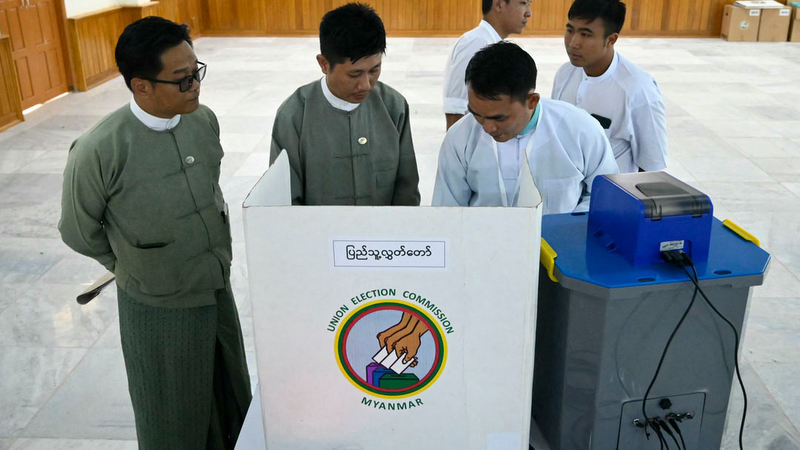
For Myanmar migrants, students and journalists in Thailand, the vote is seen not merely as flawed but as a carefully managed performance designed to legitimise continued military rule.
Announced by the State Administration Council (SAC), also known as the Tatmadaw, the election was scheduled in three phases - Dec 28, Jan 11 and Jan 25, reports the Bangkok Post.
In early December, Myanmar’s embassy in Bangkok opened advance voting for nationals in Thailand. Yet many chose not to enter the embassy gates at all. Their refusal was not apathy, but protest.
A 33-year-old Myanmar medical doctor, who asked not to be named and has lived in Thailand for three years, described the election bluntly as "a sham election", arguing it was even worse than the widely criticised 2010 polls held under military oversight.
"There are only a handful of parties allowed to participate, and all of them are aligned with the military," he said. "Even among these parties, the outcomes have already been determined."
He added that voters in military‑controlled areas face coercion and threats.
"The election is not free when people are told that if they vote the wrong way, their safety is not guaranteed," he said.
"The military had been increasing violence in contested areas months before the election. Some townships do not even have other candidates. They just declare themselves the sole candidate.
"It all looks so shameful.... It is absolutely a sham election, similar to 2010, probably worse."
Voting under fear
A 26-year-old Myanmar university student studying in Thailand also refused to vote at the embassy. "This election lacks legitimacy and is not recognised by much of the international community," he said.
"It is taking place without inclusive participation, independent media or genuine political competition. Many political actors, and most importantly, the will of the people, are excluded." His family in Myanmar also chose not to vote.
For him, participation itself carried moral weight. "Voting would risk legitimising a process that does not reflect democratic principles," he said.
A 40-year-old Myanmar journalist based in Thailand shared similar concerns.
"There is no real political competition or freedom of choice," she said. "The entire process is driven by fear of prosecution and intimidation of those who criticise it."
She described the election as a calculated political manoeuvre by the junta, carried out with the support of China. "We are at an interesting but worrying moment. The key question is what will happen next?"
Symbolic observation
In recent weeks, Thailand’s Ministry of Foreign Affairs instructed the Royal Thai Embassy in Yangon to observe voting at around 50 polling stations across four townships.
While Bangkok has framed the move as constructive engagement, Myanmar interviewees say observation alone cannot fix a fundamentally broken process.
"Without political freedom, accountability, transparency and inclusive participation, observers risk serving only a symbolic role," the student said.
The journalist agreed, pointing out that meaningful competition is impossible while opposition leaders remain imprisoned and a single dominant party enjoys full access to state resources.
"There is no way to make this election fair," she said. "Even some of the few parties that are participating have already complained about the process."
Bleak outlook
As the election moves towards its final phase, expectations remain bleak. The doctor believes the military’s victory is a foregone conclusion.
"The military will use this election to fake legitimacy, reduce international pressure, and intensify its crackdown on the opposition," he said.
The journalist sees little prospect of peace following the polls, warning that conflict and authoritarian rule are unlikely to end any time soon.
"However," she added, "we are at a critical point. What happens next is uncertain."
The student, while fully aware of the election’s failures, remains cautiously hopeful in the long term.
"We may not be able to choose where we are born," he said, "but we can shape the country we aspire to build by supporting democratic values and refusing to legitimise undemocratic processes."
Hope for change
Thai political scientist Anekchai Rueangrattanakorn of Silpakorn University offered a more cautious assessment.
While acknowledging that the election is neither free nor fair, he suggested it still reflects a limited desire for change among some voters. "Some Myanmar people who went to vote know the process is deeply flawed," he said, "but they still hope for change, even if it is only slight".
He warned, however, that another military victory would likely lead to tighter security and renewed repression, potentially triggering a new wave of refugees.
"Thailand needs to prepare itself for post-election Myanmar," he said.