


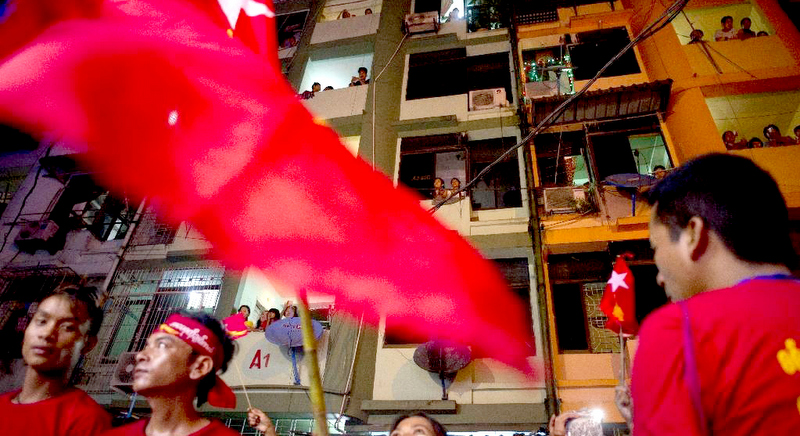
In those historic polls, Suu Kyi’s National League for Democracy party on Friday (Nov 13) won a parliamentary majority that will allow it to elect a president and form a government in a historic shift in power from the army. (See story here.)
Blessed with a bounty of natural resources – from rubies and jade to gas, oil and teak – fertile and diverse Myanmar was once also famed as Asia’s rice bowl.
But nearly half a century of ruinous economic policies by the former junta saw its people sink into poverty as the generals plunged the country into isolation.
Once one of the most fashionable cities in Asia, Myanmar’s former capital Rangoon was home to stately leafy boulevards and British colonial buildings.
But decades of junta neglect reduced many to crumbling wrecks, their fading facades overrun by weeds.
The city today is in the grip of rapid change, thick with the dust and din of construction as office towers peer over the once low-rise skyline.
The nation’s fortunes have improved since the end of outright military rule in 2011 with GDP growing at an average of seven percent a year.
The World Bank has even predicted that Myanmar will become the world’s fourth fastest-growing economy by 2017.
But recent floods, the worst in decades, have dulled forecasts for the coming months with major reform battles still to be won across all sectors.
Meanwhile life expectancy remains among the lowest in the region and 37 per cent of the population still live in poverty according to the World Bank.
Wedged between India and Bangladesh to the west, China to the north and Laos and Thailand to the east, Myanmar is home to more than 100 ethnic groups.
The majority are Burman and Buddhist but sizeable minorities weave a host of distinct cultures and traditions into the landscape.
Some of these ethnic groups have also waged the world’s longest civil war with conflict still raging in northern Kachin and eastern Shan states despite a recent ceasefire deal with some minority armies.
The nation’s Muslim minority are also under pressure after waves of religious violence in recent years and a rise in anti-Muslim rhetoric led by radical Buddhist monks.
The ruling party, which is backed by the army and has received the support of hardline Buddhist nationalist monks, say they are best placed to prevent Myanmar from splintering.
On the campaign trail Suu Kyi has repeatedly portrayed herself as the person who can bring real unity as leader of the opposition National League for Democracy.
Myanmar’s urban centres are leading the country’s embrace of global trends and consumerism.
All across Rangoon sarong-wearing men and women can be seen glued to their smartphones as in the rest of Asia, while fast food chains like KFC are cropping up.
Since the easing of censorship, newspapers and journals have mushroomed and locally-produced films and documentaries are thriving.
Just one per cent of the population was thought to have access to the Internet in 2011, but now millions are online.
Mobile penetration remains low outside major cities, where vast and remote pockets of the country have no electricity.
But that is changing fast with SIM cards today costing only around $1 (B35), compared to $3,000 (B107,661) a card under military rule.
Myanmar’s frontier market is pregnant with opportunity and a host of new entrepreneurs, both homegrown and foreign, are keenly watching the election for what might lie ahead.