


Bids for the two licences on the 900-megahertz frequency reached a record B151.95 billion.
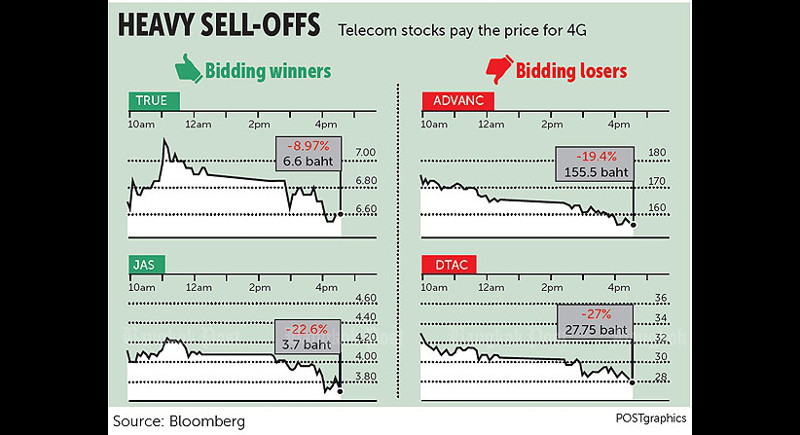
The losers at the auction weren’t spared: Advanced Info Service Plc (ADVANC) slid 19.4% to B155.5, while Total Access Communication Plc (DTAC) dived 27% to B27.75 – the latter’s steepest fall in more than five years.
As for the successful bidders, Jasmine International Plc (JAS) plunged 22.6% to B3.7 and True Corporation Plc (TRUE) fell 8.87% to B6.6.
Intouch Corporation Plc (INTUCH), AIS’s holding firm, tumbled 20% to B50.
The sharp fall in telecom stocks led the SET index to slump 1.59% to 1,264.44 in brisk turnover worth B61.47 billion.
Finansia Syrus Securities (FSS) downgraded the ICT sector from overweight to underweight after the intense bidding war, saying the winners’ net earnings are not high enough to keep them in the black when depreciation expenses for the licences are taken into account.
The 900-MHz licence winners will require an additional B5 billion each for investment and interest expenses, said head of research Somchai Anaktaweepon.
True Move, the country’s third-largest mobile operator, led the bidding with B76.298 billion, winning the right to provide 4G services on the 900-MHz spectrum for 15 years. The bid was 491% above the reserve price. True Move is a subsidiary of True Corporation.
Jasmine, a newcomer to mobile, won the other licence with a bid of B75.564 billion, 486% above the reserve price. The win paves the way for the company’s first foray into mobile internet after providing landline broadband under the 3BB brand.
True and Jasmine could increase capital in line with the high licence prices, but AIS is less attractive now that its growth story is gone, Mr Somchai said.
FSS cut its 2016 target price for AIS, the country’s biggest mobile operator by subscribers, from B270 to B250.
DTAC, meanwhile, is likely to lose its second-place ranking to True as its operating performance continues to deteriorate, Mr Somchai said.