


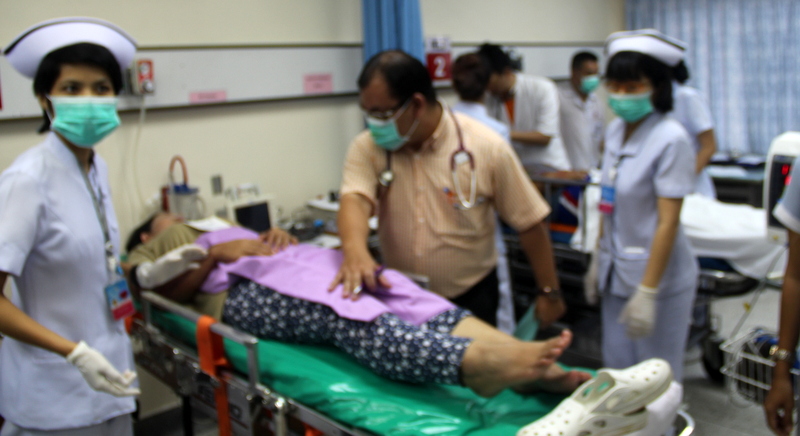
Unlike other emergency-response simulations regularly held on the island, participants in the exercise yesterday were not forewarned of the drill and no pre-drill training or rehearsals were conducted.
“We must always be ready for the real situation. That’s why we did not inform our staff of the exercise. They must know exactly what they have to do when real incidents actually happen,” said Mission Hospital CEO Atikom Sriratanaprapat.
The training simulated a bomb blast at the Phuket’s busy Bus Terminal 2, located near Mission Hospital on Thepkrasattri Rd in Rassada, that killed one person and injured 14 others.
The top concern for medical teams was triage, identifying critical patients with red tags, those needing non-critical medical attention with yellow tags, and light injuries with green tags.
“This process helps us make sure that the right people receive medical attention first, which is critical in saving lives in these situations,” Mr Atikom explained.
Joining the exercise were observers from the island’s leading rescue services organization, the Kusoldharm Foundation, and staff from the Phuket office of the government’s emergency-response agency the Narenthorn Centre, based at Vachira Phuket Hospital.
“We were not informed of the exercise, so we were quite confused at first, but now we are much better prepared for any such incidents in in the future,” one Narenthorn staffer told The Phuket News.
Mr Atikom pointed out that Mission Hospital was also well positioned to cope with foreign victims of such disasters.
“We have English-speaking staff and we have Chinese and Korean translators on call,” he said. “We also have Russian interpreters available 24 hours, so we are very well prepared to handle foreigners in need of emergency medical treatment.”