


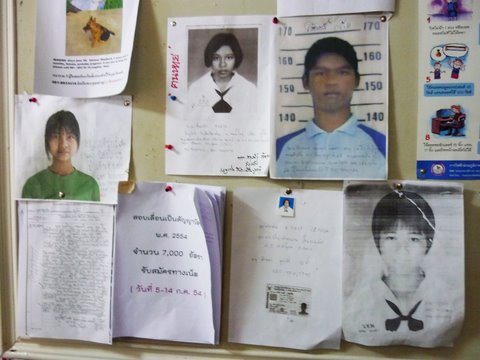
The other was not so encouraging: Smatchaya “Pin” Yanpanya disappeared after walking out of an Internet café on December 6. She has not been seen since.
These are by no means the only children currently missing from Phuket. How many are there? No one, apparently, can say – the structure does not yet exist in Thailand to track the numbers.
But things are moving – albeit at a glacial pace – to a more effective approach to missing persons.
The spark for this gradual process was the murder, in 1998, of medical student Janejira Ployanjoonsri.
In January of that year, Janejira, who was in her early 20s, was reported missing in Bangkok. Two months later chunks of her body were found in a cesspit.
The investigation homed in on her boyfriend and fellow medical student Serm Sakornrat, who eventually confessed that he had shot Janejira in a fury after she broke up with him.
After killing her, he sliced her body into small pieces and flushed the bits down the toilet. He dumped her head and other parts in various locations. Her head was recovered from the Bangpakong river.
Serm was jailed, but has just been released as part of this year’s Royal Amnesty.
Media coverage of the case had the whole country riveted. It also had two effects on police work in Thailand: discussion of the need for a structured approach to forensic science, and discussion of the management of missing persons.
Four years after Janejira’s murder, the Justice Ministry established a forensic science department, which soon found itself heavily involved in identifying dead people when the 2004 Asian Tsunami scattered bodies all over the Andaman coastline.
Identifying the thousands of bodies was slow and painstaking, not to say horrific, job. It was more than a year later that the final identification was made.
Matters were also complicated by arguments between the Justice Ministry’s forensics team, headed by the outspoken Dr Pornthip Rojanasunand and the Royal Thai Police forensics team. The police had always resented the Justice Ministry butting into the forensics business, which they saw as a police function.
Dr Pornthip’s forthright public opinions did nothing to heal the rift, though they did make her the darling of the public who saw her – still see her – as a beacon of honesty in a bureaucracy that can often not be trusted.
Notwithstanding the arguments, in the tsunami's aftermath, Thai pathologists learned huge amounts about techniques for identifying dead people.
A structured approach to missing persons still did not really exist.
Finally, in August this year – more than 13 years after Janejira’s murder – the Royal Thai Police launched its Missing Persons Management Center (MPMC).
The aim of the MPMC is to be a centre for sharing information on missing persons and on unidentified bodies, and also to collaborate with other authorities on investigating missing persons cases.
But the MPMC faces some big hurdles before it can become effective, not least the fact that someone going missing is not a crime.
“An investigation of a missing person seems to struggle from a lack of definition”, explained Eaklak Loomchomkae, Chief of the Anti-Human Trafficking Operation Centre of the Mirror Foundation.
As a result, authorities are often slow to take serious action, or they may take action only when they suspect that a missing person may be the victim of a crime.
Based in Bangkok, the Mirror Foundation has a Missing Persons Center which collects and analyses data, and collaborates with the authorities to try to get investigations underway to have missing people found. It receives about 30 missing persons reports a month, and 70 per cent of these are solved, one way or another.
But the 360 or so cases it handles in a year can only be the tiniest tip of the iceberg.
Compare that number with statistics from other countries. In the US, the National Crime Information Center lists 85,820 people missing and not found last year. Of these, about half were under the age of 18.
In Britain, which has a similar population to Thailand, the Home Office (interior ministry) says that 200,000 missing persons reports are filed each year. The “vast majority” are found, it notes.
Compare this with the Royal Thai Police records that show that 1,168 people have disappeared since 2002. Only 138 have been found.
Thai regulations don’t specify a waiting period before a person should be reported missing but police seem to have latched onto a concept prevalent in other countries that they should wait for 24 hours before accepting a report from frantic family or friends.
“We should break this tradition of waiting 24 hours,” Mr Eaklak said. “In the case of a missing child, the quicker you report, the greater the chances of finding him or her.”
Mr Eaklak, an acknowledged authority on human trafficking, believes another hurdle that stands in the way of missing people being found is the way the authorities go about things.
Often, their first action is to provide the media with photos and hold press conferences with the family of the missing person.
Mr Eaklak believes this approach is completely backwards, especially in the case of missing children – the highest proportion is between 11 and 15 years old.
Controlling the rate of missing persons needs action at all levels of society, from families right up to national-level authorities.
But currently, there is a great deal of confusion. For example, there are currently two separate databases of missing persons and unidentified bodies.
One is the four-month-old MPMC, which comes under the Royal Thai Police. The other comes under Dr Porthip’s Central Institution of Forensic Science (CIFS), under the control of Ministry of Justice.
The two databases are not linked.
Dr Pornthip has been trying to establish a specific body – under the Justice Ministry – to keep records of missing persons and unidentified bodies, and to handle examinations of bodies.
This was discussed and approved in principle by Cabinet last year but appears not to have moved any further.
The Police argue that investigations into missing persons cases and unidentified bodies should be in police hands, with the CIFS acting in a supporting role.
The turf war has resulted in zero cooperation, which explains why the two databases have almost no overlap, even though their purposes are almost identical.
The MPMC wants to set up a National Missing and Unidentified Persons System and a specialised investigation team.
In the meantime, ask the Phuket Police for statistics, and they can tell you the number of murders, thefts or rapes in the month or year. But an enquiry about the number for missing persons receives the response, “We’ll check and get back to you.” They don’t.
In the end, it seems the advice that Mr Eaklak gives to families – communicate with your children – should also be heeded by the police and other authorities: Communicate with one another.
Until that happens, missing people are likely to be low on anyone’s list of priorities, and the families of the missing will continue to search desperately for answers that may never come.
–Paritta Wangkiat