


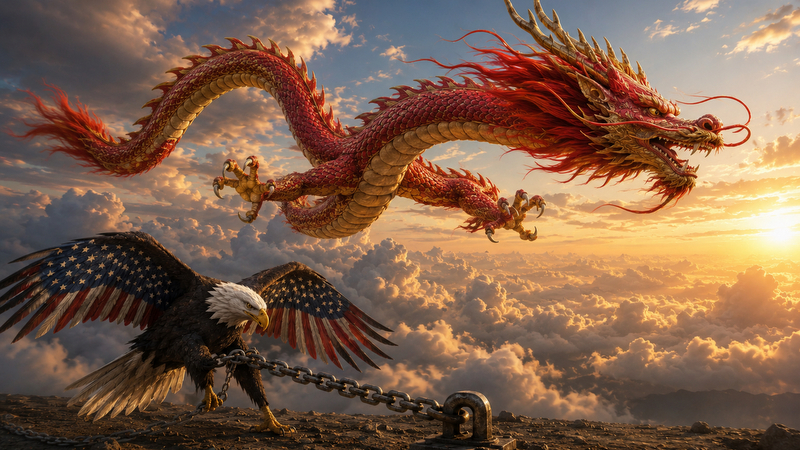
The US imposed such stringent export controls on Anthropic’s Fable model last month that it was forced to shut it down entirely before a compromise was reached 19 days later. The government then asked OpenAI to limit the release of its latest model to only “a small group of trusted partners.”
Meanwhile, “China is having another AI moment,” according to an Economist headline. Its new frontier GLM-5.2 surprised the world by being only a few months behind US peers’ capabilities.
This model, like most of China’s, is open-weight, meaning anyone can download it, remove its guardrails and use it freely for any purpose. Chinese AI typically uses an order of magnitude less compute than its US rivals, so is much cheaper.
The US government’s erratic approach to regulation, coupled with Chinese innovation, is creating a raft of dynamics favouring China’s tech. Big enterprises don’t know when their access to Silicon Valley’s best models might be shut off, and those labs – investing hundreds of billions of dollars each in data centres – don’t know whether they’ll be able to sell them worldwide or just to small groups of government-favoured clients.
These uncertainties, compounded by cost, are seeing many big customers choose Chinese models over American alternatives. Most notable is Microsoft, considering a self-hosted DeepSeek AI for its Copilot tool – despite having invested more than US$100 billion in OpenAI and founded an industry body to stop Chinese copying of US AI research.
Why is the US government apparently harming itself this way? Trump, recall, came to his second term promising low-to-no AI regulation and insisting this is a race with China the US must win.
‘Nut job’
It’s entirely possible personal animus is part of the answer. Anthropic fell foul of the government earlier this year for refusing to let the Department of War use its tech for mass surveillance and autonomous weapons. Trump branded CEO Dario Amodei a “left wing nut job” for his stance, and banned government from using any Anthropic product, before partly recanting once the cost to its own operations became clear.
The official reason for the Fable ban was national security – government engineers, it said, had found a way to bypass Fable’s guardrails. Anthropic replied the bug unlocked only one capability, not the whole model, and was already known in its other products.
Other, less-publicised motives likely include the same technology-transfer logic that has kept America’s most advanced semiconductors out of Chinese hands.
But the US government does seem genuinely fearful of losing control of AI’s capabilities. So why isn’t China – which tightly controls vast swathes of its internet and media – similarly worried about its own powerful models?
Received wisdom is that Chinese control operates at a different level – it’s baked into the training data rather than who has access. Ask any Chinese model about Tiananmen Square or Taiwan and you’ll get the party line, because its training material has been vetted for ideological correctness.
Another difference is that China is not protecting a lead but catching up. Government strategy favours diffusing free models widely and quickly worldwide, generating real-world data that feeds back into further Chinese model improvement.
It’s still puzzling that China’s leaders aren’t more worried about the risk that extremely capable AI poses to their own authority – presumably the prize of winning the AI race eclipses even that. Whatever the reason, it is now China that is, for AI, the land of the free and the home of the brave.
Joe Smith is Founder of the AI consultancy 2Sigma Consultants. He studied AI at Imperial College Business School and is researching AI’s effects on cognition at Chulalongkorn University. He is author of The Optimized Marketer, a book on how to use AI to promote your business and yourself. Contact: joe@2Sigmaconsultants.com.