


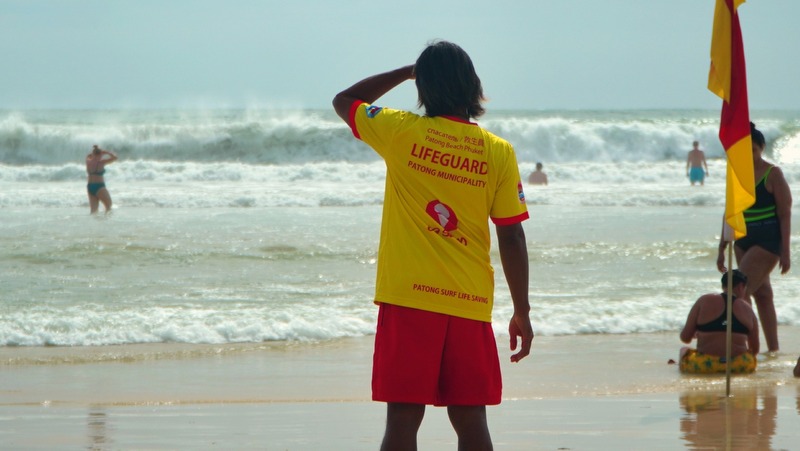
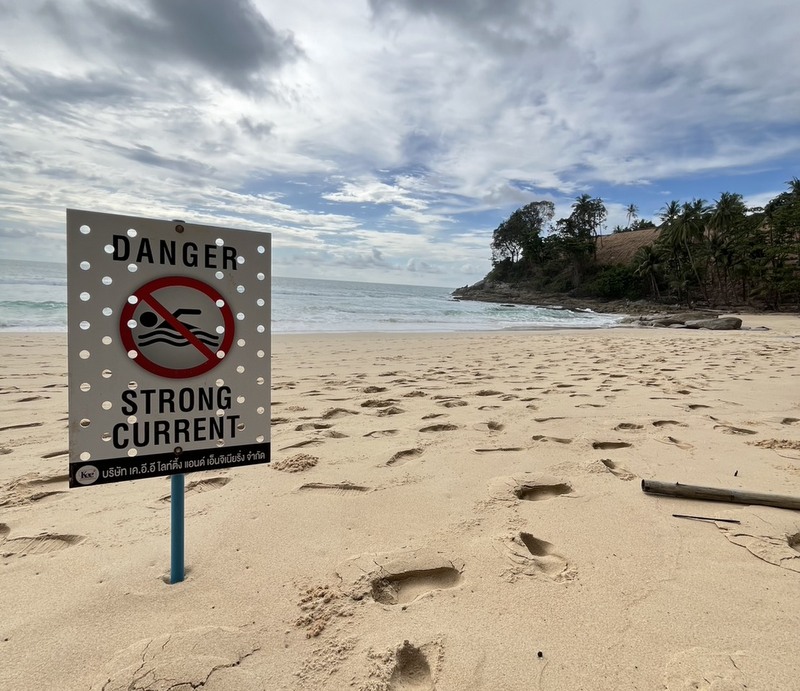
Ratchadaporn O-in, Director of the Phuket branch of the Ministry of Tourism & Sports, told The Phuket News her office has “no role and no responsibility” in reporting tourists drowning.
The admission by Ms Ratchadaporn has finally formally exposed the gaping hole in the government’s policy to help prevent tourists from drowning. Other than news reports of drownings at Phuket beaches, tourists arriving on the island are given no prior warning of how dangerous the monsoon rip currents are at the island’s popular beaches.
“It is the role of the Tourist Police to report the number, and the role of local municipalities to take care of matters. You can get the details of drowning victims from the police,” Ms Ratchadaporn said.
“Regarding statistics collection, the agency [MoTS Phuket] does not keep a total record of all tourist drownings each year. The data available only includes cases in which TAC [Tourist Assistance Center] staff provided assistance. If a tourist is hospitalised or dies without our agency’s assistance, no data is collected,” she explained.
“The primary role of the Phuket MoTs office is coordination. The TAC’s primary role is to facilitate coordination between the consulate and the relatives of tourists who have suffered accidents,” Ms Ratchadaporn continued.
“This includes coordinating the repatriation of bodies of a tourist’s death. The TAC also provides interpreters to assist tourists who cannot communicate in English or other languages.”
Similarly, the TAT does not collect accident statistics, as its primary role is marketing and public relations. The agency only gathers data on tourist arrivals, an official at the TAT Phuket office noted.
No explanation was given as to what measures ‒ if any ‒ the TAT takes to warn tourists of the dangerous, and often deadly, conditions at Phuket beaches during the southwest monsoon, from May through October, each year.
According to Ms Ratchadaporn, the primary agencies that maintain any records of drowning accident and fatality statistics, with clear details, are the Police (Tourist Police and Provincial Police) and Phuket Public Health Offices (which collect statistics when there are drowning cases and tourists are admitted to hospitals).
Ms Ratchadaporn repeated the mantra, “The role of the TAT/TAC in reducing incidents is limited to public relations and information campaigns.”
She even claimed, “These include media campaigns explaining the meaning of beach flags, such as red and yellow warnings.”
However, The Phuket News has failed to find clear evidence of the government conducting surf danger awareness campaigns specifically aimed at foreign tourists ‒ that is, not on Thai language only platforms where tourists are not likely to see such warnings.
The warnings, far from frequent and clear, are posted only on the websites and social media platforms of government agencies ‒ which no tourists coming to Phuket for a holiday are expected to see. The only clear and present warnings are those shared through news reports and social media channels of expats targeting foreign arrivals.
Ms Ratchadaporn noted that the MoTS supports local efforts, in that, “Phuket MoTs agencies are providing assistance or supporting local municipalities with training to reskill and upskill lifeguards.” However, details on exactly how the support is provided were not explained.
POLICE
However, Capt Pichet Thongtan, Director of the Marine Police Department’s Information Division, told The Phuket News that it was the local TAT office’s responsibility to collect, and report, drownings at Phuket beaches.
“Marine police only collect overall statistics on water accidents, whether fishing boats or other accidents. When it comes to tourist accidents, we coordinate with and report information to the TAT,” Capt Pichet said.
“The TAT office is required to report, and is specifically tasked with collecting information on tourist drownings. I know that [TAT in] Krabi province just reported drownings. So why isn’t Phuket reporting? Is there no report at all? Actually, they are responsible for compiling reports to submit to the MoTs,” Capt Pichet added.
The best source of information on Phuket drownings that The Phuket News could find was provided by the Tourist Police, which confirmed that from January through September this year, 14 people drowned and 14 more suffered serious medical conditions requiring hospital treatment from drowning incidents in Phuket.
The fatalities comprised three Americans, one Australian, one Italian, one Albanian, one Japanese, one Kuwaiti, one Saudi, one Canadian, one Swedish, one Russian, one Bahraini and one Chinese.
Those who suffered serious medical conditions from drowning incidents included, four Kazakhs, two Russians and one Bahraini.
August recorded the highest number of fatalities, with five deaths in a single month, Phuket Tourist Police confirmed.
Last year, Phuket recorded 20 drowning deaths and 31 more people suffering such intense harm that they required serious medical treatment. with May being the peak month, when 12 deaths and six hospitalisations were reported.
ON THEIR OWN
The funding and support of the lifeguards at Phuket’s beaches has been left in a shambles since Norraphat Plodthong, Governor of Phuket at the time, in late 2017 ordered that local municipalities were now responsible for hiring and funding their own lifeguards.
The order was handed down in the hope of putting to bed a corruption scandal over how lifeguards contracts were awarded to private companies, and how much those contracts were worth.
Before Governor Norraphat’s 2017 order, the Phuket Provincial Administration Organisation (PPAO) was responsible for funding and providing Phuket lifeguards.
However, that order came with a high price. Without proper funding and support, the drowning death rate at Phuket beaches doubled within 12 months.
Rawai Mayor Thames Kraitat is hoping to make changes that will help improve support of lifeguards serving at beaches in his area, namely Nai harn, Yanui and at Koh Racha, by making the lifeguards full-time municipality employees.
“Despite red flags and constant whistle signals, many tourists return to the water and repeat the same behaviour as soon as lifeguards turn away,” Mayor Thames said.
“Another problem is that many foreign tourists believe they are skilled swimmers, but are unaware that many areas of Phuket have rip currents, which are dangerous. When tourists encounter rip currents, no matter how skilled a swimmer, if they enter the current, they will be pulled away,” he added.
“Rawai Municipality intends to increase the number of personnel and points of responsibility. Nai Harn Beach currently has eight lifeguards and is planning to increase this to 11, but we cannot guarantee this will be sufficient due to the increasing number of tourists,” he stressed.
“Another concern is budget constraints. The annual cost of lifeguards for Rawai Municipality is approximately B8-9 million [the budget used to outsource the care to a company]. If we want to fully increase our staffing, the budget for road construction will be cut,” he explained.
“I intend to change the employment model by shifting direct care to Rawai Municipality itself. After the next two-month transition period, lifeguards will be directly employed by the municipality, and the municipality will manage all equipment,” he continued.
“One reason for this change is that tourists’ assaults on lifeguards have left the municipality without full authority to care for them. Therefore, we want to directly oversee these personnel, providing full support and assistance,” he added.
Another benefit will be that any assaults on lifeguards, like that by Kuwaiti tourists on lifeguards at Nai Harn in August, will mean that the tourists will no longer be assaulting ordinary employees of a Thai company ‒ they will be assaulting a Thai official, which brings immediate consequences.
KARON CARE
Winai Tanboon, Head Lifeguard Supervisor for Kata, Karon and nearby beaches, said the three-kilometre stretch of Karon is patrolled by just over 20 lifeguards, spaced 500 meters apart, “insufficient for the roughly 10,000 tourists who visit daily”.
He said most drownings are linked to tourists swimming after drinking alcohol or using marijuana, often after 7pm. Red flag violations are constant. “Even with about seven flags posted, people still swim,” he said.
Without lifeguards, “at least five people could die each day,” Winai said. In Karon alone, three to four people are rescued from rip currents daily, with 30-40 rescues in the past month.
“All safety issues end up with lifeguards. No provincial authorities have ever seriously addressed the importance of lifeguards. Everyone has seen tourists ignore red flags, but no action has been taken to reduce drowning deaths,” he said.
He added that the TAT, provincial officials and hotels fail to publicise sea safety. “Airports, hotels and guides must educate tourists from the moment they arrive. Swimming should be banned during monsoon season, or at least require life jackets,” he suggested.
SURIN SENSE
Viroon Chuasaman, Head Lifeguard at Surin-Bang Tao, said the real problem is the lack of safety information for tourists before they arrive.
“I have never seen provinces, hotels, or airports provide proper guidance or videos on monsoon season, red flags, or precautions,” he said. “In 20 years as a lifeguard, I have never seen senior officials or MPs prioritise lifeguard issues, especially the Phuket TAT, which promotes tourism.”
He added that lifeguard programs are divided among local authorities, leading to unequal budgets and staff shortages. “I propose transferring management back to the PPAO to ensure equipment, budgets and operations are always ready,” he said.
Mr Viroon also criticised hotels for failing to warn guests while lifeguards are blamed when accidents happen. “Instead of wasting money on overseas study trips, budgets should be used to train new lifeguard teams. Meanwhile, millions have been spent on underpass lights and Surin’s ‘glass balcony’, which has already scarred the beach’s natural beauty,” he added.