



However, the order did clearly specify that end-of-year exams may be conducted on site at schools and other educational institutions.
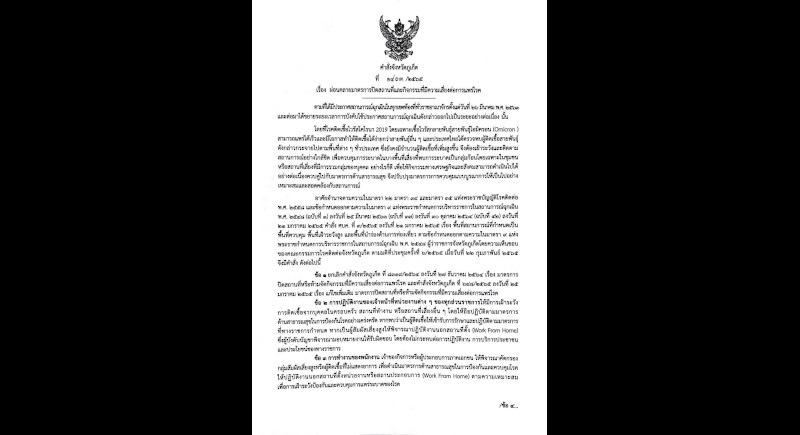
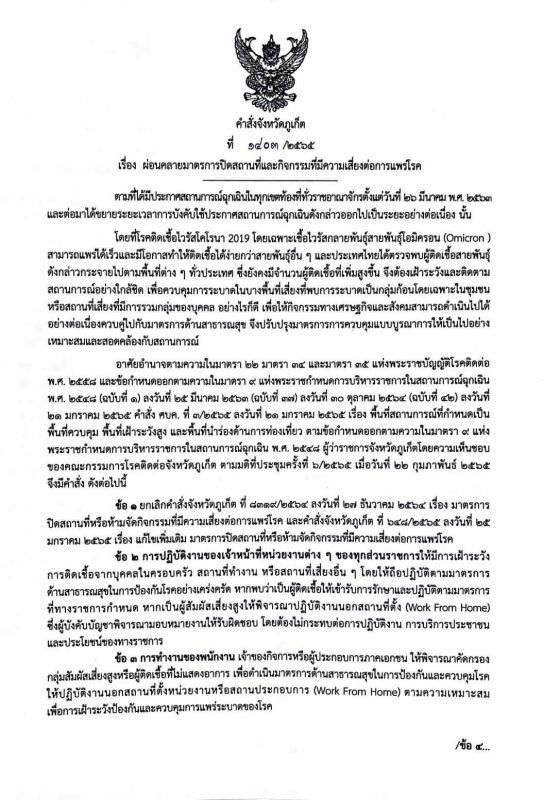
The order, Phuket Provincial Order 1403/2565, issued by Phuket Governor Narong Woonciew, was marked to be in effect from today (Feb 25) until further notice.
The new order today rescinded two previous orders regulating the operation of venues on the island: Order No. 8319/2564 dated December 27, 202, and Phuket Provincial Order No. 648/2565 dated 25 January 2022.
Under the new order, government officials were asked to maintain vigilance for COVID-19 infections at their places of work, and to work from home where necessary. All government offices are to strictly comply with COVID-19 prevention measures.
Private business owners were asked to do the same.
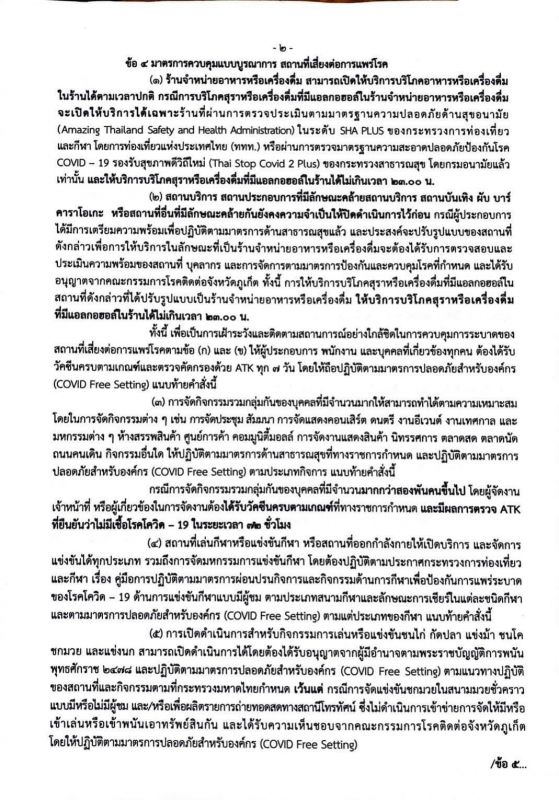
Food or beverage outlets open for consumption of food or beverages in the shop during normal hours, if the venue is to sell alcohol and allow alcohol to be consumed on the premises, the operator must first pass the Tourism and Sports and Tourism Authority of Thailand (TAT) SHA PLUS assessment (Amazing Thailand Safety and Health Administration) or pass examination of cleanliness and safety standards to prevent COVID-19 disease under the the Ministry of Public Health’s Thai Stop Covid 2 Plus policy.
Such venues may serve alcohol only until 11pm.
Service places and establishments that are similar to entertainment places, pubs, bars, karaoke or other similar places still need to be closed, the order confirmed.
“In the event that entrepreneurs have prepared to comply with public health measures and wishing to modify the form of such premises to serve as a food or beverage outlet, [the venue] must be inspected and assessed for the readiness of the premises, personnel and management according to the prevention and control measures that set and has been approved by the Phuket Communicable Disease Committee,” the order noted.
Such venues are also restricted to selling alcohol until no later than 11pm.
“In order to closely monitor and monitor the situation in controlling the outbreak of risky places for spreading the disease under (a) and (b) for all entrepreneurs, employees and related persons Must be vaccinated according to the criteria and screened with ATK every 7 days in accordance with the safety measures for organizations (COVID Free Setting) attached to this order,” the order noted.
The measures remain the same as already in effect in Phuket for months.
Organising group activities for a large number of people such as meetings, seminars, concerts, music performances, events, festivals, promotional events at shopping centres, department stores and community malls ‒ including trade fairs, exhibitions, fresh markets, flea markets, walking street markets ‒ must comply with the public health measures prescribed by the COVID Free Setting policy guidelines that were also attached to the order.
“In the case of organising a group activity of 2,000 people or more, the organisers, officials and people involved in the event must be fully vaccinated according to the criteria specified by the government and must be tested by ATK [antigen test kit] that confirms that the person is not infected within 72 hours of attending the event,” the order said.
All sports venues and places of exercise must also continue with the COVID-prevention measures set out in the COVID Free Setting guidelines, the order added.
Venues for cockfighting, fish fighting, horse racing, bullfighting, boxing and bird racing, and all venues for operating under the Gambling Act B.E. must also comply with all relevant COVID Free Setting measures.
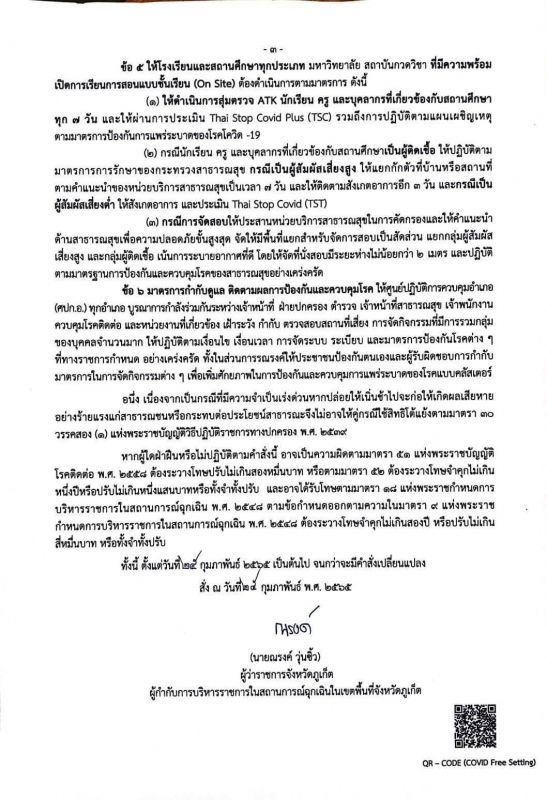
All types of schools and educational institutions, universities, tutoring institutes that are prepared to conduct “open classroom teaching (On Site)”, may do so, but must enforce the following measures:
(1) Conduct random ATK testing of students, teachers and personnel related to educational institutions every seven days and pass the Thai Stop Covid Plus (TSC) assessment, including complying with the response plan according to epidemic prevention measures.
(2) In the case of students, teachers and personnel related to educational institutions being infected, schools are to follow the treatment measures of the Ministry of Public Health. In the case of high-risk exposure, individuals are to isolate at home or at a facility as recommended by the Public Health office for seven days and monitor for signs of infection for another three days. People deemed to have had low-risk exposure are asked to monitor for signs of infection.
(3) In the case of organising exams, school operators are to coordinate with the public health office “for screening and giving advice on public health for maximum safety”. School operators are to provide a separate area for conducting exams, isolate high-risk groups and ensure good ventilation. The examination seats must be arranged at a distance of not less than two metres and strictly comply with the prevention and control of public health standards.
District offices and local municipalities were ordered to continue their efforts to prevent the spread of COVID-19 by coordinating with administrative officials, police, public health officials, Communicable Disease Control officers and “related agencies” to monitor, supervise and inspect risky locations.
They are also to ensure any events organised to accommodate a large number of people comply with COVID-prevention measures already set out.
The order included the standard waiver of claims against the government for the regulation and the penalties for breach of the order.
“Because it is a case of urgent necessity, if it is left too late, it will cause damage. seriously affecting the public or affecting the public interest, therefore, the parties may not exercise their right to object under Section 30 Paragraph 2 (1) of the Administrative Practices Act B.E.,” the order noted.
“If anyone violates or fails to comply with this order may be [may be guilty of] an offense under Section 51 of the Communicable Diseases Act B.E. 2554 and shall be liable to a fine not exceeding B20,000 or Section 52 [of the act and] shall be liable to imprisonment for a term not exceeding one year or a fine not exceeding B100,000, or both,” the order warned.
Offenders may also be punished under Section 18 of the Royal Decree on Public Administration In an Emergency Situation, and liable to imprisonment for a term not exceeding two years or a fine not exceeding B40,000, or both.