


“There are no plans for flyovers in any other areas. The Koh Kaew-Pa Khlok flyover [sic] is the only feasible option,” Mr Winai told The Phuket News.
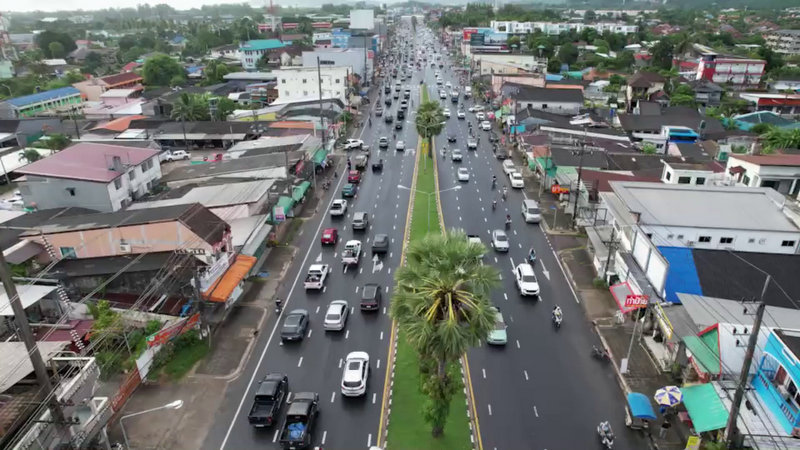
Mr Winai explained that the project is designed to divert through-traffic away from “some of Phuket’s most congested sections of Thepkrasattri Rd”, particularly around Tha Ruea, Koh Kaew and most importantly the Heroines Monument.
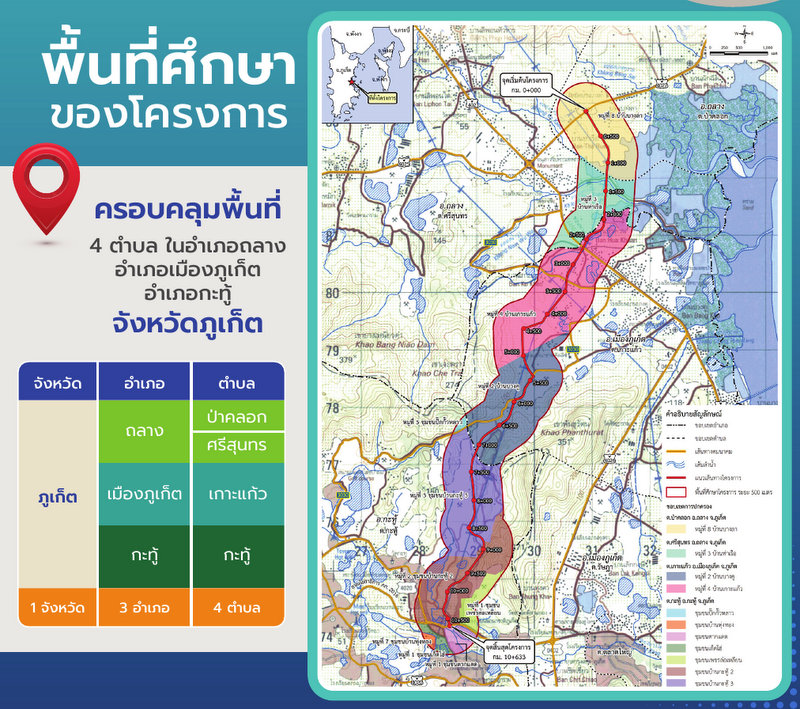
The project involves construction of a new two-lane road of approximately 10 kilometres linking Pa Khlok to Kathu. The total investment value is estimated at B5.5 billion, with about B4.5bn allocated for land expropriation and B989 million for construction, Mr Winai explained.
The feasibility study has already been completed and the project has been listed under the 2026 Budget Act, with preparations under way to seek funding in the 2027 budget for detailed design work and an Environmental Impact Assessment (EIA).
However, as with previous years, Phuket’s first flyover might yet be put on the backburner, again, Mr Winai warned.
“Final approval will depend on the policies of the next government following the general election, meaning construction is not expected to begin in the near term,” he noted.
The next government is hoped to be resolved by the Feb 8 general election. However, Thailand in recent years has experienced unusually rapid leadership changes, resulting in major government projects being repeatedly delayed and revised.
Paetongtarn Shinawatra served as prime minister for just one year, as did her predecessor Srettha Thavisin. Anutin Charnvirakul took up the post of PM on Sept 7 last year and as of Dec 12, when the Feb 8, 2026 general election was called, his administration had been unable to approve any major projects.
Of note, Anutin served as Deputy Prime Minister all the way from July 2019 through to June 2025, essentially since the Prayut Chan-o-cha administration, but still across all those years major Phuket infrastructure projects have yet to come to light, despite many repeated promises.
NO PLANS
While many Phuket expats have repeatedly called for flyovers to alleviate traffic bottlenecks, Mr Winai was adamant no other flyover projects are even on the drawing board.
The Phuket News pressed whether flyovers were being considered to ease traffic tailbacks in areas such as at Chalong Circle, in Rawai, Kathu, Patong or any other areas, even on alternative routes suffering from heavy congestion.
To that, Sorasak Thasakan, Head of Civil Engineering Planning and Operations, speaking on behalf of the Phuket Highways chief, said physical and safety constraints made flyover construction impractical in most other locations.
“In Chalong, the roads are too narrow and have limited lanes, while Rawai faces similar constraints due to dense residential development,” Mr Sorasak said.
“As for Kathu and Patong, the Expressway Authority of Thailand [EXAT] is already planning a tunnel project, which the Highways Department cannot replace or interfere with,” he added.
Mr Sorasak said high population density in these areas would also result in costly land expropriation. “As a result, the Koh Kaew- Pa Khlok route remains the only viable option at this time,” he said.
OUT OF BOUNDS
As for the Heroines Monument, easily the busiest intersection on the island, Mr Sorasak said construction of a flyover directly over the Heroines Monument is not permitted, citing strong opposition from Srisoonthorn Municipality and local residents.
Srisoonthorn Mayor Chalermpol Kerdsup said cultural and community concerns led authorities to favour an underground tunnel rather than an overpass at the monument, noting the site’s historical and symbolic importance.
However, the Department of Highways cancelled the ‘Heroines Underpass’ project last year, leaving the Koh Kaew flyover as the only major traffic relief project currently moving forward.
ONLY ONE
Mr Sorasak said the chosen design for the Koh Kaew flyover was identified as the most suitable ‒ among three options considered ‒ because it maximises the use of land beneath high-voltage transmission lines, minimises impacts on communities, and reduces land acquisition.
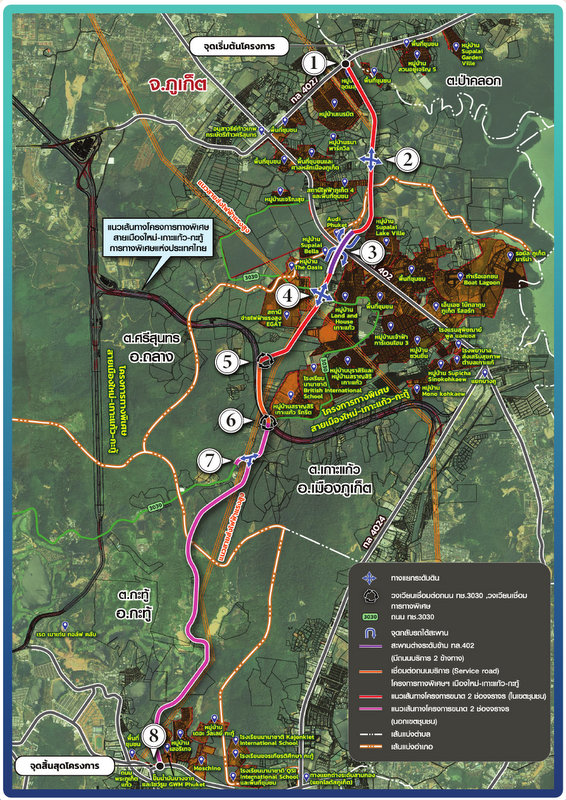
The design includes a flyover over Thepkrasattri Rd, at-grade junctions and roundabouts, and direct connections to Rural Road Route 3030 (the inland road joining Koh Kaew to Kathu) and the planned Muang Mai-Koh Kaew-Kathu Expressway.
Mr Sorasak said the project’s original objective, outlined by former Phuket Highway chief Somkit Kittisophit, was based on the assessment that traffic congestion at the Heroines Monument would remain despite upgrades to Route 4027, as Phuket’s road capacity has been overtaken by growth in tourism and investment.
Route 4027 is the ‘ring road’ which joins the Heroines Monument, travels through the eastern edge of Pa Khlok and rejoins Thepkrasattri Rd further north at Muang Mai.
Thepkrasattri Rd continues to serve as the main route into Phuket Town, with Route 4027 intended only as an alternative, Mr Sorasak said.
However, both roads still converge at the Heroines Monument, which also links to Route 4025 (Srisoonthorn Rd, heading to Cherng Talay), creating major traffic bottlenecks as standard.
A key feature of the proposed Koh Kaew flyover is a two-lane elevated flyover, approximately 13 metres wide, crossing Thepkrasattri Rd near the Supalai Bella housing estate in Koh Kaew.
The proposed route begins near the PTT gas station on Route 4027 in Pa Khlok and joins Phra Phuket Kaew Rd in Kathu next to the Bangchak petrol station near Kathu Intersection. In total, the full route passes through Pa Khlok, Srisoonthorn and Kathu, as well as four subdistricts.
Mr Sorasak said he plainly understood the appeal of using flyovers. “By allowing through-traffic to bypass ground-level intersections and traffic signals, the Koh Kaew flyover is expected to reduce conflicts with local traffic, U-turns and access points, which are among the main causes of congestion during peak hours,” he said.
However, he repeated, “But there will be only one. Building a flyover at any other location is just not feasible," he said.