


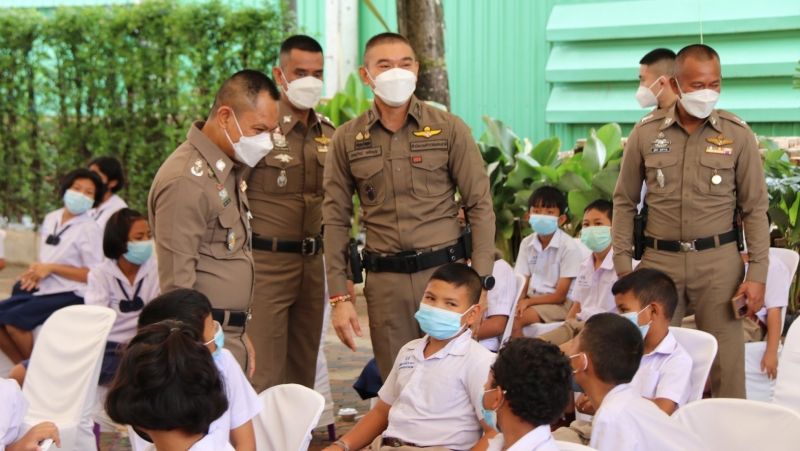
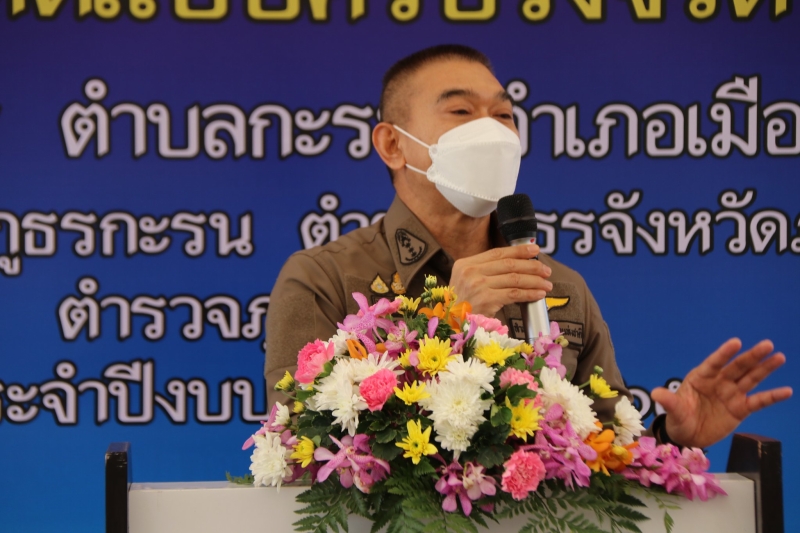
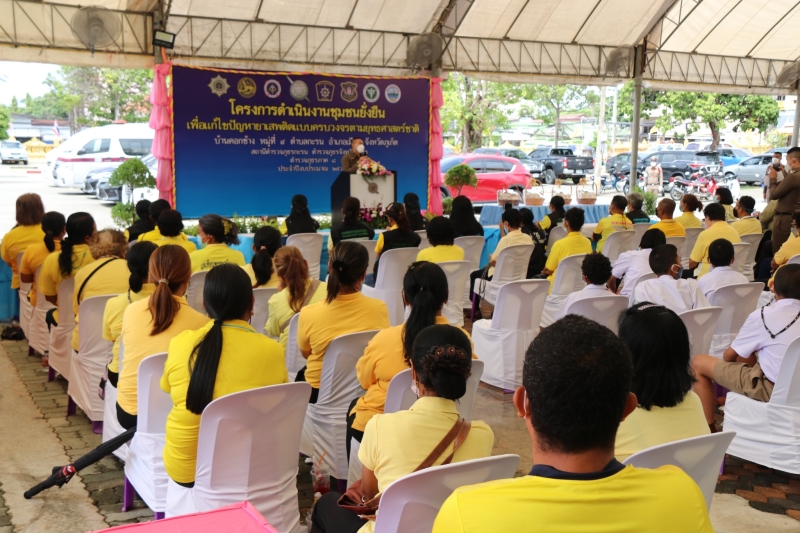
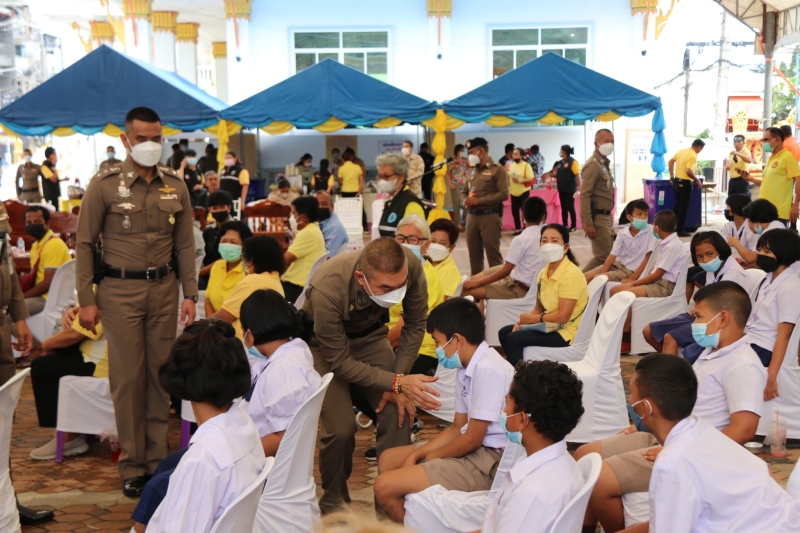
“The campaign follows a national strategy to provide a comprehensive solution to drug problems, moving forward with the national strategy that has changed the war on drugs to use the public health system and contribute to the reduction of crime in the area,” Lt Gen Panurat said at the event, held at Wat Suwan Khiri Khet (Wat Karon) in Moo 4 Karon.
Also present for the event were Phuket Provincial Police Commander Maj Gen Sermphan Sirikong and Karon Police Chief Col Theerawat Liamsuwan, along with community leaders and students.
Col Theerawat explained that under Royal Thai Police policy every police station is to have a sustainable community action project to solve the drug problem in line with the national strategy.
Karon Police had assigned its Community Relations Police Operations Unit to carry out the campaign in the area in order to acknowledge the problem and educate local residents about narcotics, Col Theerawat added.
Karon Police are responsible for just one tambon, Karon, with an area of about 20 square kilometres, comprising four villages with a total population of approximately 7,000 people, he said.
For this year Karon Police had selected Baan Khok Chang, in Moo 4, Karon, for the focus of its community anti-drug campaign, Col Theerawat added.
Why Moo 4 Karon was specifically singled out for highlighting the campaign was not explained.
Under the campaign, officers will visit every household in Baan Khok Chang to prepare for the drafting of a memorandum of understanding (MoU) on drug testing, Col Theerawat said.
Under the MoU, people who test positive for drugs will be taken under public health care for recovery and rehabilitation, after which they can return to their families, he added.
“If there are no addicts in the community, there will be no suppliers. This will make the community become a strong, drug-free community,” Col Theerawat said.
Lt Gen Panurat said that this year similar programmes were being rolled out in 1,483 communities throughout the country.
The government provides a budget of B50,000 per community to implement the project, he said.
“However, this budget was insufficient to provide comprehensive treatment for patients. Therefore, integration with network partners, including local leaders and parents is an extremely important part in expanding the project into other community areas,” he said.
Lt Gen Panurat added that the community campaigns would also help alleviate the stress on the national prison system.
There are currently 300,000 inmates in prisons, 80% of whom are serving drug-related sentences, he said.
Teerayut Ariyaudomkit, Director of the Karon Health Promoting Hospital, voiced his support for the project.
“Community participation therapy is the right path,” he said.
“After the addict has voluntarily entered the treatment process, health officials will design each patient’s treatment process according to the severity of their condition and to make the treatment as effective as possible,” Mr Teerayut explained.
“Three more follow-up visits will be conducted to allow the patient to be truly disconnected from drug dependence,” he concluded.