


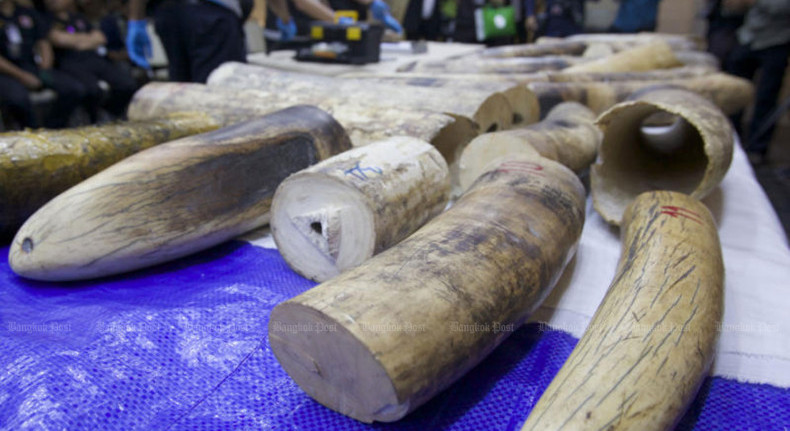
Noppadol Pholsen, secretary to Minister of Natural Resources and Environment Phatcharavat Wongsuwan, presided over the opening ceremony for the new Wildlife Crime Intelligence Unit (WCU) on Monday (Oct 16), reports the Bangkok Post.
Mr Noppadol said the WCU is funded by the Illegal Wildlife Trade Project, a five-year effort to combat the illegal wildlife trade, focusing on ivory, rhino horn, tigers and pangolins.
The WCU is also supported by the United Nations Development Programme and Wildlife Conservation Society, he said.
Mr Noppadol said the unit strengthens the intelligence system using “I2” database technology and software to collect wildlife data, which is typically more complex and difficult to analyse.
The programme helps visualise and interpret data to help authorities investigate the trade. It is also useful for wildlife authorities to map connections between wildlife poachers and their communications devices, known locations and local information in the region, he said.
The “I2” database is now fully functioning at the WCU.
The DNP, which is responsible for the WCU, has trained 80 park officers nationwide to use the database and they would work closely with the WCU.
Mr Noppadol said the WCU is also responsible for providing training programmes for the DNP’s wildlife enforcement network special working group. The WCU is also working with other agencies in sharing information on suppression of the wildlife trade.
Since Pol Gen Phatcharavat took over as minister he has pushed the enforcement of forest and wildlife resources-related laws, Mr Noppadol said.
The DNP enforces the Wild Animal Conservation and Protection Act 2019, which has been revised to add penalties for possessing, trading, importing and exporting protected wildlife trophies.
Thailand also has joined a convention on plants and wildlife to step up preventive measures against such trade, he said.
Respect nature, pleads wildlife trafficking cop
The announcement came as a senior anti-wildlife trafficking officer made a plea to respect nature in the hopes of reducing and eventually eliminating illegal trafficking.
“We need to have a better balance between humans and nature,” anti-wildlife trafficking officer Pol Col Wanpichit Wattanasakmonta told Dave Kendall on the Bangkok Post’s ‘Deeper Dive’ podcast.
“It’s not just about protecting wildlife. We would like to encourage everyone to protect our own natural resources and our environment, making the world more sustainable. We can live alongside nature happily ever after then.”
Noble ideals aside, the day-to-day workload of the superintendent of Sub-division 6 in the Natural Resources and Environmental Crime Suppression Division is chasing bad guys in an illegal industry worth US$20 billion (B726bn) - the fourth most lucrative global crime after drugs, humans and arms.
A wildlife trafficking hub
Thailand, home to 10% of the world’s animal species, has long been a hub for the trade - a source, destination and transit route.
Thankfully, the days are gone when the country was dotted with farms stocked with tigers, bears and crocodiles, shop windows displaying tiger and leopard skins, and species from around the world openly for sale in Chatuchak market.
In 2019, the new Wildlife Conservation and Protection Act protected non-native species and increased jail terms of traffickers up to 20 years. After Vietnamese trafficker kingpin Boonchai Bach initially walked free, the Supreme Court in 2022 sentenced him in absentia to five years in prison.
And on Sept 19, Malaysian Teo Boon Ching was sentenced to 18 months in prison in the US for conspiring to traffic hundreds of kilogrammes of rhinoceros horns worth millions of dollars. The trafficker known as the "godfather" had been extradited from Thailand.
Otters on a plane
Yet wildlife trafficking continues throughout the kingdom. Chaos erupted after a rat and an otter were found wandering around an Oct 4 flight from Suvarnabhumi to Taipei after escaping from a carry-on bag containing another otter, 20 Burmese star tortoises, a snake, a prairie dog and two black giant squirrels.
News reports carried a jocular tone, but the smuggling scourge is not amusing to anyone who cares about cruelty to animals, species extinction and the risk of zoonotic diseases thought by most scientists to have caused COVID-19.
“In the last two to three years, we have seized both protected animals and ‘reserved’ animals from smugglers, Pol Col Wanpichit said. “There are numerous species, including [exotic] birds, [leopard] cubs, macaques and most recently pangolins.” Snakes and tiger parts are also smuggled.
Pangolins - the “scaly anteater” trafficked for its meat and its scales for use in traditional Chinese medicine - were once common in Thailand but are now mostly captured in Indonesia and then transported live by ship to Myanmar or overland through Malaysia before they cross the Thai border. They are then rapidly trucked to the Lao border and onwards into China.
Chinese laboratories
The smuggling of macaque monkeys is also rife.
“They come from the northern part of Thailand,” said Pol Col Wanpichit. They are almost certainly headed for laboratories in China, although even when pushed, the officer followed standard police practice of not naming specific countries for fear of causing offence.
“What we can say is that they are first transported to neighbouring countries before being smuggled into a third country for experimental purposes,” he said.
While investigators have had some success combatting the criminal gangs dominating the trade, the wildlife protection officer was clear that enforcement efforts will never stamp out the trade until demand for the product drops.
“In some countries, news and information about the dangers, consequences and penalties related to wildlife trafficking are almost non-existent. And here in Thailand, some people still think: It’s hunting. It’s a way of life.”