


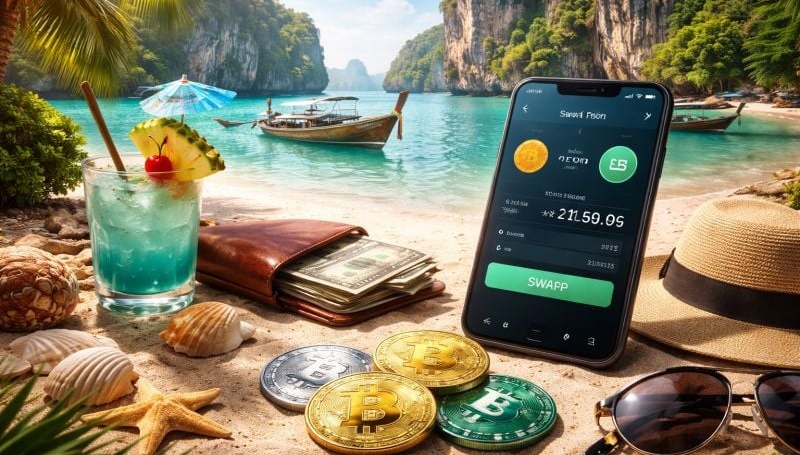
In August 2025, Thailand officially launched TouristDigiPay, an 18‑month pilot programme designed to let foreign tourists convert cryptocurrencies into Thai baht for local spending. Merchants receive QR‑based payments in baht rather than digital assets themselves. The initiative reflects broader pressure to revitalise tourism after several years of weaker arrivals, particularly from China.
The regulatory landscape: crypto converters, not crypto cash
It’s important to clarify what this new system does and does not mean. Crypto is not becoming legal tender in Thailand. The TouristDigiPay framework allows the conversion of digital assets, such as Bitcoin, Ethereum, USDT, and USDC, into Thai baht through licensed exchange partners. Visitors then spend the baht using existing digital payment infrastructure, like PromptPay QR codes. Merchants never handle crypto directly.
The programme operates under strict regulatory oversight by the Securities and Exchange Commission (SEC), the Bank of Thailand and related authorities. It incorporates anti‑money‑laundering safeguards and consumer protections, with conversion limits currently set at roughly 550,000 baht (about $17,000) per visitor for the pilot.
This approach is consistent with Thailand’s broader digital asset policy: crypto beyond basic trading remains not recognised as official currency, and direct use is still tightly controlled outside regulated environments.
Where visitors actually spend crypto money today
On Phuket itself, outside of this official programme, everyday crypto spending among tourists remains limited. Vendors at market stalls, beachside cafés and taxis almost universally rely on traditional baht payments and local QR systems. Early experimental schemes, including Bitcoin pilots in Phuket announced in late 2024 and early 2025, placed emphasis on converting crypto to cash before settlement to protect local businesses from volatility.
Among visitors familiar with digital finance, the common pattern is pre‑trip conversion to fiat before spending — often through crypto exchange cards or second‑layer wallets that settle in baht. This behavioural trend predates TouristDigiPay and reflects practical necessity more than ideological preference.
What travellers prioritise in swap services
Within this evolving context, tourists who do engage with crypto swap services tend to evaluate options against three main practical metrics:
1. Execution speed
For travellers juggling flights, check‑out times and day trips, waiting for extended blockchain confirmations or prolonged KYC delays significantly reduces utility. A swap that takes minutes rather than hours aligns better with real‑world needs.
2. Clear, transparent costs
Headline fees matter less than effective total cost, which includes network fees, exchange spreads, and conversion slippage. Services that present all charges upfront — without hidden spreads — earn trust from cost-conscious travellers. For those exploring options, evaluating FixedFloat alternatives can help identify platforms offering both reliable execution and transparent fees, making them among the best choices for short-term travel use.
3. Mobile‑first convenience
Tablet‑or laptop‑centric services fare poorly in a destination where almost all financial interaction happens from smartphones. Platforms that leverage QR code settlement and integrate smoothly with mobile wallets — including e‑money systems linked to national infrastructure — win out.
Comparative context: global crypto tourism experiments
Thailand is not alone in exploring crypto payment solutions targeted at travellers. Other countries, including Malta, the UAE, and some Japanese regional initiatives, have tested limited merchant acceptance or conversion mechanisms for digital assets. These experiments vary widely in scope and user experience, reflecting differences in regulatory frameworks and market maturity.
For tourists considering options beyond Thailand, exploring alternative cross-chain services can help identify platforms that combine low fees, mobile usability, and broad cryptocurrency support. By reviewing these competitors, travellers gain insight into which services are practical for real-world use, particularly when multiple blockchains and token types are involved.
Thailand’s approach stands out because it integrates crypto conversion within an established regulated e-money and QR payment network (PromptPay), widely familiar to merchants and visitors alike. This reduces friction for everyday spending and avoids the volatility risks that direct crypto acceptance can pose to small businesses.
Tourism metrics shaping the experiment
Tourism accounted for a substantial slice of Thailand’s GDP before the pandemic. In 2019 nearly 40 million foreign tourists generated about 1.9 trillion baht (roughly $59 billion) in revenue. By early 2025, forecasts had slid to an anticipated 33 million visitors as arrivals lagged overall recovery.
Amid this backdrop, policymakers see crypto‑linked options as one way to attract tech‑savvy, long‑stay visitors and digital nomads, segments that might otherwise favour destinations with more familiar financial tools and lower friction in everyday spending.
Practical takeaway: utility first
Looking at all regulated pilots as well as existing real-life behaviours, the same findings are visible:
- Tourists do not want crypto ideology as their main source of satisfaction, they want their needs to be met.
- While decentralization seems to be a much discussed topic, it is actually speed and predictability that make a difference and generate results.
- Having a clear cost structure and being able to use the mobile phone are the two most important things when one is on holiday.
Still, the dream of using crypto payments extensively in Phuket is a bit far off. Nonetheless, with legally controlled conversion channels like TouristDigiPay being rolled out, tourists would have the possibility to spend with digital assets as if it was their daily spending, while at the same time local merchants would not be exposed to unnecessary risks or volatility.
In this respect, the usefulness of crypto for tourists in Phuket is probably a lot less of a risky adventure than it may have been, and more another mode of global financial habits being combined with local currency needs, if and only if POS (point-of-sale) is executed in a reliable, transparent, and user-friendly way.