


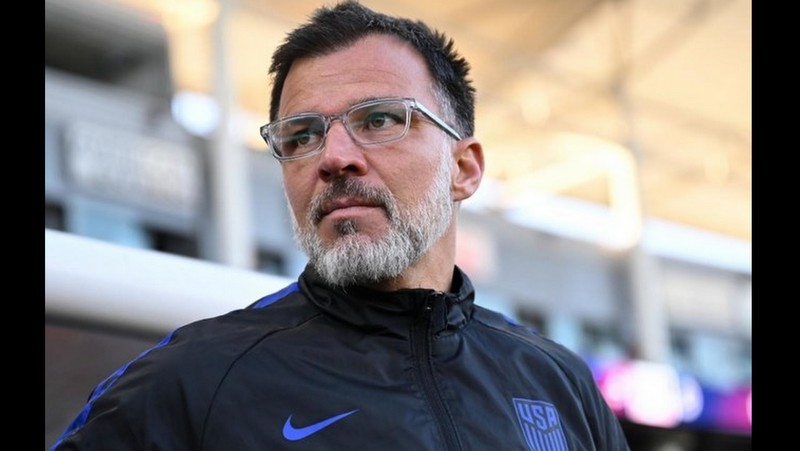
To understand Anthony Hudson, you first have to meet Junior. As I am ushered into Hudson’s Bangkok apartment, I am greeted not by a wall of tactical magnetic boards or a shimmering array of data monitors, but by a frenetic, welcoming bundle of energy in the form of his dog.
Junior doesn’t care about xG or the high-press triggers of Turkmenistan. He is a reminder of the quiet domesticity that Hudson has cultivated far from the traditional centres of the English game. Interestingly, Junior never ventures outside; he sits patiently at Hudson’s feet, perfectly composed under his management – a small, domestic reflection of the discipline Hudson expects on the pitch.
The interview took place in January, back when the air was marginally thinner and the pressure of Tuesday’s (Mar 31) Asian Cup decider felt like a distant cloud on the horizon. But as we sit here now, with the War Elephants’ squad assembling and an injury list that reads like a war diary, Hudson’s words from two months ago have shifted from philosophical musings to a survival blueprint. This is how you build an elephant when the world expects it to stumble.
The Shadow of the Name
Hudson’s background is often reduced to a footnote about his father, the legendary Chelsea and Arsenal midfielder Alan Hudson. It is a lineage that brings both an innate understanding of the game’s soul and a relentless, sometimes exhausting, level of scrutiny. Being the son of a 1970s maverick means you grow up seeing the game as a craft, not a career.
His own playing career was cut short, a brief stint in the lower tiers and a spell in the United States with Wilmington Hammerheads that served primarily as an apprenticeship for the touchline. By 27, while his peers were still worrying about their calf muscles, Hudson was already an assistant at Newport County. By 31, he was the youngest coach to earn a UEFA Pro License. However, rather than settling into the comfortable, well-padded cells of the English academy system, Hudson chose a path of deliberate discomfort.
The Global Pioneer
To label Hudson a “nomad” is to miss the intentionality of his career. While many British coaches are content to rotate through the same three dozen clubs in the EFL, Hudson has displayed a rare brand of professional bravery, stepping outside of the UK comfort zone to test his theories in cultures where a “long ball” isn’t a tactic, it’s a translation error. He has carved out a reputation in Bahrain, New Zealand, the Colorado Rapids, and Qatar, before eventually meeting the sudden, humid reality of Thai League 1 with Pathum United.
“The journey of a coach is one of constant growth,” Hudson says, leaning back as Junior finally settles. “All of those experiences – the study visits with Marcelo Bielsa, the years in national setups across different continents – they solidify what you think is important. They teach you how to get the most out of players in environments that don’t look like what you grew up with.”
The Ghost of Rigidity
This global perspective has transformed Hudson from a youthful fundamentalist into a pragmatic architect. In his early years – specifically during his tenure with the Colorado Rapids in 2017 – he was a disciple of the high-intensity, structured press. He arrived in the MLS intent on grafting a European tactical skeleton onto an American body. It was a period of immense challenge where the results didn’t always follow the theory, leaving him with a healthy, seasoned distrust of rigid systems.
“I’ve gone into places and been really strict,” he admits, his tone carrying the dry wit of someone who has survived the car crash and now drives much more carefully. “I’d say, ‘This is the system, these are your roles,’ and I’d try to fit the players into that box. But unless it’s working, you’re doing a disservice to the players. My responsibility now is to look at the context, the qualities of the players, and get the most out of them without veering from my core beliefs.”
The Anti-Data Manifesto
In a modern footballing world where managers are increasingly treated as glorified accountants, Hudson remains an unapologetic holdout for the power of the eye test. While modern reporting often leans heavily on the numbers, Hudson plays a compelling devil’s advocate.
“Honestly, data drives me mad,” he laughs. “There is key data that is important, sure. But it would never lead my decision-making. It’s there to support what I’m seeing or feeling. For me, watching the breakdown of a game, seeing the issues with my own eyes – that is the biggest form of information you can take.”
The Death of ‘Jai Dee’
The conversation inevitably turns to the upcoming match against Turkmenistan. Thailand is traditionally the “nice” team of Southeast Asian football. They play with Jai Dee (big heart) and Sabai Sabai (relaxed) – a style that is aesthetically pleasing but often lacks the clinical, almost antisocial aggression required to win in the final ten minutes of a knockout match.
Hudson wants to end that. He speaks of the “seven-a-side” culture that dominates Thailand’s grassroots – a game of rapid transitions, high technicality, and relentless intensity. “Thai players are incredibly comfortable on the ball,” Hudson observes. “But the best version of a Thai team is an aggressive one. I don’t think sitting back and being passive suits the players we have. The fans want to see tackles flying in, intensity, and a team that builds pressure aggressively.”
The Pathum United Mystery: The Taxi Call
For the Thai football fan, Hudson’s sudden exit from Pathum United remains a source of endless speculation. He had stabilised the club, the players were responding, and then – silence. “I don’t know,” Hudson says, the confusion still evident even months later. “We were in a taxi on the way home, me and my assistant. My agent was actually here to talk about a long-term contract. We got a phone call, and that was it. But listen, I have no hard feelings. One door closes, another opens.”
The Audacity of the Dream
As the afternoon light fades in his apartment, Hudson turns his attention to the World Cup. With the expansion to 48 teams, the traditional glass ceiling for Southeast Asian nations has suddenly become porous. “It’s easy to say this sitting on a couch with zero pressure,” he admits, leaning in. “But I genuinely believe Thailand can go to the World Cup. I’ve seen the competition in the region, I’ve seen the quality of these players, and I truly believe we can get there.”
It is an audacious claim, bordering on the delusional for some. But as he looks at Junior, still sitting perfectly at his feet, Hudson looks like a man who has seen enough of the world to know that the “delusional” are often the only ones who actually achieve anything. On Tuesday we will see if his evolution is enough to dismantle Turkmenistan. He isn’t just building a team; he’s trying to build an elephant that can run.