




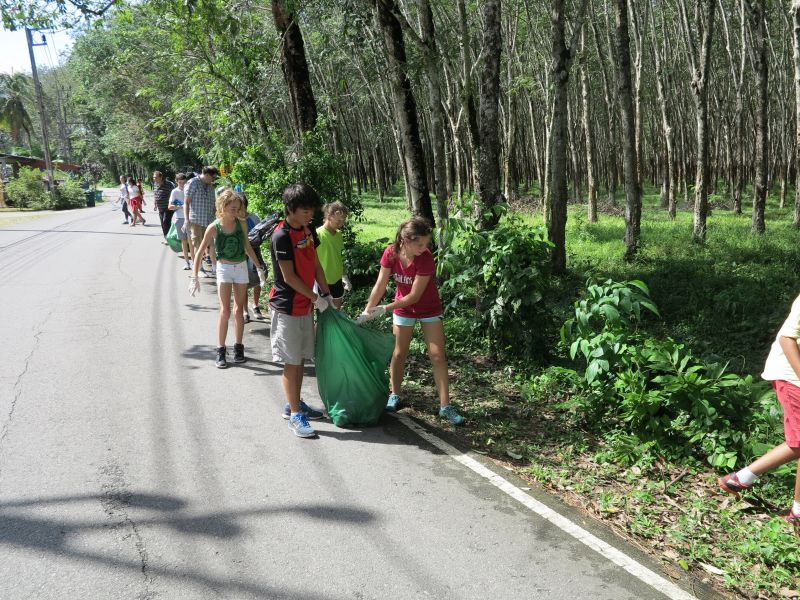
The aspiration of all good schools should be that, when their students graduate, they will have developed into autonomous human beings, able to make decisions by themselves set against a strong set of values which will guide the process. If only it were that simple.
As an educator, it is reassuring when a coherent set of practices rooted in a particular educational philosophy that seemed intuitively to make sense is subsequently validated by research. The practices I am referring to are those that have been developed over the years based upon the educational philosophy of Kurt Hahn, the founder of Outward Bound and the United World Colleges movement: the research was conducted in schools at the turn of the century by Alan McClean, an eminent psychologist.
Hahn had a tremendous belief in the good of the young, that education was a preparation for life not just for university and that service should play a central role in that education. His view was that education should be about personal growth and development in all areas: intellectual, physical, spiritual and emotional, and students should be encouraged to take on genuine responsibility at an early age. It therefore had a much broader remit than just focusing on academic achievement.
Children are active, curious and playful from birth and are naturally inclined towards exploration and learning. You only have to watch a toddler for a few minutes to recognize this. Schools need to harness a child’s natural curiosity so they will engage in tasks for the sheer enjoyment of learning, undertaking them for their intrinsic value and personal satisfaction not for extrinsic reward – marks, grades and prizes. There are four key factors to creating such a learning environment: engagement, feedback, structure and stimulation.
Fundamental to any school is the quality of the relationships between the teacher and the students and the students with their peers. There is an age-old adage in teaching that states, “The students don’t care what you know until they know that you care.” Experience, time and again, shows that this is the case. Trust, honesty and mutual respect should govern all interactions, not least amongst the students, and it is worth noting that research conducted in the United States, demonstrates that properly structured service-learning programmes in schools greatly enhance the quality of student interactions, the locus of attention being shifted from self to other.
Students, like all of us if we are to develop as human beings, need regular feedback on how they are doing, feedback that involves genuine (not plastic) praise of effort and provides strategies for improvement. Only by providing this are students able to achieve success which should be referenced at a personal level rather than by comparison to others. The latter can be hugely damaging.
Structure is a pre-requisite for creating an environment in which self-motivation will grow. Children need boundaries in which to operate but in setting those boundaries, the focus should be on learning rather than control and discipline, every situation viewed as an opportunity for growth.
Finally, they need to be stimulated. Teachers need to ensure that no matter what the circumstances, tasks are relevant and interesting. They also need to provide an appropriate level of challenge so that the students feel stretched but not overwhelmed. Stress induced from inappropriate pressure to perform hinders rather than enhances learning.
But if that is the recipe, the key to achieiving this perfect learning environment is the manner in which the ingredients are mixed together – the school culture.
The most inspiring schools will have it firmly embeddded in their culture that mistakes are an accepted and essential part of the learning process; mastery of an area and a desire to keep improving are more important than performance; an educated person is someone who learns from every new experience and as the children grow older the locus of control shifts to the students, with the expectation that they will take more and more responsibility for themselves, their actions and their learning. If schools always try to control students or make decisions for them they do them a huge disservice.
If only it were that simple but that is where the skill, knowledge and experience of the teacher are so crucial.
Written by Julian Whiteley, formerly the Head of United World College of South East Asia, currently Chief Executive of Phuket International Academy
Julian.whiteley@pia.ac.th