



Menara KL
Looking out over most of Kuala Lumpur, speckled with everything from colonial buildings to residential high-rises to one of the most beautiful structures in the world, the twin Petronas Towers, it's easy to say that Menara Tower is one of the biggest attractions of the city.
The tower reaches 421 metres from pedestal to the top of the antenna and features two restaurants, one of which – Atmosphere 360 – rotates and gives diners spectacular views of the city.
At night, with the Petronas Towers dazzling in the background, one could imagine this being one of the best man-made wonders of the world.
Tourists can also enjoy an aquarium, Formula One simulators, an XD Theater, and a small animal zone (not big enough to call a zoo). But there's one Malaysian feature that quickly becomes a theme in the country: shopping!
When you first reach the pedestal at Menara KL, the Formula One store and a gift shop offer small knick knacks for tourists. On the observation deck, the wall is lined with souvenir booths that sell everything from T-shirts to makeup.
It's also easy to get in touch with your inner Sherlock Holmes while looking out from the observation deck of the tower. Because of Menara KL's location, it is a very convenient spot for engineers and businessmen to scout for potential properties.
Overhearing a conversation between two men – a tour guide and someone who seemed to be a building investor – I learned that several properties in Kuala Lumpur, like many other places around the world, feature massive half-finished projects that have simply run out of funding.
Pointing at one of these properties that surrounded a small body of water not far from where we stood, the tour guide explained that the project was to be a beautiful bus station before the owners ran out of money trying to work their way around the water.
“It's a story that, sadly, happens far too often,” said the businessman.
Kuala Lumpur City Gallery
One of the highlights of KL is the Kuala Lumpur City Gallery, owned and run by architectural modeling company Arch. The gallery is famous for their three-dimensional model of Kuala Lumpur, which features scaled-down replicas of the entire city centre, down to the exact number of windows on buildings.
Andrew J.K. Lee, the founder of Arch, one of the biggest model-making companies in Asia, personally walked our group through the gallery to view some of the other models being made by their team of steady-handed artists.
Once that was over, we got a chance to put together our own model using tweezers, glue, and teak wood – a simple but fun activity perfect for kids and adults.
The scale city model, which is housed in a 115-year-old building, is a labour of love for Lee.
He began several years ago by first creating a walking map of the city, which took a year to make. Now, roughly 2,000 tourists walk through the gallery's doors everyday, most of whom end up dazzled.
Petaling Street
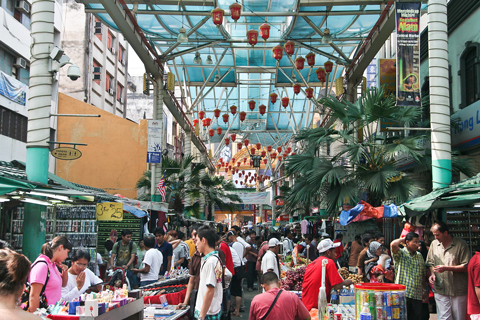
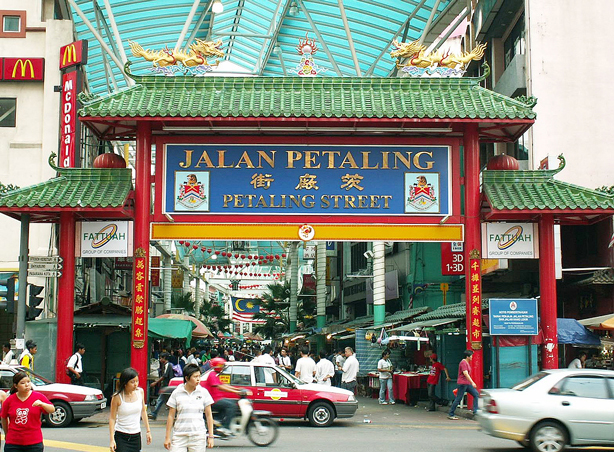
Wandering around the shops of Petaling Street (known in Malay as Jalan Petaling), KL’s biggest Chinese market area, smells attack you. It's mostly a mixture of money, stress, and chicken.
Tourists flock to this area to get some of the cheapest buys in the city, but the best stuff – as in all Chinatowns around the world – is being made in small back-alley kitchens.
Nephews and cousins serve food made by aunts, uncles, and grandmothers to a largely touristy crowd of people who order, more or less, the same thing all the time: chicken and rice, a noodle dish, or fish.
You don't need tour guides to find a great place to eat in Petaling Street, just follow your nose to the nearest smell. Many stalls sell square-shaped slices of greasy beef that, if lucky, would only make you half-sick – iron stomachs only need apply.
It is preferable to eat at a stall with chairs since this is a big indicator that people actually eat here. My favourite is the nasi ayam (chicken rice) from a small stall in a side street here, made by chef Moy – a Malaysian Chinese who opened his stall just five years ago.
He tells me that most of his customers are tourists because of the RM4 (B40) price for a plate and a soft drink (a bargain by Phuket standards).
The side streets of Petaling Street are full of micro-economies that include everything from butcher shops to fisheries to vegetable stalls. And the cats love every bit of it.
J.P. Mestanza visited Kuala Lumpur as a guest of Tourism Malaysia. This year has been designated ‘Visit Malaysia Year 2014’. For more information, visit tourism.gov.my