


Among them, natural resource emancipation, and in particular energy independence. And even though Phuket black-outs seem to be lessening while crude oil prices plummet ever-closer to a decade low, there’s a lot more reason to rejoice, for we are now have more choice, never mind the fossil fuel order.
For those who’ve followed the Happy Habitat beat, you’ll know I’m an enthusiast and advocate for alternative energy, especially solar power, which has never been more affordable and practical for common citizens in Phuket, Thailand and the world.
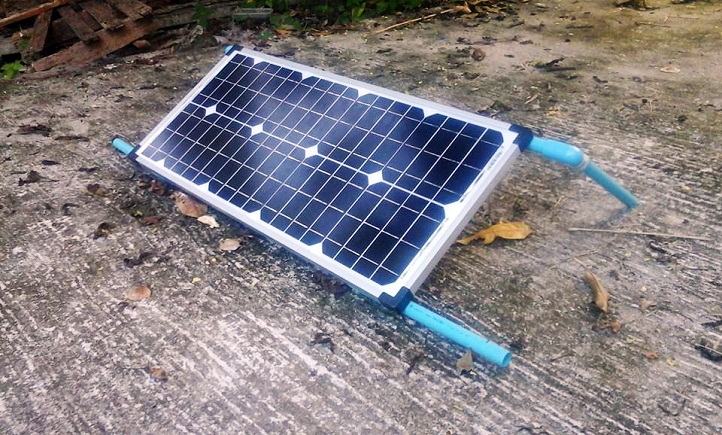
Even at B30-60 per watt in Phuket currently, photo-voltaic (PV) domestic energy production is definitely practical for most islanders who can read and understand this, and the news on this solar front keeps getting better, with PV panels to be produced in China for as little as B14 per watt this year. Before you can really appreciate what this means, you’ve got to understand the fundamental math in domestic energy consumption. Here I’ll simplify/outline the basics.
What’s with the wattage?
In slightly advanced laymen’s terms, a watt is a unit of energy, equal to the product of volts (V) and amps (A). Barring engineers, us common folk don’t really need to understand or be concerned with the actual physics of a watt (W), but really just need to know that energy use is measured in W, and be able to do basic calculations on how much energy one uses, needs to use, in W. For example, the office computer monitor in front of me right now is consuming as much as 150w (220V x 0.7A) for each hour it’s turned on, while the desktop PC it is plugged into is using as much as 250W to process this information. Meanwhile, my smart phone that is charging via the USB port is only drawing 5-10W (5V x 1 to 2A) every hour it charges.
Most appliances will list/label the wattage which it is rated (the maximum amount of energy it will draw). This number tells you how much energy it needs to function, which is important to figure before you take the jump into solar power, or any other alternative energy source for that matter.
If you are planning to emancipate yourself from fossil fuels, partially or wholly, like myself, the first step you should take is to figure out how much electricity you use, roughly, every day in W. Then, you can identify how much energy you would need to produce (using solar panels) and store (in batteries), and also figure out if there are any ways you can consolidate and eliminate unnecessary energy consumption/waste.
Seeking a sufficient set-up
Many people have thought about going solar, but often don’t get beyond examining/scrutinizing their personal comforts, which are often too excessive to be in harmony with “eco”. Such folks might get stuck on questions like, ‘Can I run my surround sound home entertainment system and sub-woofers, 60,000 BTU air conditioner, freezer fridge and 50-inch LCD TV?’ Well, if it’s such obstacles holding you back from investing in solar, then yes, it’s safe to say that you may remain a slave to fossil fuels (and oil-rooted wars) for some time.
That said, by learning how to be energy conscious and consolidate accordingly – asking yourself what it is you truly need to sustain if not thrive in terms of energy consumption – you will find that the solar route is a blessing waiting to be embraced. But it all starts with some basic calculations.
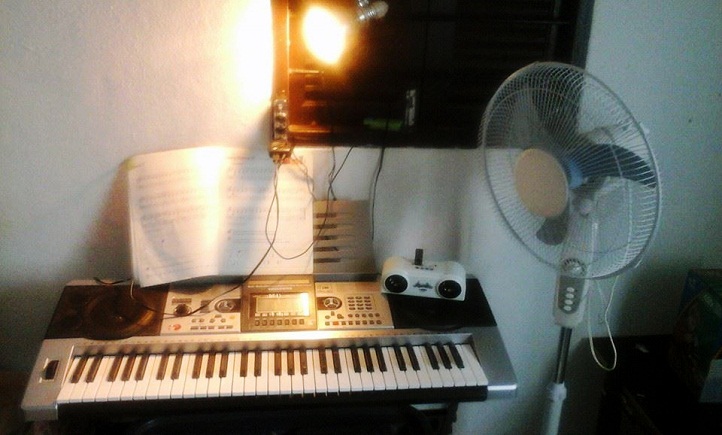
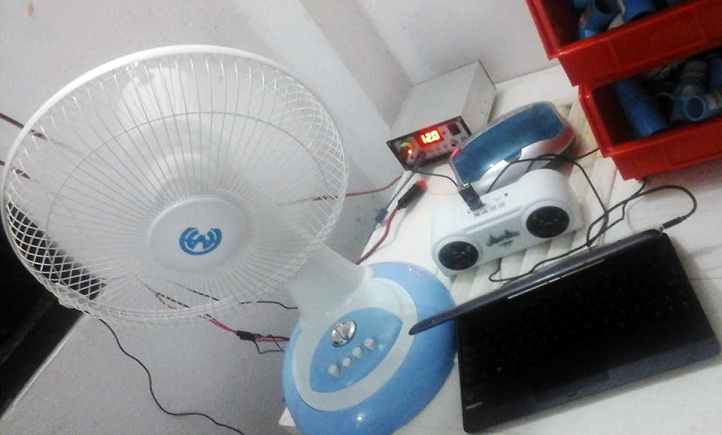
When I’m at home all day/night on a day off, for example, with my current solar system set-up, I would typically need to use 120W for a cooling fan (precisely 120 Watt-hours, which means I run a 15W fan for 8 hours); about 60W for lighting (10W LED light turned on for six hours), 20W to keep my smart phone charged and another 50W to work on my lap-top for five hours. In addition to this, I might have my picnic cooler plugged in for six hours to keep my drinks cooled, consuming a whopping 240W. I might decide to practice a few songs on my electronic keyboard for an hour too (10W for one hour).
Thus, altogether, on such a day at home, I would need to use about 500W of electricity, or about half a kilowatt of energy. And since my fully-charged battery has a capacity of about 500W (12v x 40A-hours), my storage capacity should be just enough to supply said needs, even if it were raining all day, assuming my battery was fully charged from the start.
It should be noted that my set-up was designed specifically using low-energy or energy-efficient direct-current (DC) circuits that don’t require an inverter or utilize any wasteful alternating current (AC) circuits. Keep in mind that there are a multitude of factors that would cause one to lose energy or produce/convert/store energy inefficiently, which we’ll have to get into another time. In general, one should always design their set-up with some sufficient slack/over-kill (having battery storage for a kilowatt in my case).
In any case, a journey of a thousand, million, billion, trillion steps, begins with the first, said some old wise guy. So what are you waiting for? Grab a pencil, figure out your wattage now, and start surveying for spots around your home/land that get full/optimal sun exposure. In a future column, we’ll look at different types of solar panels and batteries on the market. In the mean time, I’d love to hear from you, and be sure to read more about going off the grid in NPhuket on the author's blog.