


First, it should be noted that the electricity line running into the property is siphoned from the Soi-master's house at the front of the dirt lane some 300 meters away; as this community is technically off the official grid, the siphoned if not locally micro-generated electricity supplied to villagers is charged at between B20-24 per unit (one kilowatt-hour), compared to energy from the official grid in Phuket, which costs between B2-6 per kWh, depending on various factors (peak hours, private residence vs serviced apartment, promotional caps, for example).
I gave the 13-year-old collector boy on a moped a B100 bill and couldn't be bothered asking for change, though I regret not asking for the hand-written receipt for keepsake if not to snap a photo to accompany this article; perhaps for next month's bill which I expect to be even lower.
The truth is I've used much more than 3 kWh of electricity this past month. The 3kWh of electricity that I paid for was mostly consumed via turning on and off the AC220V, 15W fluorescent lights – on the porches, in two bathrooms, the kitchen and in my workshop. There was at least one occasion I recall plugging in the AC220V, 80W LCD TV to watch a movie with my son, and his mom plugging in her iPhone to charge a few times.
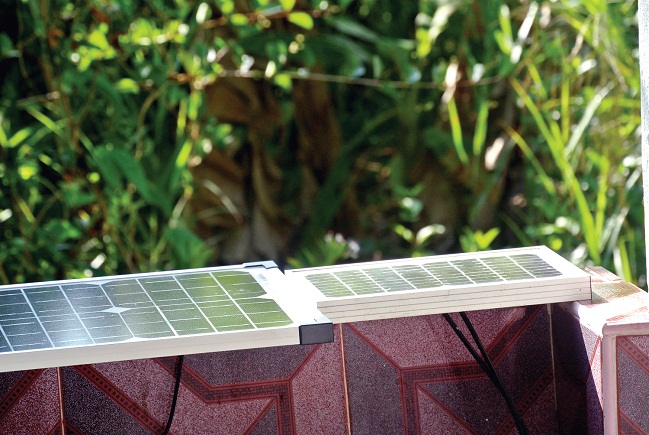
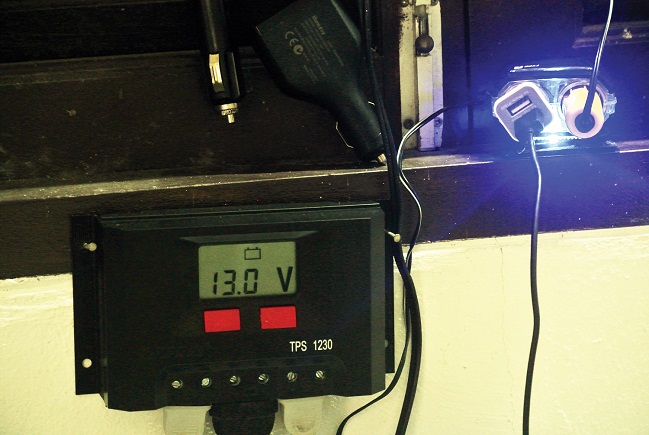
Even so, I do have some doubt as to how accurate the make-shift meter actually is. In any case, it certainly is not spinning as quick and frequent as it's used to over the past year, for most of my energy requirements are now independently generated on site, thanks to affordable access to basic, domestic photovoltaic (PV) solar technologies and systems – solar panels, deep-cycle batteries, charge regulators and the respective direct current (DC) circuits.
On any given working day, in which I'm home from work by 8-9pm and there through to the early morning, I estimate I use as much as 500 watt-hours (Wh). And, on a day off in which I'm home for a better part of the day, I might use up to one kWh. Thus, I reckon I've used some 15kWh from my own grid throughout the past month, but probably no more than 20kWh. Comparing this figure to my latest electricity bill, I can deduce that I’m currently 80-90 per cent off the Phuket grid. One year ago, it was opposite and I was 90-95 per cent on the grid.
In a near-future column, I’ll share with you an overview of my energy consumption for all my water pumping, lighting, cooling and multimedia, including rough calculations in watts, along with observations and other notes from my transition over the past year, and other challenges/steps I face in the near future.
- The right solar panel for you -
Oh, before I forget, in the last column I promised to tell you about the different types of solar panels on the market. This topic can be pretty technical and complex, and there is plenty of information on the internet explaining everything to the finest detail, but for this space, I’ll try to keep things simple.
Basically, there are three types of PV solar panels you can find in Phuket or elsewhere in Thailand for that matter: 1. monocrystaline, 2. polycrystaline and 3. thin-film. Generally, monocrystaline panels are the most expensive, but also most efficient in terms of space-use and energy-conversion. Likewise, polyscrystaline and thin-film panels are cheaper, but less efficient, so they take up more space to achieve the same wattage of a monocrystaline panel.
Thus, the most important factors to determine which panels are best for you are:
A)budget and
B)space.
If you have limited amount of space, but not worried about costs, then monocrystaline is better.
But if you don’t have a big budget but lots of space, then you might want to consider polycrystaline or thin-film types. You will need to determine where you will place your panels – an area that gets the maximum amount of exposure to the sun being most ideal.
Also, if you haven’t read my last article about calculating your energy needs, then be sure to catch up, and stay tuned for the next column, when I’ll share some of my own calculations. Watch this space.
A version of this article first appeared in “A path to energy independence in Phuket: forming the foundations” published on the author’s blog, Siamerican.com