


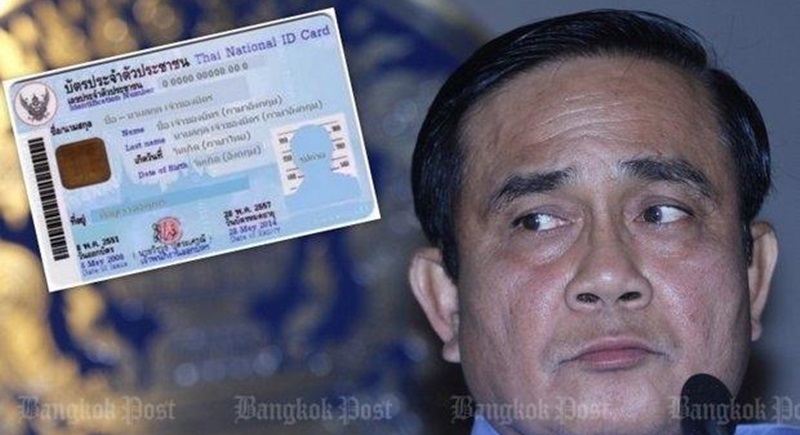
The saga was set off when Prime Minister Prayut Chan-o-cha said at the weekend that wage and job data should be included on Thai ID cards by 2017 to help the government improve the way it spends money on low-income earners.
Some claimed it was an infringement of privacy and a violation of human rights and argued people’s salaries and occupations are personal and should not be displayed on ID cards, even to electronic readers.
Responding to the uproar, Interior Minister Anupong Paojinda said yesterday (Dec 14) such information would only be included in an internal ministry database as part of the government’s efforts to provide low-income earners with better access to free or discounted government services, including public transport and utilities.
He insisted that use of the data would not violate people’s rights or privacy and the extra information was being collected solely for the public interest.
Despite previous indications to the contrary, it would not be visible on the cards.
The minister said Gen Prayut first proposed earlier this year the idea of embedding details about salary levels and occupations in microchips included on all recently made Thai ID cards.
He argued it would help the government determine the number of poor people more precisely and target subsidised public services, such as free bus and train fares, to specific areas.
It also would save the state money, help lower the tax burden on the poor, and improve the government’s taxation system.
Also yesterday Gen Prayut was forced to defend his idea, saying it would help the government work out its budget and aim subsidies at low-income earners, which would be fairer to all taxpayers.
Many were concerned the disclosure of such information could spur discrimination and put people at risk of exploitation by criminals.
Gen Prayut said the wage and career data would not be shown on the ID cards, but would be stored in a government database.
He insisted he did not see how it could violate privacy or cause embarrassment.
“How can it be embarrassing? I want to differentiate [between low income earners and high-income earners]. This is not about class discrimination.
“We want people to gain access to public services more efficiently,” he said.
In a street interview, Panthipa Jaikwang, 36, a shop owner on Chaengwattana Road, said she disagreed with the premier's idea.
“My earnings differ from month to month, so how could you calculate my exact income? I see no point in putting these personal details on the ID card,” she said.
Ms Panthipa also said cabinet ministers should try out the idea first.
“If this idea is so good, the ministers should do it first. They should put their salaries and professions on the cards and see how they feel.”
Jareeporn Nalwbut, 29, an office worker from Nonthaburi province, also disapproves of the idea.
“I would feel uneasy if anybody knows my monthly salary. Even my close friends do not really know how much I get paid per month,” Ms Jareeporn said.
She said the government can easily provide services and help citizens without having to acquire individuals’ personal information.
However, Jirawat Truanboot, 40, a lottery vendor in Bangkok, welcomed the idea if it could help lower-income citizens access free public transport easier.
“I don’t mind if the ID card shows my income as long as I get free services from the government,” he said.
Read original story here.