


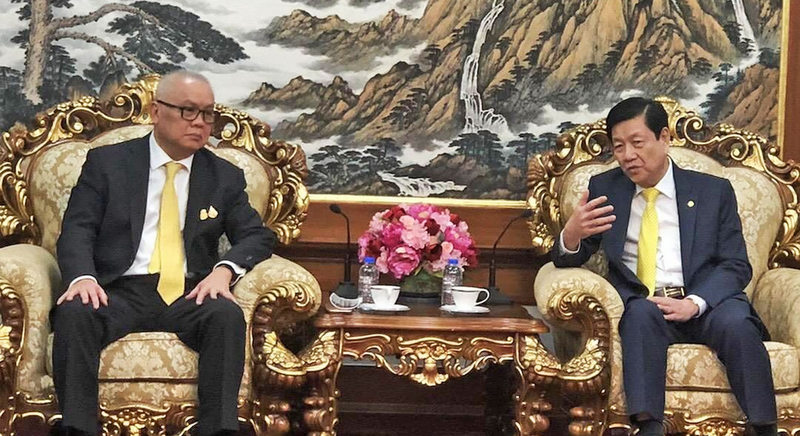
Narongsak Puttapornmongkol, president of the Thai-Chinese Chamber of Commerce, said China’s economy is on a path to a strong recovery and this could benefit Thai exports and Thailand’s overall economy.
According to Mr Narongsak, China’s economy returned to growth in the second and third quarters, rising 3.2% and 4.9%, respectively.
The positive economic data followed the first annual decline in decades in the first quarter, when Chinese GDP fell 6.8% as the country saw nationwide shutdowns of factories and manufacturing plants.
“If the Thai government speeds up improving investment regulations to facilitate foreign investment and property purchase, notably for Chinese investors, I am confident it will effectively draw foreign investors, including those from China, to invest in the Eastern Economic Corridor [EEC] and in the property business in Thailand,” Mr Narongsak said.
He urged the government to beef up promoting connectivity between China’s Belt and Road Initiative and Thailand’s flagship EEC project and elevate the relationship between the two countries in terms of trade and investment.
Mr Narongsak called on the government to extend investment privileges to cover more industry categories and attract more foreign investors, noting that many industry categories have yet to enjoy investment benefits offered by the Board of Investment (BoI).
He said the chamber is also awaiting a clearer policy on immigration incentives for foreign investors. Foreign investors are still required to stay in state quarantine for 14 days.
“Chinese investors remain keen to invest in Thailand,” Mr Narongsak said. “About 1,000 Chinese investors are waiting for permission to enter Thailand to pursue their business in Thailand, mainly in rubber, paper and plastic, and property businesses.
“Among them are two Chinese companies with B10 billion in investment plans each to invest in smart cities in Chachoengsao and Chon Buri. They have already bought 3,000 rai of plots in Chachoengsao and 700 rai in Chon Buri to develop smart cities to supply to investors in the EEC.”
According to Mr Narongsak, Thailand is still a target destination for Chinese investors, as indicated by investment applications approved by the BoI in the first half that saw China rank No.1 in terms of investment applications approved.
The BoI approved investment applications for 96 projects worth B35.4bn owned by Chinese investors in the first half of the year. Some 23 projects of the total investment are in the EEC.
Japan ranked second for BoI-approved projects with 119 projects worth B34.4bn. Third was Taiwan with 46 projects worth B13.4bn.
Japanese investors ranked first in terms of the number of investment applications seeking BoI privileges in the first half, with 99 projects worth B22.6bn, followed by China with 95 projects worth B17.5bn and Singapore with 55 projects worth B10.6bn.
In 2019, the BoI reported that Chinese investment applications surpassed those made by Japanese companies for the first time, worth almost four times as much at B262bn.
Japanese investment applications totalled B73.1bn, while Hong Kong investors were in third place with a value of 36.3bn.
Chinese investors applied for investment incentives to avoid the continued US-China trade war.
Of the total investment applications from China, roughly B160bn were for projects in 12 targeted industries and general sectors, while B101bn was for the high-speed railway linking three big airports.
The BoI said total investment applications in 2019 stood at B756bn from 1,624 projects. This value was 16.2% lower than 2018 applications, which were worth B902bn.
Despite the pandemic, Mr Narongsak said he remains upbeat that two-way trade between Thailand and China can reach US$140 billion in 2021, up from $91.7 billion in 2019.