


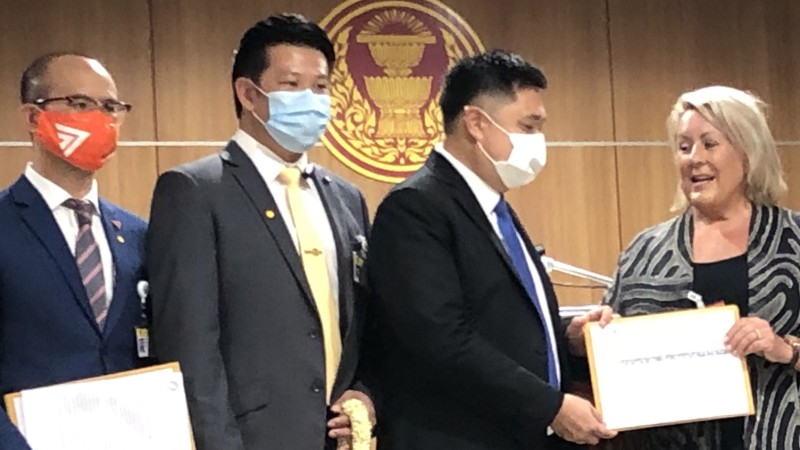
“The future for elephants in Thailand looks extremely grim. In order to make a few baht, the mahouts may take their elephants back to begging in the streets or other cruel and degrading activities,” said Ms Field yesterday in presenting her petition to Sorachat Suchit, Vice President, Commission on Land, under the Ministry of Natural Resources and Environment.
“Do these magnificent animals, your national symbol, deserve this? I don’t believe they do,” she added.
If the desperate situation deteriorates further and elephants begin to starve to death, the impact on Thailand’s tourism industry would be extremely negative, Ms Field pointed out.
Ms Field had two specific requirements:
- Immediate and regular financial aid to help these elephants, their mahouts and families to have food and shelter – particularly in this critical time.
- To consider issuing a law to protect elephants – to keep them safe and protected.
Closing her presentation, Ms Field said, “I respectfully ask you to use your influence – and your hearts – to demonstrate your reverence for the elephant, your national symbol. Please do not leave them starving and suffering.”
Dire concerns for the welfare of elephants in Phuket were raised in late March, when all zoos and elephant camps were closed as part of the restrictions imposed to prevent the spread of COVID-19.
“The mass closure of the elephant camps in Phuket has left hundreds of elephants in danger of being chained up continuously at the camps,” said Louise Rogerson, who was instrumental in setting up the Phuket Elephant Sanctuary, the island’s first full no contact elephant reserve.
Ms Rogerson has worked with captive elephants in Thailand and Cambodia for over a decade and successfully spearheaded campaigns for their welfare and release and established the Elephant Asia Rescue and Survival (EARS) Foundation. She is now the Project Director of the recently founded Tree Tops Elephant Reserve in Phuket.
More dire is the concern that many elephants will suffer severe malnutrition from lack of food as owners will not be able to buy food for them, with no tourists paying for the privilege of feeding the majestic animals, Ms Rogerson also noted at the time.
In Phuket alone, the order to close the camps and the lack of tourists placed about 280 elephants at risk, she said.