


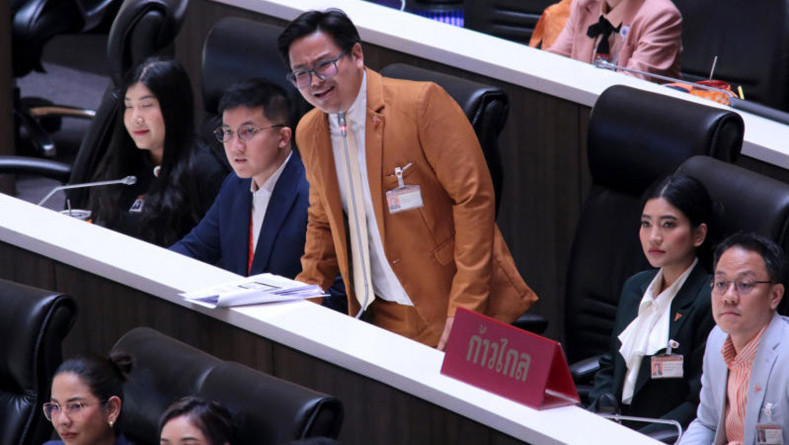
On the second day of the debate on the budget bill for 2024, Aekkarat Udomamnuay, a Move Forward Party (MFP) MP for Bangkok, said the ruling Pheu Thai has a policy to reform the armed forces to ensure they are professional and replace the mandatory conscription with voluntary recruitment, reports the Bangkok Post.
“But when I look at the Defence Ministry’s budget allocations, I wonder whether the armed forces will be able to reshape themselves,” he said.
He said the Defence Ministry has requested B198 billion, an increase of B3.8bn from the 2023 fiscal year.
A breakdown of budget spending shows that spending on military personnel has increased every year by 55%, and in particular, the army has spent about 64% of the total budget, he said.
“Is the Defence Ministry trying to expand the size of the armed forces? Is this running counter to its plan to downsize the military,” Mr Aekkarat said, adding that the spending on military personnel includes allowances and uniforms.
According to sources, the Defence Ministry’s budget allocations were often slashed during past economic crises.
During the 1999 financial crisis, the ministry’s budget for that year was cut by 21% from the previous year, and during the COVID-19 pandemic, its budget for 2022 was slashed by 6% from the year earlier.
However, while the current government says the country’s economy is still in bad shape, the Defence Ministry has sought more than B198bn, up 2% from about B194bn the previous year, according to the sources.
Mr Aekkarat went on to say that a budget allocation of B565 million for position allowances for military personnel never goes down, adding that there are more than 2,000 generals at the Defence Ministry who are equivalent to directors-general at other agencies
However, each ministry has only about 10 directors-general, he said. “Is this really Pheu Thai’s policy to downsize the armed forces?” he again questioned.
Mr Aekkarat also criticised the Defence Ministry’s secret budget, saying the law does not allow parliament to scrutinise this budget.
Chayapol Sathondee, an MFP MP for Bangkok, noted that the Defence Ministry’s budget spending on arms procurement has been slashed by B2.4bn mainly because the ministry has opted for “a small down payment and a long-term instalment plan”.
Mr Chayapol said that in the 2023 fiscal year, the ministry paid a 13% down payment on arms purchases and a 9% down payment in the 2024 fiscal year.
However, the government will have to pay long-term debt worth B57bn, double the amount in 2023, he said.
Romdon Panjor, an MFP list MP, focussed on the budget for addressing the unrest in the deep South, saying about B25bn has been earmarked for the issue, up 6.5% from the previous year. He suggested reducing the budget by more than B1bn.
Mr Romdon added that more than B5bn has been set aside for the Internal Security Operations Command (Isoc).
Of that amount, more than B3.5bn might be linked with “ghost” personnel who never worked in the region, he claimed and asked Isoc to provide an explanation.
Responding to the opposition’s criticism, Prime Minister Srettha Thavisin said that the unrest in the deep South has eased due to efforts from all sides.
“I believe that Isoc also shares the aim of restoring peace to the region. I am also ready to accept opinions regarding Isoc’s budget spending for consideration,” Mr Srettha said.
The budget bill seeks B3.48 trillion. It was supposed to take effect Oct 1, but it was delayed some months following the election so the coalition government could find its feet first.
The debate ended yesterday, and a vote will be held today before a 72-member House committee is formed to vet the bill.
As of press time, no government MPs or cabinet ministers responded to the opposition’s criticism over the issue of the military downsizing.