


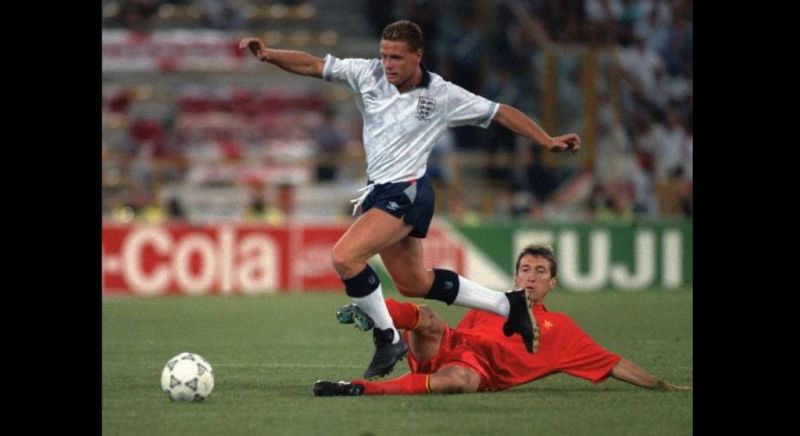
Paul John Gascoigne was undoubtedly the greatest English footballer of his generation; sublimely talented, fearless, unpredictable, an audacious entertainer and maverick who played with an infectious joy and smile on his face that epitomised a geunine passion for the game.
Unfortunately, like many gifted artists in a variety of fields, the highs were frequently shattered by devastating low spells. Gazza would suffer career-threatening injuries, life-threatening battles with alcohol and drug addiction and a series of mental health issues. Most people know his story and, over the years, have formed their own opinions on the jovial Geordie, be they positive, negative or neutral. However, in his prime Gazza transcended the game of football and stood as a shining light, a beacon of hope and a spearhead of positive change.
The 1980s was a tumultuous decade in much of the world, and certainly in England. Socially and politically the country was near breaking point, with the likes of the Falklands War, minor strikes, race riots and the poll tax bill just a handfull of issues dividing a nation governed by the ‘Iron Lady’ Margaret Thatcher. The mood was often one of agitation, frustration, anger and revolt.
Much of this civil unrest overflowed into sport to define a period when English football was well and truly in the doldrums. Widespread and frequent hooliganism had seen English clubs barred from European competition and, sadly, lives lost as violence became commonplace. English football and its associated fans were seen as pariahs. Unrelated, the Hillsborough disaster of 1989 saw a fatal human crush during a football match where, ultimately, 97 people lost their lives.
Going into the 1990 World Cup in Italy, it’s safe to say the state of the beautiful game in the country that invented it was at its lowest ebb, well and truly on its knees. Sentiment surrounding the national team didn’t fare much better with little or nothing expected going into the tournament and the manager Bobby Robson a frequent victim of character assassinations and vitriolic attacks by a blood-hungry media.
Beacon of hope
However, the tournament was to become a defining point in British history, and not just on the football pitch. After a slow start, England eventually made their way to the semi-final in an enthralling manner and the impact it had back on English shores was profound. They often say sport has the power to unite and galvanise divided or disallusioned communities and nations, and that is exactly what England’s football team during the summer of 1990.
At the heart of the team was Gazza. He had only just made the cut for squad selection but he became the team’s talisman, its maverick who wowed fans and bamboozled opponents. A shining beacon of hope, he epitomised promise, progress and the possibility of brighter days ahead. Although a master craftsman in his field, he didn’t take life too seriously, eschewing the age-old notion of the stiff upper lipped Englishman who dared not show any emotion. Bobby Robson labelled him “daft as a brush” and he certainly appeared to be so. His on field displays and chesire cat grins in celebration after each game lifted the spirit of a nation and allowed people to be distracted from the everyday travails they faced. The everyday man and woman on the street identified with him. He was one of them.
The semi-final showdown in Turin on July 4, 1990 with bitter rivals West Germany has become the stuff of legend. Gazza had largely dictated the game, driving the team on with a fearless and spirited performance. Late in the game he received a booking for an over-enthusiastic rather than malicious challenge on an opponent. It meant he would miss the final, should England get there. His subsequent outpouring of emotion on the pitch is what many people remember him for and how he became defined in many people’s eyes. His wobbly bottom lip and tears were heart-breakingly genuine, leaving every fan in England, if not elsewhere, fully sympathising with him. To his credit, he put personal disappointment aside and continued to drive his team on to within a whisker of winning. Despite being the better team during the match, England lost the game via a dramatic penalty shoot out.
Watershed moment
The dream was over and every fan felt the bubble burst. It was a hollow, empty feeling. However, the sorrow and dismay was only temporary. Something had happened, something had changed and it felt like the beginning of something promising, as if brighter days were on the horizon; it felt OK to be positive and optimistic for the first time in a long time. It felt strange!
The England football team had shown the way, had lifted the collective spirits of a nation and Gazza was at the heart of it all, lighting up the stage brighter than any elaborate fireworks display ever could. The team returned home as heroes, with hundreds of thousands of fans greeting them at the airport and lining the streets as the team bus made its way to central London. It was truly astonishing – who knows how fervent the celebrations would have been had they actually won the thing!
That sun-drenched summer of love in 1990 where football and hope so effortlessly intertwined was a watershed moment and things did improve afterwards. The political landscape, whilst always by its very definition volatile, did stabilise and society seemed much more accepting and united, for a while anyway. Further afield, radical change was soon to come in the Soviet Union with the fall of communist totalitarianism and the end of the Cold War. The Berlin Wall had not long before been demolished and borders reunited - Germany was no longer West or East but united as one. Music was changing, experimental and exciting, which would usher in a whole new genre of electronica, rave and the Britpop era of Rule Britannia. English football had been reborn and, on a domestic level, would shortly evolve into the Premier League which has since become the richest and most admired domestic league in the world.
The euphoria didn’t last – being realistic, how could it? However, it was there for a while and it was beautiful while it lasted. Of course, there were a myriad of differing factors but the England football team’s journey at Italia ‘90 was one of the principal touchpaper moments that ignited much of this change in sentiment, certainly in England. One man certainly doesn’t make a team but it is hard not to recognise Gazza’s influential role and his importance as the master of ceremonies at the heart of this movement.
Sure, he has made some really poor life decisions since and his off field antics have been well documented. He has made many bad, foolish mistakes that he no doubt truly regrets. Who hasn’t? Sadly much of this has clouded many people’s memories of what a talent he was and what an impact he made, of what he represented. Time has a way of doing that and, of course, everyone is entitled to their opinion. However, the Gazza that shone and delighted so many back when he was doing what he did best, what he was born to do, is the version I will always remember. And that’s why I am looking forward to seeing and hearing from him when he visits Phuket this evening.
- The views expressed in this article are those of the author and not The Phuket News -