


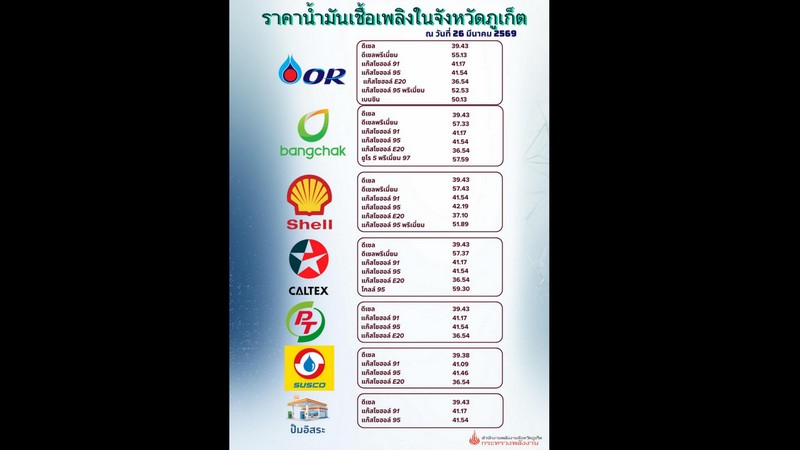
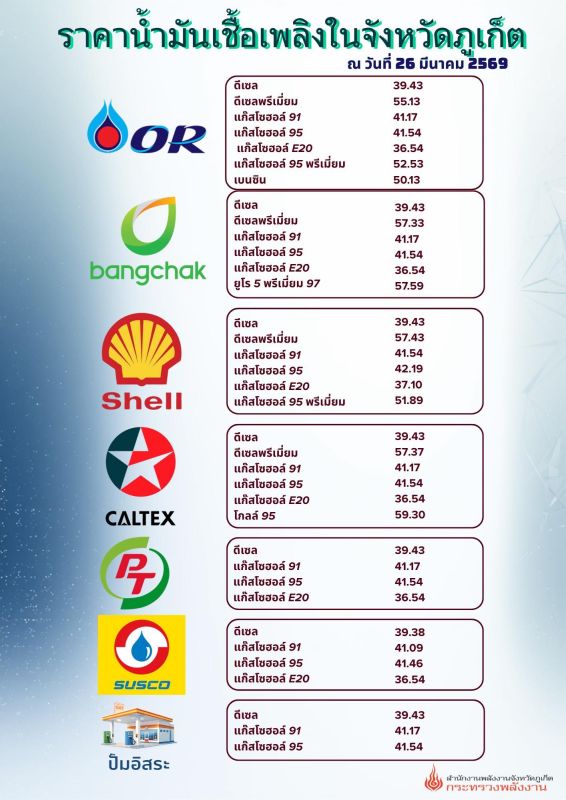
The Phuket Provincial Energy Office confirmed the new standard retail prices, reporting average rates from major service stations across the island following the nationwide adjustment.
Diesel is now selling at about B39.38 to B39.43 per litre, while premium diesel ranges from B55.13 to B57.43 per litre.
For petrol, Gasohol 91 is priced between B41.09 and B41.54 per litre, and Gasohol 95 between B41.46 and B42.19. Gasohol E20 is currently the cheapest widely available option, averaging B36.54 to B37.10 per litre. Prices for premium-grade fuels, including gasohol 95 premium and Euro 5 variants, vary depending on the service provider.
Officials noted that prices may differ slightly between stations based on operator costs and location.
Despite the sharp increase, provincial authorities have so far offered no public statements regarding the price hike beyond reiterating warnings against profiteering practices. Fuel retailers have been instructed to clearly display prices and ensure transparency in sales volumes.
Phuket officials are no longer issuing public daily reports detailing which petrol stations are still in supply of specified fuels, instead now deferring to the ‘Thai Pump Radar’ platform (click here), as promoted by Phuket Governor Nirat Phongsitthaworn on Monday.
The price hike follows a nationwide policy shift announced late yesterday, when the government ended subsidies that had been used to keep fuel prices artificially low amid rising global oil costs.
According to the Ministry of Interior, governors across Thailand have been ordered to intensify inspections of petrol stations to prevent hoarding and unfair pricing. The directive forms part of measures under Prime Minister’s Order No. 3/2026, introduced in response to concerns over potential fuel shortages linked to ongoing conflict in the Middle East.
Permanent Secretary of the Ministry of Interior Arsit Sampanrat said provincial authorities are closely monitoring fuel distribution and retail practices to ensure supply remains sufficient to meet public demand.
While the overall national supply situation remains stable, some provinces have reported temporary shortages at busy service stations, largely due to delivery scheduling delays rather than a lack of fuel reserves.
Mr Arsit noted that recent developments, including Iran allowing Thai crude oil tankers to pass through the Strait of Hormuz on Mar 24, offered a positive signal. However, he cautioned that the geopolitical situation remains uncertain, requiring continued vigilance.
Authorities have instructed provincial energy offices to submit daily reports on fuel sales and stock levels, while district officials have been tasked with verifying that petrol stations are not engaging in abnormal sales behaviour.
The Ministry of Interior has also designated Provincial Damrongtham Centres nationwide as hubs for receiving complaints and coordinating responses to fuel-related issues. Members of the public can report concerns via the 1567 hotline, available 24 hours a day free of charge.
The latest increase comes amid a surge in domestic fuel consumption, which officials say has been driven in part by large-scale hoarding. National diesel usage has risen significantly above typical levels since global prices began climbing.
Government officials have defended the decision to lift subsidies, citing the mounting financial burden. The Oil Fuel Fund reportedly spent B20 billion in just three weeks attempting to cap prices, raising concerns over long-term fiscal sustainability.
Targeted assistance measures are expected to be introduced to support vulnerable groups, including low-income households, farmers and transport operators, as higher fuel costs begin to ripple through the economy.