


Tensions involving the United States, Israel and Iran, particularly the risk of disruption through the Strait of Hormuz, have heightened concerns over oil availability and costs, reports the Bangkok Post. While Thailand maintains strategic reserves, regional leaders and businesses warn that extended conflict could test supply chains and inflate prices nationwide.
Rationing fears rise
Chaiyong Maneerungsakul, a senator for Songkhla and spokesman for the Senate Committee on Military and State Security, outlined the potential impact on southern energy supplies.
A former southern oil wholesaler, he said Thailand holds around 60 days of oil reserves, but southern depots, in Surat Thani and Songkhla, could sustain the region for only about 15 days if distribution is curtailed. He warned prolonged war could prompt rationing. Petrol stations that typically receive 60,000 litres per delivery might see allocations halved to 30,000 litres. Sales could be restricted to direct vehicle refuelling, banning bulk purchases into drums or storage tanks. Opening hours might also be reduced from 6am-10pm to as early as 6pm closures.
"For the public, there will not be a shortage of oil, but there may be an impact on price," he said. "Those affected will be oil jobbers and wholesale traders, because major oil companies will allocate supply to their own branded stations first."
Sen Chaiyong said constrained supply could revive the illicit fuel trade. "Operators need production lines to continue. It will be another big wave of non-system oil," he said, adding smuggled fuel prices would also rise. A transport industry source in the South indicated off-system diesel and petrol are selling at about B25 per litre, up from B20-21 previously, reflecting mounting demand amid economic pressures.
Tossapol Kwanrod, president of the Rubber and Palm Oil Farmer Networks of Thailand, urged the acceleration of biodiesel production. "If war is prolonged and oil shortages occur, we must urgently produce biodiesel reserves," he said, adding Thailand’s capacity to produce up to B100 in the past, before Euro 6 standards reduced blends to B7. Although palm output may not fully meet demand, he argued expansion would strengthen long-term energy stability.
Transport costs climb
In the Northeast, rising diesel prices are already biting. On Mar 4, Chaiwat Wongbenjarat, managing director of Nakhonchai 21 Co and deputy managing director of Nakhonchai Tour Co, detailed the burden on bus operators. Diesel has risen by B4-5 per litre in recent days, he said, with fuel accounting for 35-40% of operating costs. The increase is pushing overall costs up by around 10%. Should prices continue climbing, operators may seek permission from the Department of Land Transport to reduce services.
"Our costs are already higher than the current fare structure," he said, calling for targeted state assistance, such as fuel price controls for bus operators or reduced import duties on spare parts. Nakhonchai 21 runs 58 daily return trips between Nakhon Ratchasima and Bangkok, while Nakhonchai Tour operates routes linking the North, North-East and Central regions, including Chiang Mai and Mae Sai.
Local businesses are also stockpiling. Oranuch Deeduaychat, 38, who runs a cassava pulp yard and animal feed production facility in Nakhon Ratchasima, ordered staff to refuel tractors, loaders and lorries to capacity and filled reserve tanks with around 1,000 litres in a single day. Diesel locally stands at B30.36 per litre, despite the government capping the price at B29.94.
"I do not know how far the fighting will affect prices here," she said, adding her reserves may last a week. Beyond that, sustained increases could force her to raise product prices to survive.
Panic buying spreads
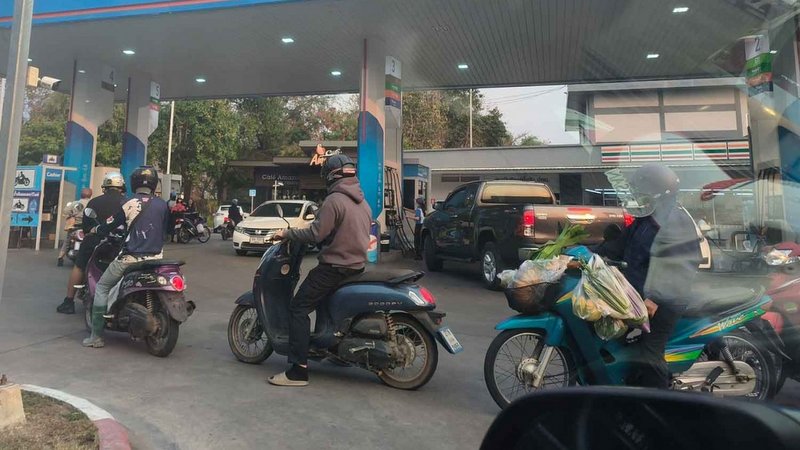
In Chiang Mai, queues formed at petrol stations from early yesterday morning (Mar 4) as residents rushed to fill tanks amid fears of shortages. The anxiety persisted despite assurances from Prime Minister Anutin Charnvirakul that the Energy Ministry was monitoring the situation.
Several stations displayed signs indicating certain grades, particularly E85 and E91 (Gasohol 91), were temporarily unavailable. Long lines were reported across urban districts, with many motorists refuelling before work as a precaution against potential scarcity.
Governor Nirat Pongsitthaworn instructed provincial commerce officials and weights and measures authorities to intensify inspections, preventing hoarding or opportunistic price hikes. "It is difficult to forbid panic in such circumstances, but maintaining confidence and preventing exploitation is essential," he said.
Border supply strains
Further north in Chiang Rai, similar scenes unfolded. By Tuesday evening many stations had run out of fuel and closed early. Some reported shortages were limited to specific grades, while others suspended sales entirely.
Officials including provincial energy chief Porasak Ngamsomphak and commerce head Suphamit Tengpae inspected stations, particularly along the Thai-Myanmar border in Mae Sai and Mae Chan districts. Operators confirmed fresh deliveries were expected from yesterday morning.
Across the border in Tachileik, Myanmar, prices surged sharply. Bottled fuel that had sold at B100–200 for 1.5 litres earlier in the day rose to B250 by evening, with volumes reduced to 700 millilitres, reflecting speculative trading. Many Chiang Rai motorists opted to fill entire tanks rather than purchase usual amounts.
While Thailand’s oil reserves offer a buffer, the unfolding Middle East conflict has exposed vulnerabilities in pricing, logistics and public confidence. From southern depots to northern border towns, the immediate impact has been psychological as much as physical, yet sustained disruption could test both markets and policymakers in the weeks ahead.