


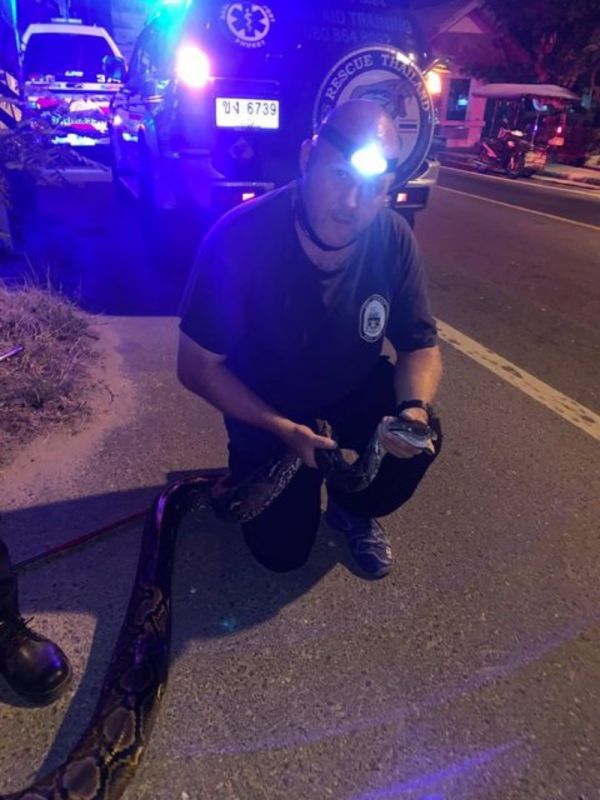

The rescue team were call to the Novotel Phuket Karon Beach Resort & Spa, near Karon Circle, at about 11pm, reported rescue worker Vinnie Modell.
“It was a big old boy. It took all my strength to lift it,” Vinnie told The Phuket News.
On arrival, the rescue team were directed to the back of the resort near the service area, where the snake was still waiting.
“They were not wrong. A beautiful four-metre python weighing more than 20kg (approximately) was having a nap behind the building,” Vinnie said.
With some help from fellow rescue workers, Vinnie soon had the python safely in hand, and the team removed it from the resort to release it back in a national park as soon as possible.
“These are beautiful snakes, the orange colour of their eyes are stunning. Although they are non-venomous, I would not attempt to remove a snake of this size alone. One wrong move and I would be in life-threatening trouble,” he said.
“The snake bites its prey with its rows of inverted teeth up-to and including 52! Then it wraps its body around slowly suffocating its prey! Yes it could easily kill me. That’s why we ideally have a minimum of two more people to help deal with it,” he said.
Vinnie gave a special thanks to Joy Hue, Paveena Hue, Joe Hue & Similan Diving Safaris for the head torch he wore in catching the snake.
“It was a real lifesaver. I would have been in trouble for sure without it!” Vinnie said.
Vinnie also related to The Phuket News his clear opinion on the announcement by the Director of the Khao Phra Thaew Natural and Wildlife Education Centre in Thalang last month that all snakes caught in homes in Phuket are to be taken off-island.
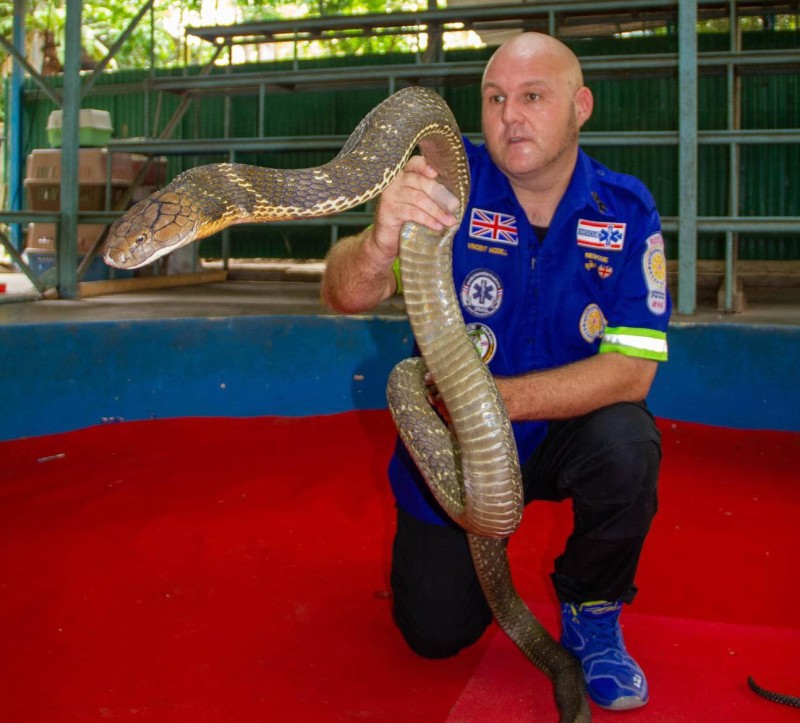
King cobras should not be removed from their natural habitat, he said.
“The king cobra is the predator snake of the snake world. They eat all the other snakes; monocled cobras and other snakes that do all the biting,” Vinnie explained.
“They do not attack people because they are just not interested in you. They know they can’t eat you, so they do not even want to waste the venom,” he added.
“Removing king cobras from the wild allows the smaller problem snakes to get bigger, to grow until they become a problem,” he concluded.