


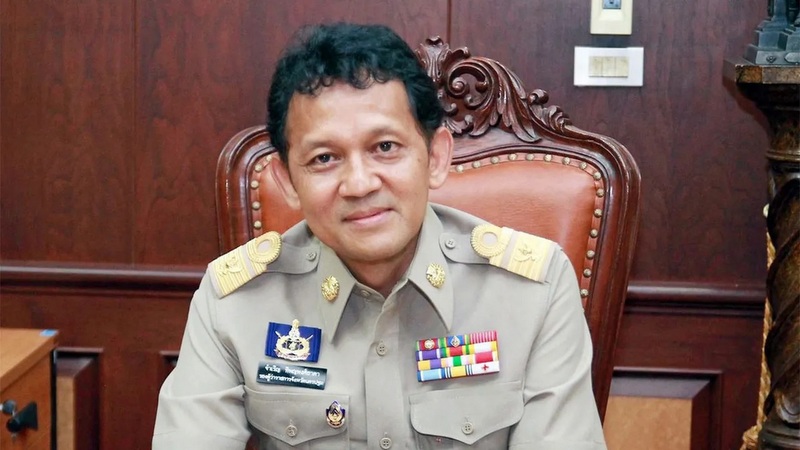
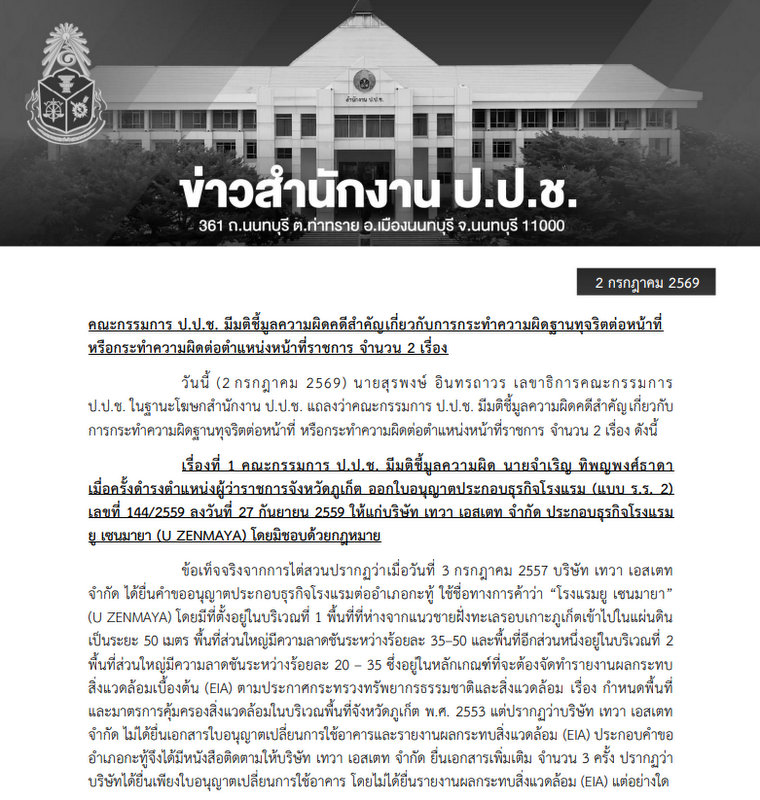
The ruling, announced on Thursday (July 2), comes more than a decade after the original licence application and less than four months after the NACC found Mr Chamroen had amassed more than B321 million in unexplained wealth while serving as a provincial governor.
The NACC has resolved to forward the case to the Office of the Attorney General (OAG) for criminal prosecution, while also recommending disciplinary action against the former governor.
The commission, however, did not explain what benefit Mr Chamroen allegedly received from approving the licence, despite concluding that his actions unlawfully benefited the hotel developer.
LICENCE UNDER SCRUTINY
The case centres on Hotel Business Licence No. 144/2559, issued on Oct 27, 2016, for a hotel project developed by Thewa Estate Co., Ltd under the name ‘U Zenmaya Hotel’, now operating as ‘Zenmaya Oceanfront Phuket’, the NACC said in its report online.
The investigation traced the matter back to July 3, 2014, when the company sought approval to operate the hotel.
Investigators found that the development fell within an environmentally protected coastal zone covered by Phuket’s environmental protection regulations introduced in 2010.
Under those regulations, projects of that scale were required to comply with environmental impact assessment (EIA) requirements before a hotel licence could legally be issued.
The NACC said the company submitted documentation relating to changes in the building’s use but failed to provide the required EIA documentation.
Officials repeatedly requested additional documents, but investigators found the developer only supplied reports describing changes in the building’s intended use rather than a proper environmental impact assessment.
LICENCE APPROVED ANYWAY
Despite those deficiencies, the licence was ultimately signed by Mr Chamroen on Sept 27, 2016 – just days before he was transferred to become governor of Nakhon Sri Thammarat.
The NACC said that before leaving Phuket, Mr Chamroen instructed subordinates to expedite pending matters requiring his approval.
The hotel licence application was subsequently presented to him together with a memorandum outlining the facts of the case, including notification that the application required an Environmental Impact Assessment report.
Despite being informed of that requirement, Mr Chamroen signed the hotel licence and authorised the business to begin operating, the commission said.
The NACC concluded that he cooperated with Thewa Estate Co Ltd in issuing the licence without complying with the Hotel Act and relevant Ministry of Interior regulations governing hotel licensing.
The commission further found that the approval provided an unlawful benefit to the company.
However, the announcement stopped short of identifying what, if anything, Mr Chamroen personally received in return for approving the licence.
CRIMINAL CHARGES
Following its investigation, the NACC resolved that Mr Chamroen should face prosecution for malfeasance in office under Section 157 of Thailand’s Criminal Code.
The commission also found grounds for offences under Thailand’s anti-corruption legislation and said the complete investigation file, together with evidence and its ruling, will now be forwarded to the Office of the Attorney General for prosecution through the courts.
Separately, the investigation report will be submitted to the appropriate disciplinary authorities for action under the Organic Act on Prevention and Suppression of Corruption.
An OAG review is required before any criminal case proceeds to court.
Like all criminal defendants in Thailand, Mr Chamroen remains presumed innocent unless and until found guilty by a final court judgment.
LONG-RUNNING CASE
The decision concludes an investigation stretching back more than 10 years from the original hotel application and almost a decade since the licence was issued.
The licence was approved only days before Mr Chamroen left Phuket after serving as the island’s 46th governor from October 2015 until the end of September 2016.
He subsequently served as governor of Nakhon Sri Thammarat, Phang Nga and Satun provinces before resigning from government service in 2023.
SECOND MAJOR NACC RULING
The latest decision is the second major corruption ruling involving Mr Chamroen this year.
In March, the NACC announced that investigators had found he accumulated B321.67 million in assets that were disproportionate to his legitimate income while serving as governor in several provinces.
According to the commission, the unexplained assets included bank deposits, luxury vehicles and dozens of land and property holdings registered in the names of Mr Chamroen, his wife and a minor child.
The NACC ruled that the wealth could not be lawfully explained and resolved to ask the Office of the Attorney General to seek a court order confiscating the assets and transferring them to the state.
That investigation covered his tenure as governor of Phuket, Nakhon Sri Thammarat, Phang Nga and Satun, as well as his broader career in government service.
The asset seizure proceedings and the criminal prosecution over the Zenmaya hotel licence are separate legal matters, although both stem from investigations conducted by the anti-graft commission.
If prosecutors accept the latest case and proceed with criminal charges, Mr Chamroen will face allegations that, while serving as Phuket governor, he abused his authority by approving a hotel licence despite being aware that the development had not met the environmental documentation required under Thai law.