



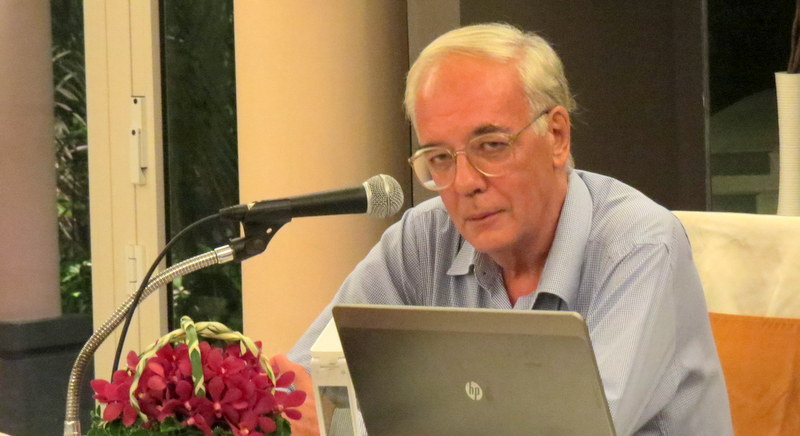
Mr Catterwell, well versed and much respected for his opinions in Thai political affairs, noted that he was one of many such people called in to provide comments and suggestions on the drafting of the nation’s charter.
“Many people are being asked to provide their input, including journalists. Perhaps not the journalists you might see in the news, but journalists, too, are being asked for their opinions,” he said.
Mr Catterwell’s presentation was based on his comments prepared for the Office of the Permanent Secretary, Ministry of Defence, which in turn was based on the English translation provided by the Council of State as recently as April 17.
After a brief review of Thailand’s history of swift changes of government and the periods immediately thereafter, topics of review covered 21 points in total, from freedom of information, the selection and composition of elected and non-elected representatives at the national level, police reform and the overseeing of the civil service.
In all, Mr Catterwell rated the coup “about 7.5”. Throughout Thailand’s history, some coups needed to happen, he noted. “Of these, the eventual outcomes of some were good, others not so good. This coup needed to happen, but we have yet to see where it goes,” he said.
Asked after his presentation to offer an overall view of the progress made so far in creating the draft charter, and the confidence it might inspire, Mr Catterwell said that, in short, much has yet to be done.
“It would be most helpful to see a detailed master plan, or envisaged navigation routes towards a master plan, of what is envisaged,” he wrote in his notes.
“The Provincial Administration Organisation (PAO) and the Tambon Administration Organisation (TAO) are nowhere mentioned.”
And other sections, such as the freedom of information clause enshrined in the previous constitution, have yet to be introduced in the draft of the new one.
Yet, asked if the move was tending toward a more centralised or decentralised form of governance, Mr Catterwell said, “It’s moving toward decentralisation – it has to.”
Of serious concern was the provision allowing for a future prime minister to call for a “vote of confidence” and, if passed, leaving the head of the government unencumbered until at least the next session of parliament.
Similarly, the provision for the automatic passing of laws, under which that if a law were proposed and suffered no objection within a predefined period, the law would be passed without delay – posed another serious concern.
“If a bill is presented and there is no objection while people are still debating it, then I would say to hold that law back until it has been discussed thoroughly and people were ready to vote on it, not pass it through,” Mr Catterwell explained.
“I have yet to hear if they have taken up this suggestion,” he added.
Of all the reforms, however, Mr Catterwell rated police reform a top priority, while calling for the ambit – and the budget – of the National Counter-Corruption Commission to be expanded.
He also called for clearer definitions of responsibility and areas of accountability for ministers.
“This draft constitution adds little in terms of public oversight, audit or corruption investigation of the civil service as a whole. Much more effort needs to be exerted in this area,” Mr Catterwell noted.
“In this connection and taking a simplistic view, I sift coups in Thailand into two categories: “Power Struggle Coups” and “Fix it Coups”. The 2014 coup, in this interpretation, is Thailand’s fifth ‘fix it’ coup…
“My simple litmus test for whether the 2014 coup was successful or not is whether Thailand as a result ends up with an effective police force.
“Had the police force been effective and respected since about 2001, there would be no issue of reconciliation. If the Army would like to avoid future coups, kick start meaningful police reform right now. Law, Order and Justice are meaningless without an effective and respected police force.”
Suggestions for future topics of BCCT speaker events were solicited from those present at the event. Topics offered included tourism, taxation, the Labour Protection Act and the formation of the Asean Economic Community at the end of this year.
For more information or to ask about or offer suggestions for upcoming events, email greg@bcct.com