



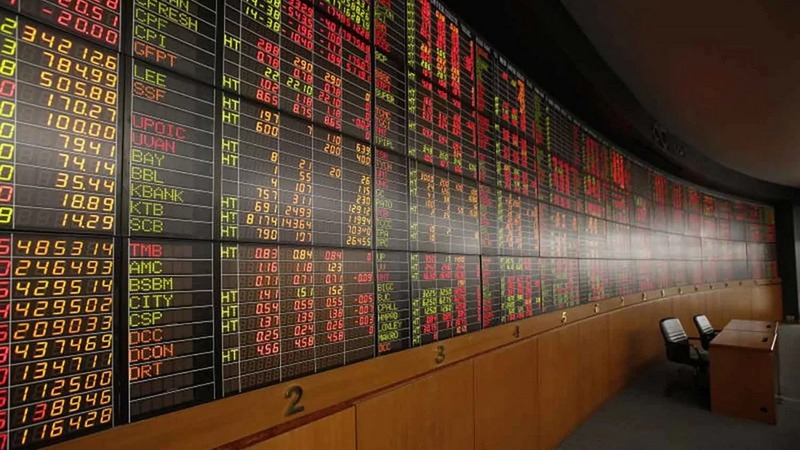
The sustained sell-off was driven by the prolonged trade war, geopolitical tensions and US tariff measures, while investors remain cautious the Federal Reserve may delay its interest rate cuts, a move that could weigh on risk appetite across emerging markets, reports the Bangkok Post.
Foreign investors were net sellers of B4.5bn of Thai shares in October, bringing the total net outflow to B101bn for January to October, said Soraphol Tulayasathien, senior executive vice-president of the SET.
Foreign investors accounted for 51.8% of total trading value, followed by local individual investors at 31.8%, local institutional investors 9.77% and proprietary trading 6.62%.
The average daily trading value of the SET and Market for Alternative Investment (MAI) was B39.4bn last month, down 27.9% year-on-year, with a year-to-date trading value of B42.6bn.
Despite the decrease, the Thai index gained 2.8% from a month earlier to finish at 1,309.5 points at the end of October.
"The upward momentum gained additional support in late October as US-China trade tensions eased following the Apec meeting in South Korea and the Fed’s decision to trim interest rates by 25 basis points to a range of 3.75-4.00% to buffer against economic risks," said Mr Soraphol.
However, analysts maintained a cautious tone on long-term global economic prospects, citing uncertainties around shifting trade and monetary policies, technology-related risks and inflated artificial intelligence stock valuations, and the elevated public debt level, he said.
Locally, market sentiment was supported by government stimulus measures that delivered quick wins with measurable economic impact, effectively boosting household incomes, said Mr Soraphol.
Strong export and tourism data also lifted profit forecasts for listed companies across multiple industries, he noted.
Seasonal trading patterns may support the market in the year-end period, as long-term equity fund redemptions typically subside while tax-saving Thai ESG funds tend to attract increased inflows in November and December.
During October, three companies floated shares on the SET while two firms debuted on the MAI. This year 15 companies have gone public, with six of which posting share prices falling below initial public offering (IPO) levels on the first trading day, "reflecting investor caution amid market volatility", said Mr Soraphol.
SET president Asadej Kongsiri said the exchange continues to strengthen information disclosure requirements to help investors assess IPO valuations based on company fundamentals before making investment decisions.
Several IPOs were postponed this year due to unfavourable economic conditions and market volatility, while ongoing efforts to enhance market liquidity will take time to yield results, he said.
The SET’s forward price-earnings (P/E) ratio was 12.2 times at the end of October, lower than the Asian average of 14.6 times, while the historical P/E ratio was 16.7 times, also below the regional average of 17.0 times.
The Thai bourse’s dividend yield of 3.76% remained higher than Asia’s average of 2.96%, reflecting solid fundamentals despite subdued valuations.