


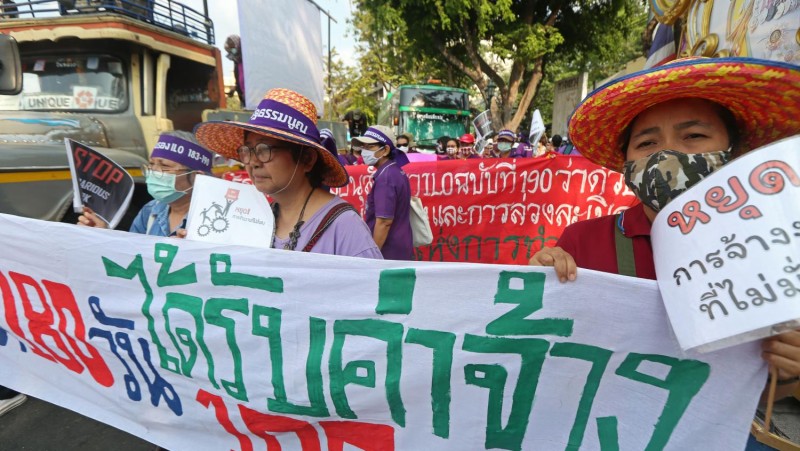
Kalin Sarasin, Chairman of the Thai Chamber of Commerce, said up to 7mn workers have been laid off so far, with figures likely to reach 10 million over the next few months if the pandemic continues.
“We hope the number of laid-off workers will not surpass 10mn,” he said.
The chamber is asking the government to rev up relief measures for the business sector.
Mr Kalin and business leaders attended the first meeting of the advisory committee chaired by Thosaporn Sirisamphand, Secretary-General of the National Economic and Social Development Council (NESDC).
Prime Minister Prayut Chan-o-cha on Apr 8 ordered the formation of the advisory committee, with 13 members from the public and private sectors to hear suggestions about the government’s existing measures and how to best apply the B1 trillion in loans to be secured from the recently issued royal decree to optimise benefits for companies and employees.
The government hopes the private sector proposes additional opinions about relief measures for the pandemic and a rehabilitation plan for the economy after the deadly virus ends.
NESDC plans to hold advisory committee meetings every one to two weeks before submitting proposals to the prime minister.
On Monday the private sector presented 12 proposals, including one to allow the private sector to use expenses spent to curb the spread of the pandemic to claim deductions of up to three times; to exempt corporate income tax for SMEs for two years and lower corporate income tax for other business operators at not more than 20%; to allocate a budget to create or retain employment and goods purchase from domestic producers; and to allow employment on an hourly basis at B40-41 per hour for about four to eight hours per day.
They also requested the government lower contributions on the part of employers to the Social Security Fund to 1% from 4%; devise financial assistance for employees with a monthly salary of up to B15,000 to have the government contribute 50% of monthly wages and companies pay 25%; and to allow the private sector to use expenses spent on labour during the outbreak to claim deductions of up to three times.
Mr Thosaporn said the next meeting of the advisory committee is scheduled for Monday, during which a decision on the proposals will be made before they are forwarded to Gen Prayut, then on to the Cabinet for approval.
Preedee Daochai, Chairman of the Thai Bankers’ Association (TBA), said the private sector hopes the government will offer lenient conditions that allow all small and medium-sized enterprises (SMEs) easy access to the B500 billion in soft loans approved last week.
Last Tuesday, the Cabinet passed an executive decree allowing the Bank of Thailand to extend B500bn in soft loans at 2% annual interest for two years with a six-month interest-free period to SMEs for a credit line of no more than B500mn each.
Commercial banks and specialised financial institutions will also offer six-month deferment periods for SMEs with a credit line of up to B100mn each.
“The latest aid measures for SMEs may not work as expected as long as commercial banks require collateral to extend these loans,” Mr Thosaporn said. “The private sector will later propose how all SMEs can access these soft loans.”
Suphachai Chearavanont, chairman of the board for True Corporation, said the world will witness complete change after the pandemic, adding he plans to propose the government implement digital solutions for businesses, education and state services.
“Digital technology should be supported for business, startups and education,” he said. “E-meetings should be allowed at both domestic and overseas levels, while the security of online services should be promoted and upgraded.”
Applications should be designed to prevent people from going to at-risk locations, said Mr Suphachai.
Read original story here.