


“The rate should not be over 7 per cent, which is why we have launched this programme.”
The Public Health Office is operated by Phuket Town’s municipal government, which, among other things, is responsible for overseeing the health of students attending the city’s seven municipally-run schools.
Viewed from a certain angle, the doctor’s programme is nothing less than a blow against Neo-Liberalism’s most hallowed tenet: that the market is always right.
However, Dr Tasanee is not trying to effect economic or political revolution; she merely wants to change how people, especially kids, eat and play, to make them healthier and happier as they grow, and thereby reduce the public sector’s medical burden.
It sounds disarmingly non-controversial: eat healthy, exercise and ipso facto live longer; what could be simpler? In reality however, she is finding it rather hard...
In order to meet her goals she must confront market forces head on, for the distressing fattening-up of society is apparent across culture, age, educational and income groups; it transcends national boundaries. It is occurring, not because of “fat genes” but because people like fattening foods and because marketing necessarily indulges consumer tastes.
So Dr Tasanee is fighting the momentum of popular desire, and, wonder of wonders, she’s having a bit of success.
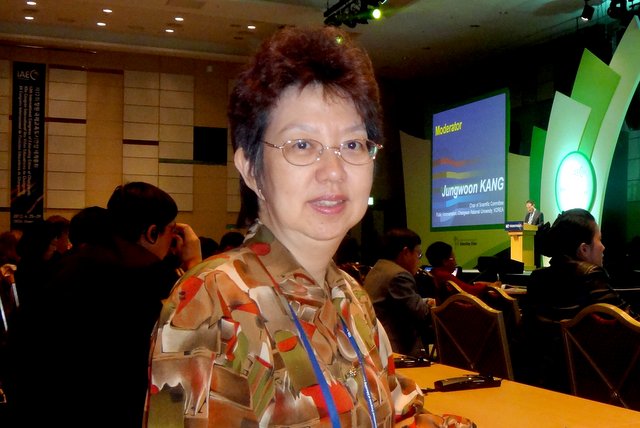
At the end of April, a delegation from Phuket – including the doctor, Mayor Somjai Suwansuppana and Vice-Mayor Khawee Tansukatanon – were invited to talk about the city’s anti-obesity crusade at the International Congress of Educating Cities organised by the city of Changwon in South Korea.
For 12 years Changwon has held workshops on a variety of matters interesting public administrators. The topic for this year’s congress was Green Environment and Creative Education.
Dr Tasanee delivered a paper to representatives from some 451 cities on Health Impact Assessment in Relation to Childhood Obesity wherein she outlined the city’s seven-point “Five-Star” programme to tackle fat kids:
Increase consumption of fruits and vegetables at lunch-time;
Replace soft drinks with plain milk and low-sugar drinks;
Eliminate the sale of deep-fried foods;
Increase the number of healthy food and low-sugar drink vendors operating in schools’ vicinity;
Educate children about food;
Forbid junk-food advertising;
Ensure that children have the opportunity to exercise for at least 15 minutes a day.
The invitation came after a contingent from Changwon visited Phuket to inspect the programme. The city had already won Thailand’s National Health Award for Healthiest City in 2011. Mayor Somjai spoke at the congress’ Mayors Round-Table.
The doctor regards hers and the city’s achievements modestly.
"Health Impact Assessments usually involve factory workers,” she explained. “I just applied the concept to public health administration.”
Under the programme, each of the roughly 10,000 students attending city-run schools is evaluated: the obese are referred to a pediatrician in a special programme subsidised by the city.
The rest are trained in good-eating and exercise habits. On December 26, 2009, at the urging of Mayor Somjai, parents, vendors, students, teachers and administrators – whom Dr Tasanee calls ‘stakeholders’ signed a memorandum of understanding (MoU) with the mayor to implement the Five-Star programme.
Results have been heartening, though not triumphant. At one school, no junk food is sold and vendors have been moved from inside the school gates to outside.
Other schools have not been as successful in eliminating problem vendors, but throughout the school system the overall rate of obesity has dropped from a high of 17.04 per cent in 2010, to 13 per cent last semester.
Keeping down the fat requires constant vigilance and promotion. As part of the programme, for example, students at Pibul Sawadi School have learned to role-play – Mayor Somjai even brought a troupe of them to the Bangkok meeting that ended with Phuket Town’s Healthiest City award.
Dr Tasanee says genetic factors undoubtedly contribute to obesity but thinks the condition results more from lifestyle choices by parents.
“Kids get fat as infants,” she explained, “from over-feeding or mal-feeding (meaning too much sugar in the diet) and too little physical exercise.”
She also thinks the paradigm in mothers’ minds of what constitutes “cute” in infants must change from rosy-cheeked pudge-buckets to something a little trimmer.
The doctor insists on a “back to basics,” approach to diet: “More vegetables, less oil, less fried stuff.”
She knows she’s bucking the trend. Modern convenience stores and fast-food stands sell mostly junk. But Dr Tasanee feels there is no alternative to putting up a fight.
“Fat kids don’t understand why they’re fat. If they knew, though, that one coke contains six teaspoons of sugar or that after eating a piece of pizza you should run or walk fast for 30 minutes, they might be encouraged to take control of themselves,” she added.
Of course, the problem is far greater in the Americas, Europe and the Middle East.
Americans, though only 6 per cent of the world’s population, constitute more than one-third of the world’s obese, according to researchers from the London School of Hygiene and Tropical Medicine.
Other nations where weight gain is seemingly out of control include Egypt, Mexico, Qatar and South Africa, the London School researchers say.
In Asia, too, especially in developed areas (with the notable exception of Japan), the trend towards a porcine roundness of figure is clear – and thus rather alarming, because Asia holds 61 per cent of the global population.
If the trend continues, the researchers say, humanity’s fatty excess will weigh as much as a billion more people of normal weight, which may prompt an environmental disaster of unknown proportions.
So it’s important now to fight fat. Perhaps one day, the world will look back on the likes of Dr Tasanee – on those who saw the problem and initiated processes by which it might be overcome – as the real heroes of our time.