


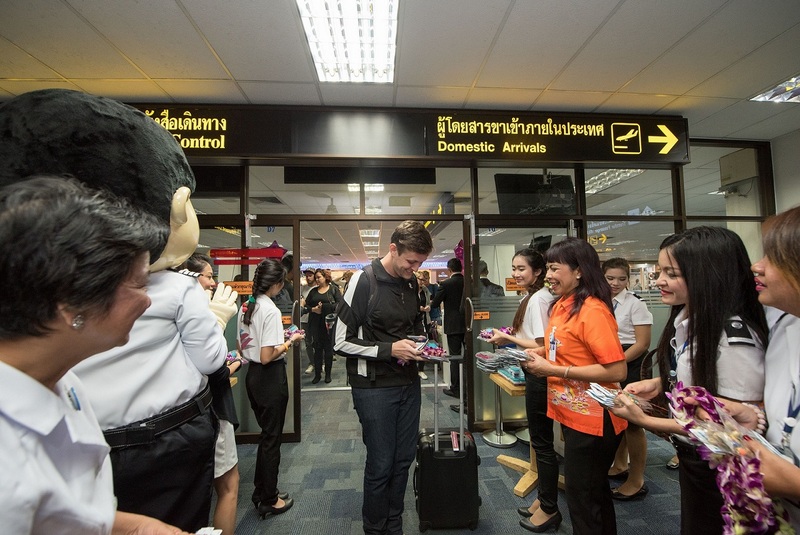
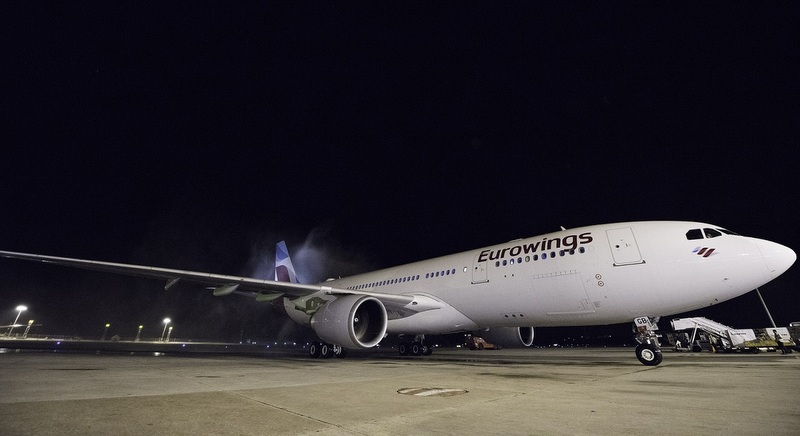
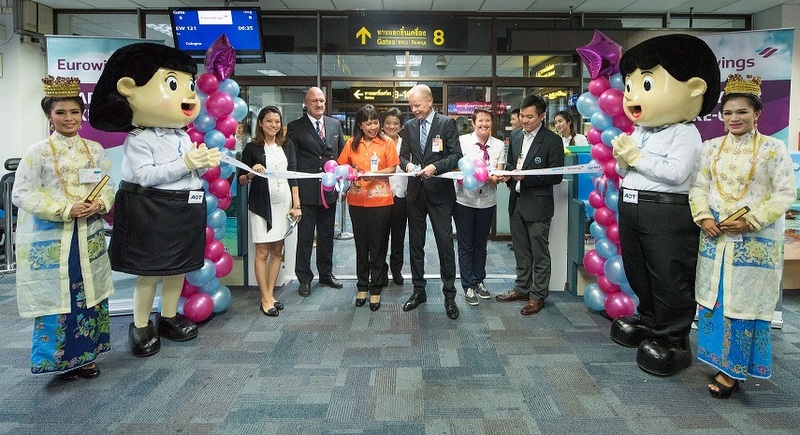
The inaugural flight to Phuket landed on the island last Saturday (Dec 19), and the maiden flight to Bangkok on Monday (Dec 21).
“Eurowings looks to strengthen its position in point-to-point traffic with the introduction of low cost long-haul concept to Phuket, offering affordable ticket prices with high quality inflight products on an Airbus A330, which is fitted with three travel classes,” noted the company’s release earlier this week.
Eurowings is Lufthansa Group’s second no-frills carrier to operate regular flights between Europe and Thailand, and Thailand was chosen as the first and only country in Asia by Eurowings to get this high-risk airline business model off the ground.
Separate non-stop flights from the airline’s Cologne base to Bangkok and Phuket are among the six initial routes which the airline hopes will set its intercontinental venture in motion.
Being a highly popular tourist destination for Germans and other Europeans, the country offers significant potential for Eurowings to succeed in the initial foray, Christian Hein, senior vice-president for sales, said.
There is a population of 25 million in the area surrounding Cologne, where its flights start and which offers business potential for Eurowings, he said.
The only long-haul low-cost airline operating to Thailand on a scheduled basis is Norwegian Air Shuttle, the third largest low-cost carrier in Europe.
The budget Norwegian carrier commenced flights to the Thai capital from Oslo on June 2, 2013 and currently offers three flights a week each from Oslo and Stockholm as well as two flights a week from Copenhagen.
Eurowings will offer two services a week each on the Cologne-Phuket and Cologne-Bangkok routes, with inaugural flights landing in Phuket on Saturday and Bangkok on Monday.
Mr Hein said the intercontinental operation was experimental, acknowledging that it was a new business model that had high risks.
“Give us a bit more time to understand how sustainable the [long-haul low-cost] model is, maybe in one year,” he said.
Eurowings is happy with what it sees so far in terms of bookings, which has boosted the airline’s confidence in the model's viability.
“If things don’t work out, we are going to sell it to someone else,” he said.
In order to get a good economy of scale, he said Eurowings also needed to expand its foundation, particularly with the addition of more aircraft beyond the two 310-seat Airbus A330-200 wide-body jets currently in place.
Eurowings plans to raise the number of long-haul aircraft in its fleet to seven in one year.
That will be part of the carrier’s plan to increase its entire fleet of single-aisle and wide-body aircraft to 250 over the next two years from the current 84.
Eurowings plans to pursue that major fleet expansion by means of mergers and acquisitions of other airlines, he said.
At the beginning of next year, the Germanwings brand, which has been controlled by the Lufthansa Group over the last 15 years serving Europe, will be phased out and entirely replaced by Eurowings.