


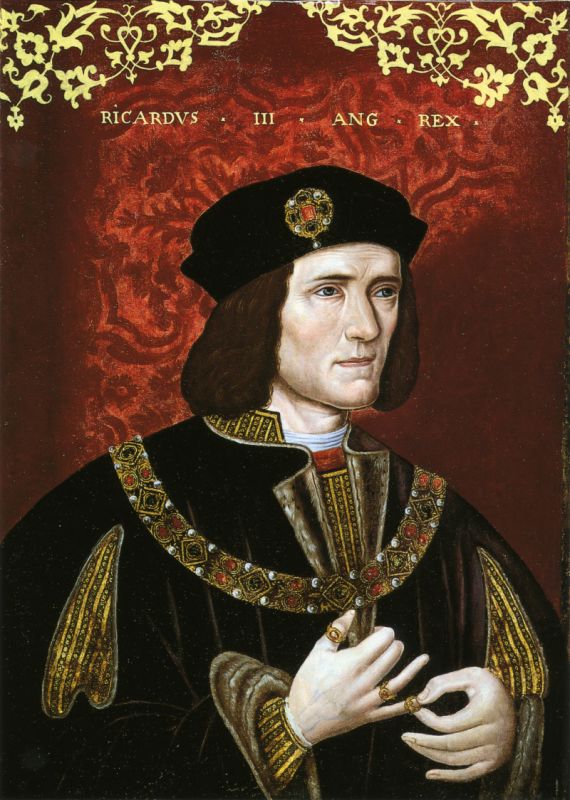
The remains of the last English monarch to die in battle were discovered buried under a municipal car park in 2012, almost 530 years after he was killed in 1485.
The medieval king will be laid to rest on Thursday (March 26) in Leicester Cathedral in central England, in the presence of royalty, in a service broadcast live on national television.
Five days of events leading up to the burial got under way yesterday when the king’s descendants and the archaeologists who excavated his remains laid white roses, the symbol of his royal house, on his coffin.
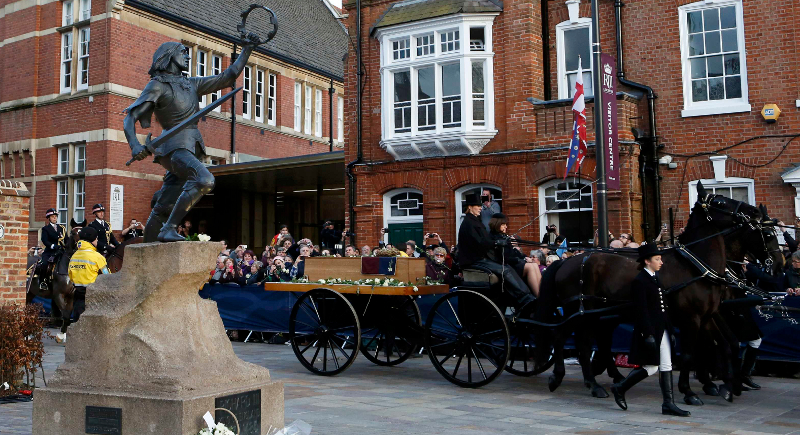
Th coffin was then taken to Bosworth, where he fell in battle. There, many attended in period dress and battle armour, and the dead king was honoured with a 21-gun salute.
The Leicester county council said 35,000 people had lined the streets yesterday.
The Bishop of Leicester, Tim Stevens, said Richard’s death marked an “extraordinary moment” in English history.
“It was a change of dynasty, an end of a period of violent civil war, the beginning of the period in which Shakespeare was to write his great [histories], including Richard III, and a different way of governing the country,” he said.
Richard ruled England from 1483 until he was killed near Leicester by soldiers loyal to Henry Tudor, who became King Henry VII.
It was the last major battle in the 32 years of dynastic fighting known as the Wars of the Roses, and Richard’s defeat saw the crown pass from his House of York (whose symbol was the white rose) to the House of Tudor (the red rose).
After the battle the slain 32-year-old was buried without fanfare at Greyfriars monastery, which was demolished in the 1530s during the dissolution of the monasteries by King Henry VIII, son of Henry VII.
Richard’s remains were thought lost. But members of the Richard III Society teamed up with Leicester University archaeologists to excavate the site, rightly predicting where in the old church he would have been buried.
They found a skeleton consistent with contemporary descriptions of the king, notably his curved spine, and battle injuries. Radiocarbon dating showed the man died between 1455 and 1540.
“Skeleton 1” had eight head wounds, including a brutal slash to the base of skull which cleaved away bone. Another blow had pierced his skull.
The discovery of the bones was confirmed by a DNA match with Richard’s closest living relative – Canadian carpenter Michael Ibsen, who fittingly has now made the monarch’s English oak coffin.
By coincidence, the remains were beneath a letter R indicating a reserved space in the car park.
Finding Richard’s remains triggered impassioned wrangling over what to do next, but following a judicial review his bones are to be reinterred in Leicester rather than York, his northern stronghold.
After visiting the battlefield, the coffin was taken on a horse-drawn cart through the streets before being welcomed with a ceremony at Leicester cathedral.
Queen Elizabeth II’s daughter-in-law Sophie, the Countess of Wessex, will attend the reburial, along with her cousin Prince Richard, Duke of Gloucester, who is patron of the Richard III Society and a blood relative.
The discovery of his skeleton encouraged scholars to look again at Richard’s record of social reform, rather than relying on Shakespeare’s Tudor-era portrayal of him as a villainous tyrant and murderer.
In a sermon, the leader of England’s Catholics, Cardinal Vincent Nichols, praised Richard for developing the presumption of innocence in the legal system and the practice of granting bail.
“Within the depth of his heart, amidst all his fears and ambitions, there surely lay a strong desire to provide his people with stability and improvement,” he said.