


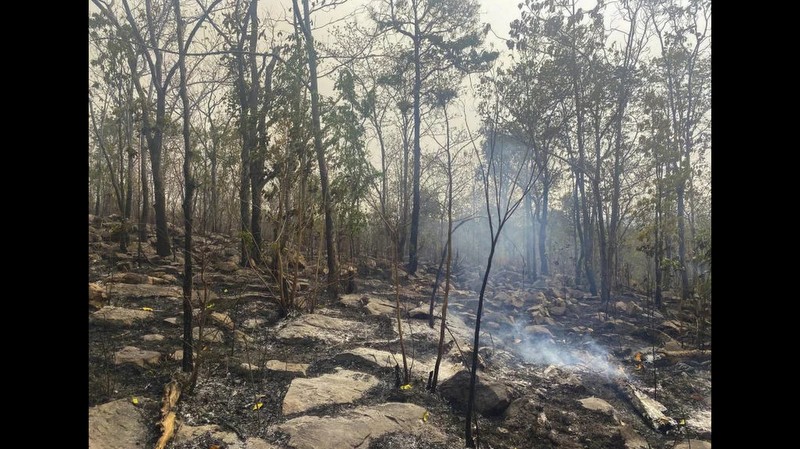
More hotspots are being reported in agricultural and forest areas, he said. Local authorities in many provinces have issued formal notices and been instructed to strictly enforce laws against open burning, alongside designating controlled burning zones, reports the Bangkok Post.
In one recent case, it was found that slow-burning incense bundles were being used to ignite sugar cane trash in fields in Buriram, so that the culprits would be long gone by the time the fires started.
In addition to agricultural burning and forest fires, other pollution sources such as vehicle emissions and construction are being addresses to mitigate the impact of fine dust pollution on the public.
Burning in forest, agricultural and open spaces in Thailand is punishable by both fines and imprisonment - in some cases both. The penalties and laws are as follows:
- Burning on one’s own property or in public areas that causes a nuisance, such as burning garbage or other items, may be ordered by local officials to cease. Failure to comply is an offence under the Public Health Act, punishable by imprisonment for up to 3 months and/or a fine of up to B25,000.
- Burning in roadside areas or within 500 metres of a roadway, resulting in smoke or other substances that may endanger traffic safety, is an offence under the Road Traffic Act, punishable by a fine of up to B1,000.
- Burning in agricultural areas, such as burning sugarcane fields, rice stubble, or open burning likely to endanger others and their property, is an offence under Section 220 of the Criminal Code, punishable by imprisonment for up to 7 years and/or a fine of up to B140,000.
- Burning forests in national parks or wildlife sanctuaries is punishable by imprisonment for 4-20 years, a fine of B400,000-2,000,000, or both.
- Burning forested land in national forest reserves is punishable by imprisonment from 1 to 10 years and a fine of B20,000 to B200,000. In cases where more than 25 rai is burned, the punishment is imprisonment from 4-20 years and a fine of B200,000 to B2 million.
Worsening dust pollution has taken a toll on both the economy and society, the Pollution Control Department said.
Public health concerns must not be overlooked, as pollution adversely affects multiple bodily systems, including the respiratory and cardiovascular systems, as well as eyes and skin. Prolonged exposure may also increase the risk of lung cancer.
Mr Surin has called for public cooperation, urging people to refrain from all forms of burning in prohibited areas.