


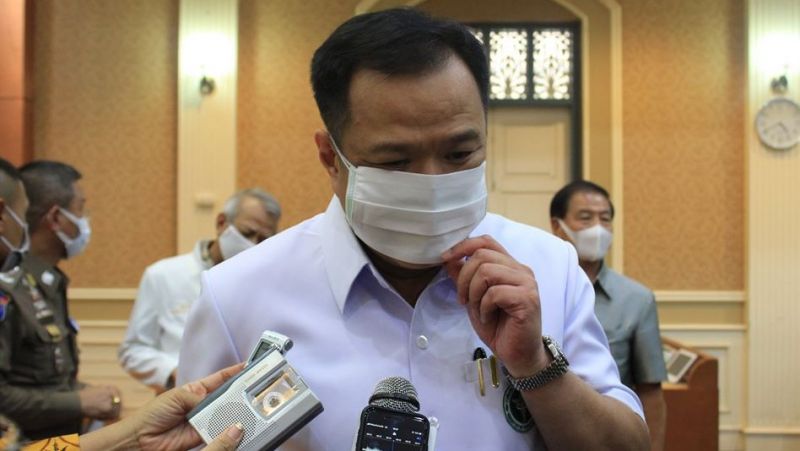
The trio were in Phuket yesterday (Apr 23) to lead a meeting on the economic impact of COVID-19 on tourism. At the meeting it was explained that the predicted impact for the six months February through July totalled a loss of some B127.159 billion in lost tourism revenues.
The meeting, held at Phuket Provincial Hall, saw Phuket Governor Phakaphong Tavipatana present, along with a host of high-ranking Phuket officials.
Thanusak Phungdet, President of the Phuket Chamber of Commerce, urged to ease the “tambon lockdown”, under which all non-essential travel between subdistricts on the island is banned.
In announcing the “tambon lockdown”, Phuket Governor Phakaphong Tavipatana pointed out that Phuket is the only province in the country to have such a measure in place.
“We can keep ‘red risk areas’ closed, but open ‘non-red areas’ for business,” Mr Thanusak said.
“We want to relax the lockdown as soon as possible, so the province can prepare for a return to normality. Keeping the borders between subdistricts closed for a long time will cause the people to suffer from not being able to work and having no income. Right now there are people who want to go to work, but they must travel between subdistricts to do so,” he added.
“It is expected that there will be no confidence among tourists to come to Phuket for the next six months. It is therefore very important that the private sector and the people to create jobs,” Mr Thanusak said.
“If the subdistrict borders are opened, it will have a positive psychological effect on the area,” he added.
Kongsak Khongphongsakorn, President of the Thailand Hotels Association Southern chapter, said that hotels on the island are aiming to reopen, at least partially, in July.
“We are confident that Chinese tourists will come from October 1 onwards, and we should start receiving bookings from June 1,” he said.
In the meantime, hotels will focus on the domestic market, but for even that to work some changes are required, he added.
Mr Kongsak said that “Big Data” could be used to help investors and policymakers plan further development of the tourism industry, including understanding tourism markets better and dealing with issues that affect Phuket’s appeal, such as traffic on the island.
Phuket Tourist Association President Bhummikitti Ruktaengam also joined the call to ease the lockdown restrictions.
“The key is to restore confidence among tourists that we are taking measures to help control the spread of the virus,” he said.
“We also should be taking this opportunity to ‘repair’ Phuket by fixing some of the major problems the island has been facing, such as the problem with traffic,” he said.
Sombat Atiset, Executive Chairman of the Katathani group of hotels, said he would like to see efforts to appeal to “unlock” the European market.
“By July or August we should be able to maintain our existing markets and ensure that Phuket is without disease,” he said.
Deputy PM Anutin, who also serves as the Public Health Minister, said anti-epidemic measures rolled out so far have “reasonably good” effect, and he said easing some of the restrictions was coming.
Businesses such as hairdressers and restaurants will see some reprieve, but the easing of restrictions will be limited, he said.
However, measures will be in place to try to prevent a “second wave”, Mr Anutin said.
“There is no vaccine yet, which means there is no way to prevent this disease,” he said.
He noted that the lack of tourists has allowed major tourist areas to recover their natural beauty.
“As for stimulating tourism, we need to look at the big picture. Don’t expect foreigners because some countries still have problems in their country, such as China and Europe, and so on.
“Such tourists will probably gradually return, but by then we must have everything in proper order. We need to have a vaccine, when that happens, they will come back,” he said
“Until then we need to stay vigilant and do our best to keep the disease under control,” he added.
Tourism Minister Phiphat also urged people to understand that any opening of areas to allow businesses to start trading again will be “step by step”, he said.
“The ministry is not neglecting Phuket. Previously, Phuket generated over B400 billion a year in tourism revenues,” he said.
He also noted that aout “50-60 provinces” are currently not risk areas for the disease.
“The Tourism Authority of Thailand will organise a tourism campaign in the country. But to do this hotels must first be well prepared to provide convenience, cleanliness, and safety before accepting people,” said Mr Phiphat.