


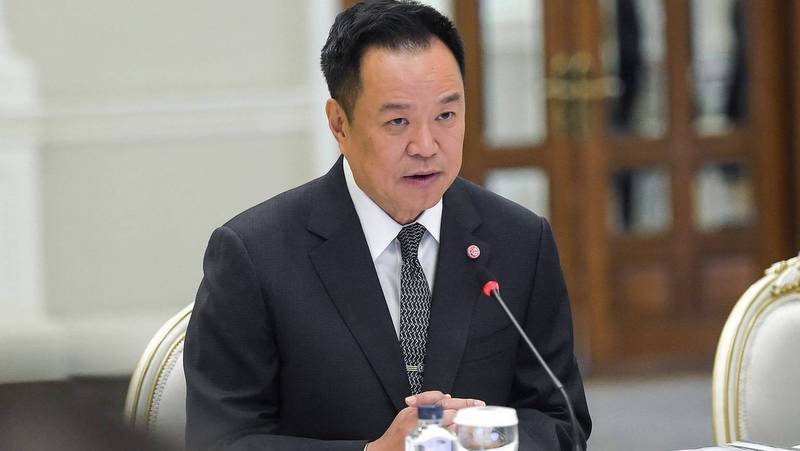
Mr Ekniti, also a deputy prime minister, said on Wednesday (Apr 22) the government would first prioritise reallocating expenditure within the 2026-2027 fiscal budgets before contemplating any increase in the debt ceiling or the use of emergency borrowing powers, reports the Bangkok Post.
Thailand’s public debt currently stands at approximately 66% of GDP, below the existing ceiling of 70%, leaving borrowing headroom of around four percentage points, or roughly B800 billion.
The ceiling, set by the Monetary and Fiscal Policy Committee, can be adjusted when necessary, as was done during the COVID-19 crisis when it was raised from 60% to 70%, he said, emphasising that any decision on additional borrowing must be taken cautiously and in stages.
The first step, he said, is to ensure the most efficient use of existing budget allocations. For the 2026 fiscal year, government agencies that have yet to disburse funds ‒ despite the year being more than halfway through ‒ have been given a deadline of Apr 30.
Any unspent allocations will be reclassified as central funds to address urgent priorities, including the impact of the Middle East war and support for vulnerable groups.
The second step involves a comprehensive overhaul of the 2027 budget, which is currently being drafted, he said.
Preliminary estimates suggest that B70-100bn could be reallocated from the 2026 budget, which, when combined with around B25bn in remaining central funds, would provide a reserve of B95-125bn, Mr Ekniti said.
This would require the passage of a budget transfer bill through parliament, which the government hopes can be expedited given the urgency of the situation, he said, adding that the bill is expected to be submitted to parliament at the earliest by mid-June.
In line with the prime minister’s policy direction, ministries will also be required to cut non-essential or inefficient spending, such as overseas study trips, provincial development projects of limited urgency and new government building construction.
In some cases, leasing private facilities may replace capital expenditure. Savings will be redirected towards public welfare and national recovery efforts. The Middle East war is likely to have prolonged effects, particularly on global energy prices, he said.
He also said that if it becomes necessary to issue an emergency loan decree, borrowing will not exceed B500bn to address the economic crisis.
"If we don’t borrow, the impact on the economy could be more severe, potentially causing GDP to contract." According to the National Economic and Social Development Council’s forecast, Thailand’s economy in 2026 is expected to grow by 1.4% with inflation at 2.9%. For 2027, GDP growth is projected at 2.2% with inflation at 1.5%.
He said that if global conditions normalise and oil prices decline permanently, borrowing may not be necessary. However, he believes the current crisis will likely last longer than anticipated, so fiscal "ammunition" must be prepared in advance.
Even if negotiations ease hostilities, oil prices may not return to previous lows. Speaking after attending the recent International Monetary Fund and World Bank Spring Meetings in the United States, he said there was a broad international consensus on two priorities: supporting vulnerable populations and using the crisis as an opportunity for structural transition.
Prime Minister Anutin Charnvirakul yesterday chaired a meeting to consider the framework for the fiscal year 2027 budget.