


Wenhui Zhong
chinese@classactmedia.co.th
Baba refers to the descendents of males who migrated to Nanyang (South Sea) in the past and married local women. They are said to have accumulated huge wealth through assiduous work in businesses. Meanwhile, females are referred to as Nyonya.
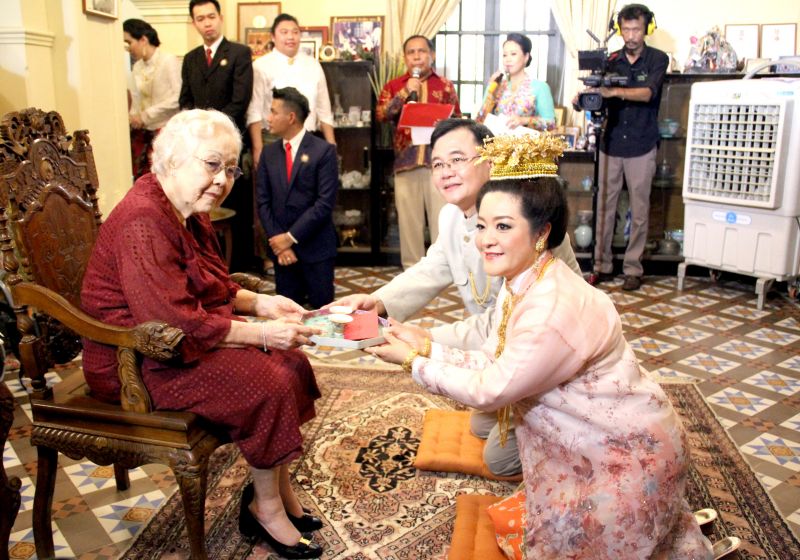
Peranakan Chinese or Straits-born Chinese are the descendants of Chinese immigrants who came to the Malay archipelago including British Malaya and the Dutch East Indies. As marriage is a major event of one’s life, Peranakan communities have became a showcase of strait Chinese culture and traditions.
Wedding preparations
Before the Peranakan wedding day there is a combing rite for the bride and groom which is held by a fully-blessed elder. The bride sits on the concave side of gangtang (rice measure) facing out, while the groom sits on its flat side facing in as the elder chant rhymes for good luck.
Traditional Baba weddings used to last up to 12 days, but the most important days were the first, third and the last day.
The first day was to rejoice the marriage day with the groom wearing a scholar’s cap and the bride dressed in red. The couple would be served one red and one white sweet rice ball to swallow, symbolising blessings.
On the third day, the couple offer tea to both sets of parents to show their filial piety, and in return the parents give them red envelopes of money.
The last day is a great feast as relatives and friends celebrate the wedding with singing and dancing.
Another tradition of the Baba wedding is to place a chicken coop with a cock and a hen under the bed. The bride will observe which of the two comes out first. It is believed that the order hints the sex of the future child – a boy if it is a cock, a girl if it is a hen.
Bridal trousseau
Nyonya’s wedding hair accessories are known to be meticulous and luxurious, they include a diamond-inlaid crown and a variety of gold pins which are placed to give the accessory the shape of a flower, adding to the bride’s elegance.
The bride wears different styles of dresses on each wedding day, the first day being the most splendid and elegant. Most of their accessories are made of gold in order to fully highlight the bride’s elegance and status.
On the last day, the twelfth, the bridal dress is not as opulent as the first day, but is still comprised of bright colours. Very often, the jewellery is borrowed from relatives and friends. The jewellery worn by the bride is not only a symbol of wealth of her family, but also a symbol of her parents’ social relations.
Handicraft
Peranakans follow the tradition that men went out to earn money while women stay at home to do the housework. Therefore, Nyonya had to learn needlework and cooking from a young age. The better their needlepoint, the more educated they were thought to be.
Long before their wedding, young Nyonya embroider various alluring patterns of flowers and birds on cloth or animal fur with beads, then made them into shoes. This intricate beading is deeply ingrained in Peranakan artwork, a highlight of Nyonya culture. Shoes decorated by beads are shiny and brightly coloured. Brides give their own hand-made shoes to her husband and in-laws as a present. They often lay the beaded shoes on display to show off – the large quantity and beautiful designs would prove the bride was virtuous.
Other than beaded shoes, the bride handcrafts a variety of other ornaments such as glass ornaments, pillowcases and other textiles, generally designed with flowers and butterflies. Curtains made by the Nyonya are hung in the wedding chamber, reflecting the exquisite handicraft. It is not only a work of art, but can also be interpreted as rich cultural connotations.
In addition, Nyonya were also known for their own unusual cuisine which follows the traditional Chinese cooking methods but add various Southeast Asian spices. Furthermore, making luscious, pleasant and colourful Nyonya cake is considered a great opportunity to show off cooking skills to the guests.
Even though the Peranakan have long moved away from their motherland in China, they’ve done well to preserve old traditions over the years. A Peranakan wedding in Southeast Asia is a great way to experience some of these age-old Chinese cultural traces.
This article refers to exhibition in Penang Peranakan Mansion and A Peranakan Legacy written by Peter Wee, the president of the Peranakan Association of Singapore.