


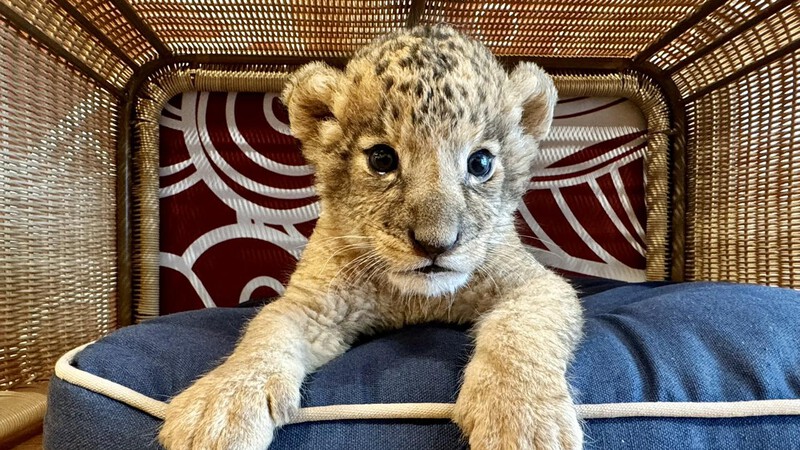
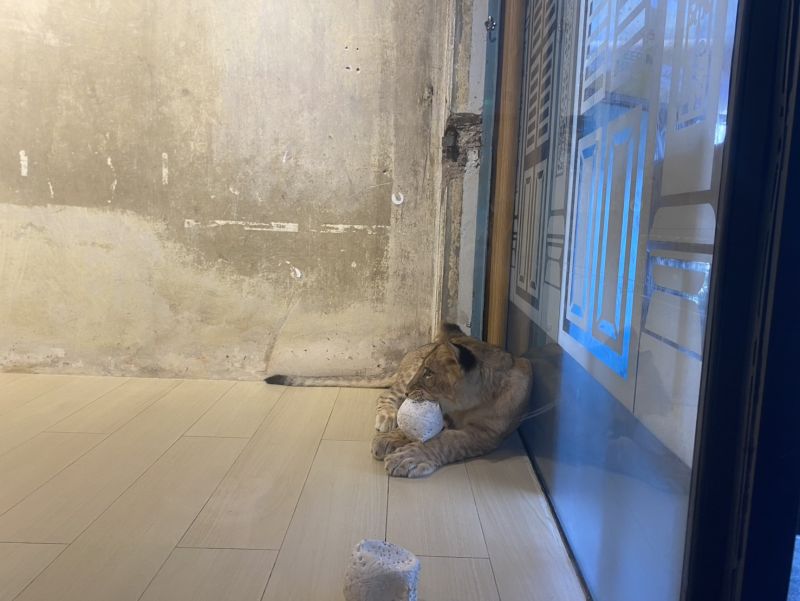
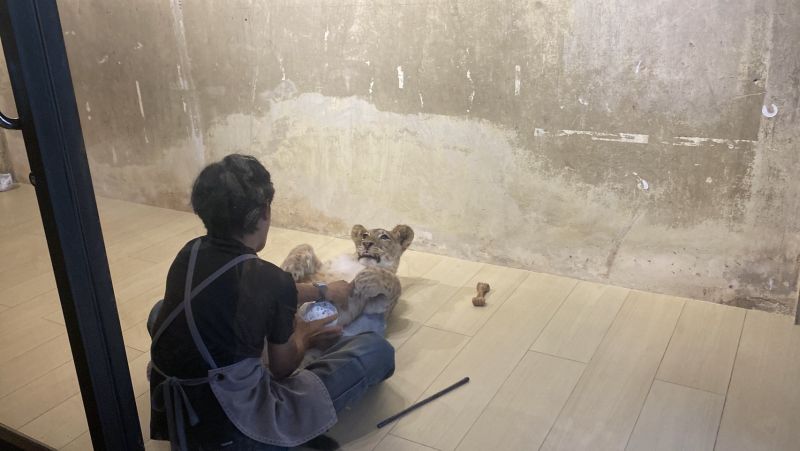
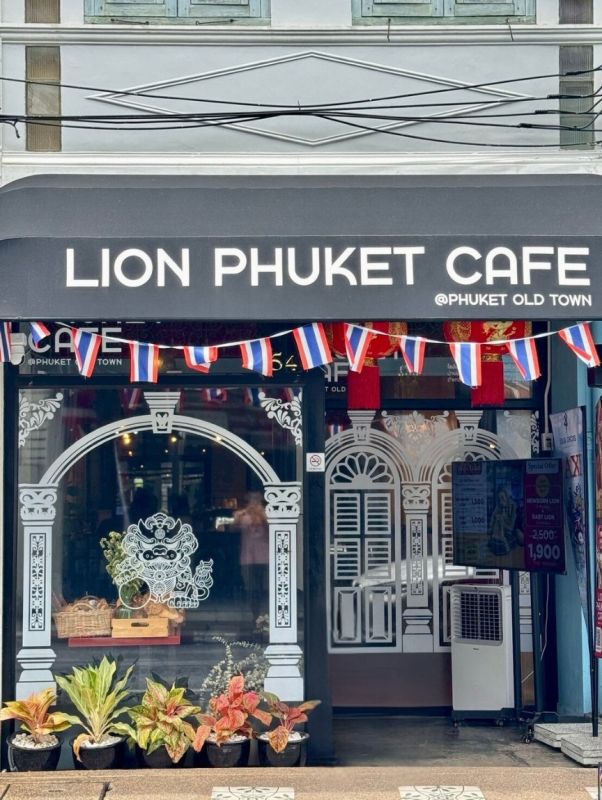
The controversy erupted after footage circulated online showing lion cubs inside a glass enclosure at Lion Phuket Café on Krabi Rd in Phuket Town, prompting widespread concern over animal welfare, public safety and the legality of keeping wild animals in a tourism setting.
The issue quickly gained traction after being highlighted by Siranudh ‘Psi’ Scott, a Thai-Scottish marine conservationist and former advisor to the Director-General of the Department of National Parks, Wildlife and Plant Conservation (DNP).
Mr Scott pointed to Thailand’s legal framework governing wildlife, noting that under the Wildlife Conservation and Protection Act B.E. 2562, the breeding, possession and commercial use of certain protected species can be permitted under strict conditions.
“The law allows for controlled wildlife and certain protected species with economic potential to be bred and traded, provided operators obtain licences from the relevant authorities,” he said.
However, he raised concerns about how the law is applied in practice, particularly in tourism-driven environments.
“It’s because the Wildlife Protection Act in Thailand allows you to obtain permits to breed, sell, import and export wildlife, including endangered and protected species,” Mr Scott said.
Despite the existence of this legal framework, public concern remains high, especially in destinations such as Phuket where wildlife attractions openly rely on tourism.
Online reaction to the viral footage reflected ongoing unease, with many users questioning both enforcement and ethical standards.
One commenter wrote, “I have contacted many government agencies and also PETA and other animal rights activists and nothing was done… It’s so sad.”
In a separate exchange, a foreign commenter asked, “Is this allowed in Thailand? This is very sad… what are they doing to the lions to make them interact with humans?”
Responding to the question, Mr Scott alleged mistreatment. “Our laws allow the sale, breeding and captivity of endangered and protected wildlife if you pay for a permit,” he said. “I believe they heavily sedate and abuse the lions.”
He also endorsed a widely shared comment criticising the gap between legality and ethics, which stated that laws do not always reflect humanity or compassion toward animals, particularly when influenced by powerful interests.
Another commenter questioned the integrity of officials involved, asking, “How much are these officials getting paid to say that? This is obviously not okay!”
Mr Scott responded bluntly: “They’re all stupid and corrupt.”
DEFENCE
Speaking to The Phuket News, the café manager, who asked to be identified only as ‘Lina’, rejected the allegations and insisted the lions are raised under strict care protocols from the moment they arrive. “We care for them like a baby,” she said.
Ms Lina explained that in early stages each lion is separated for close monitoring, with attention given to cleanliness, feeding and health. “They are fed in rounds according to schedule, and we adjust the amount depending on each animal,” she said.
Each cub is assigned a dedicated caregiver, or “keeper”, responsible for monitoring its condition. “If a new lion arrives, that caregiver must look after only that one first, so we can check the animal properly,” she said.
The café currently houses three lions ‒ two white males and one larger female ‒ all sourced from licensed farms, she said.
Ms Lina said the lions are kept at the café for about four months, in accordance with conditions set by authorities.
“When officials come to inspect, they measure the space and set requirements such as enclosure height to ensure safety,” she said.
“After four months, we have to send them to be cared for by the Wildlife Conservation Office,” she added.
She said the café is only permitted to keep lions from around four months of age and works with licensed farms to source the animals. However, she declined to provide details about the cost and location of the farms.
Ms Lina said all lions receive vaccinations and are monitored by a resident veterinarian. “If the lions show any abnormal symptoms, our veterinarian will check them immediately,” she assured.
She added that the animals are provided with designated living spaces: “Lions sleep and eat at the café. They have their own rooms, with bedding and separate areas,”
SAFETY
In response to concerns about public interaction, Ms Lina outlined strict safety and hygiene protocols.
Customers must sanitise their hands before entering. Those interacting with the lions must wash again with disinfectant, remove shoes, wear covers and sanitise once more. After contact, they must wash their hands again, she said.
Staff follow the same procedures at all times.
Ms Lina also rejected claims that the café bypassed legal requirements. “We did not buy a permit… We waited until the permit process was completed before bringing the lions in,” she said.
“The department comes to check regularly, and the municipality also oversees the operation,” she added.
OFFICIAL RESPONSE
Officials from the DNP confirmed that the café is legally in possession of the animals under the Wildlife Conservation and Protection Act B.E. 2562.
According to officials, all three lions are properly registered and microchipped, and the operator has completed all required legal procedures.
They also confirmed the business is Thai-owned and unrelated to the previous controversial Glass House Café case involving a Chinese operator in Ratsada.
The owner, Peeraphat Thongna, 34, from Trang, holds a valid licence, while Yatavee Sangpratheep is listed as the registered veterinarian.
Surasak Anusorn, Director of the DNP’s Regional Office of Protected Areas 5, declined to comment on potential penalties related to the earlier Glass House Café case.
The DNP office issued a public clarification shortly after the video circulated and dispatched officials to inspect the café.
Authorities reiterated that the animals are being kept in accordance with legal and welfare standards, and that monitoring is conducted regularly.
Despite these assurances, the case has highlighted the gap between regulatory compliance and public perception, particularly in wildlife tourism settings.
For now, officials maintain that the café is operating within the law.
GLASS HOUSE
The latest incident has also reignited attention due to Phuket’s recent history involving lion cub cafés. In January 2025, police raided The Glass House Café and Space in Ratsada, where lion cubs were used for paid photo sessions with tourists.
Two Chinese nationals were arrested for working without permits after officers found them operating inside the café.
Immigration police said the pair were shareholders in the business, raising concerns over violations of laws restricting certain occupations to Thai nationals.
Both suspects denied the charges and were released on bail pending legal proceedings.
Authorities have not confirmed whether further charges were filed against operators of The Glass House.
The case followed an earlier controversy in February 2024 involving a lion cub known as “Nong Kiwi”, which was displayed at the same venue.
Officials later seized the cub after determining it was not properly registered and that its living conditions did not meet required standards.
Investigators found irregularities in ownership records, including discrepancies in microchip data and failure to notify authorities of the animal’s possession and transport.
The cub was relocated to a wildlife facility in Suphan Buri.
Officials also noted that the animal had been transported daily between the café and private accommodation, breaching regulations requiring controlled wildlife to be kept at registered locations.