


The fuel subsidy applied since the start of the war in Iran has drawn concern from credit rating agencies about the government’s lack of adherence to fiscal discipline, said Nattapon Kamthakrua, assistant managing director of securities analysis at Yuanta Securities (Thailand).
“The government previously focused on minimising the impact on domestic consumption and some sectors such as petrochemicals amid oil price spikes, which weakened the country’s fiscal status,” he said.
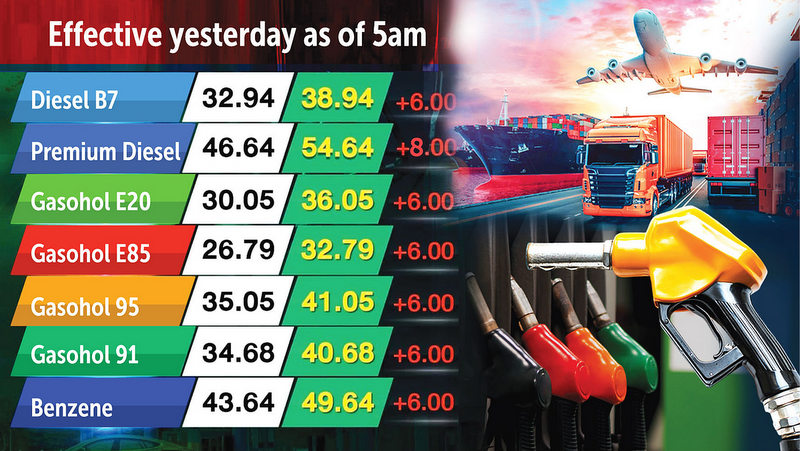
With the government ending fuel price caps, sending pump prices up by B6 per litre nationwide, Mr Nattapon said Thailand is “unlikely to face a credit downgrade”.
As rising petrol prices could dampen domestic consumption, he predicts a bigger headwind from shrinking debt servicing capacity, especially among vulnerable groups. However, the new government is expected to be sworn in shortly and kick off measures to cushion such effects.
STAGFLATION RISK
Poonyawat Sreesing, senior economist at SCB Economic Intelligence Center (EIC), agreed that allowing domestic prices to move in line with actual market prices could lessen the risk of a Thai credit downgrade.
“However, risks remain if jumping oil prices significantly lower the country’s GDP growth because that is also a factor for a credit downgrade,” he told the Bangkok Post.
EIC lowered its GDP growth estimate for 2026 yesterday (Mar 26) to 1.4% from 1.8%, noting that inflation could be as high as 3.2%.
“Low GDP growth and high inflation also mean Thailand faces higher risk of stagflation,” said Mr Poonyawat.
Nuttaporn Triratanasirikul, deputy managing director of Kasikorn Research Center (K-Research), said skyrocketing oil prices could affect GDP growth in a range of 0.2-0.7%, as the think tank now projects the economy to expand 1.9% this year.
Before the Middle East war erupted, K-Research estimated domestic consumption to edge up by only 1.8% this year. Now the figure could miss the target, she said.
“We didn’t expect domestic pump prices to go up by as much as B6 a litre at once," said Ms Nuttaporn.
“We thought the increase would be B2 per hike. This could be a shock for consumers.”
PRICE SHOCK
The Federation of Thai Industries (FTI) warned of significant consequences for production costs and consumer prices.
Manufacturers understand global crude oil prices have surged, driving retail fuel costs upwards, said Apichit Prasoprat, vice-chairman of the FTI.
However, he criticised the government for implementing such a steep increase all at once, calling it “a dramatic rise” that will burden businesses across multiple sectors.
According to the FTI, higher diesel prices will directly raise logistics costs. An increase of B1-2 per litre could hike logistics expenses by 1-3%, while a B2-4 uptick could lift costs by 5-12%. A B4 rise would drive logistics costs up by as much as 15-20%, noted the group.
With the government’s B6 increase in diesel prices, businesses are bracing for even heavier financial strain, said Mr Apichit.
He warned consumer product prices will inevitably climb by at least 5-8% in the near future, as manufacturers can no longer absorb the added expenses.
Some companies may even be forced to temporarily suspend operations due to soaring fuel costs and shortages of certain raw materials, said Mr Apichit.
Seafood processing is expected to be hit particularly hard, as fishermen face higher fuel bills when going out to sea, which will translate into more expensive processed seafood in the market, he said.