



The concern comes as the Ministry of Agriculture and Cooperatives holds talks with Russia over the potential import of 1-2 million tonnes of urea fertiliser per year, underscoring the extent of Thailand’s dependence on external supply at a time of mounting geopolitical uncertainty.
Thailand imports more than 90% of its chemical fertiliser, with total demand estimated at 4-5mn tonnes annually. Much of that supply is tied to global energy and raw material markets, particularly in the Middle East, leaving the country vulnerable to price shocks and potential shortages if conflict escalates or key transit routes are disrupted.
Import data further highlights the concentration of risk. Around 22.5% of Thailand’s fertiliser comes from China, followed by 14.6% from Saudi Arabia, 8.6% from Malaysia, 7.7% from Russia and 7.1% from Qatar ‒ a supply chain heavily exposed to geopolitical and trade instability.
Officials have increasingly warned that any disruption affecting strategic routes such as the Strait of Hormuz could have immediate consequences for fertiliser availability, with knock-on effects for agricultural output and food security.
Against that backdrop, efforts are intensifying to expand domestic production, particularly organic fertiliser, as part of a broader strategy to reduce structural dependence on imports.
Nationally, Thailand produces about 3.32mn tonnes of organic fertiliser per year, with targets to increase that to as much as 3.5-4mn tonnes. However, officials acknowledge that organic fertiliser cannot fully replace chemical alternatives, particularly for high-demand crops.
“It’s important to consider the overall picture,” agricultural specialist Petchara Wannapech said, speaking on behalf of Phuket Land Development Station chief Songwut Saengsuriya.
“For example, 100kg of organic fertiliser contains only about one kilogramme of nitrogen,” she said. “Chemical fertiliser provides equivalent nutrients in smaller quantities and delivers faster results.”
This limitation remains critical for sectors such as oil palm and rubber, which require high nutrient input for commercial yields. “Some sectors require large amounts of chemical fertilisers for rapid results,” Ms Petchara added.
LOCAL RESPONSE
In Phuket, however, even small-scale fertiliser production is now being viewed as part of a wider resilience strategy ‒ one that links waste management with agricultural supply.
Current output remains modest. Phuket produces about eight tonnes of fertiliser per month ‒ roughly 96 tonnes per year ‒ primarily from food and organic waste streams.
“However, the real figure is higher,” Ms Petchara said.
“We know that in Phuket Town alone, we produced eight tonnes per month last year, but currently production exceeds this amount, as it does not include output from Patong and private sector operators.”
At the Phuket Land Development Station, production focuses on agricultural waste rather than municipal food waste.
“The office produces a large amount of fertiliser from inedible fruit waste, using microbial inoculants for composting,” Ms Petchara said. “The amount of fruit waste compost produced is about 40 tonnes per year.”
Liquid fertiliser is also produced and distributed locally. “Currently, we produce about 6,000 litres per month, including bio-fermented liquid,” she said. “Each production run distributes approximately 1,000 bottles to local farmers.”
Distribution remains targeted rather than commercial. “At present, the production volume is not that large. We are focusing on distribution to those in need,” Ms Petchara said.
Despite its limited scale, officials see the model as a foundation for future expansion. “The future plan is to produce more volume,” she added.
PATONG MODEL
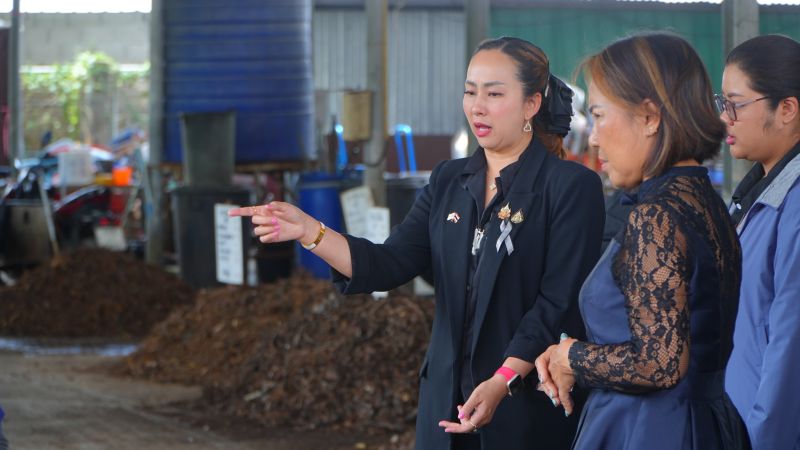
At the municipal level, Patong has emerged as one of the island’s most active sites for converting waste into fertiliser, though capacity constraints remain a major challenge.
Deputy Mayor Arwut Nuchet, speaking on behalf of Mayor Lalita Maneesri, said the municipality currently collects about one tonne of organic waste per day, mainly fruit scraps from local businesses.
“Patong Municipality currently does not directly process wet waste, but focuses on organic waste such as fruit scraps,” he said.
However, the conversion process relies on natural composting, which limits throughput.
“The process requires about one and a half months per cycle, which restricts capacity,” Mr Arwut said.
The municipality is also producing liquid fertiliser from wastewater sludge generated by its treatment system, which is distributed for agricultural use.
To address bottlenecks, Patong is planning to introduce new technology capable of accelerating production.
“The next phase is to procure an organic waste shredder capable of processing waste into fertiliser within 24 hours,” Mr Arwut said. “The machine can handle approximately one tonne per day.”
However, cost remains a significant barrier. “The machine costs millions of baht, so we must start with a trial run,” Mr Arwaut added.
Officials said the pilot project is intended to build confidence among local businesses, including hotels and restaurants, before any wider rollout.
ZERO-WASTE PUSH
At the provincial level, fertiliser production is being driven by a broader policy push to reduce waste at the source.
Phuket Governor’s secretary Aom Kanthima confirmed that all local administrative organisations are now required to implement composting systems as part of a zero-waste target.
“The governor has a policy to reduce organic waste at the source to zero in all local administrative organisations by the end of this year,” she said.
“That means every local administrative organisation must have its own waste composting machine.”
However, the initiative is being implemented without central government funding.
“According to the previously proposed plan, the province did not receive funding,” Ms Kanthima said. “Authority has now been delegated to each local organisation to procure equipment themselves.”
Progress is being monitored through regular meetings, with local authorities required to report updates on implementation.
“There will be a progress monitoring meeting this Friday, and we hold it every month,” she added.
LIMITS AND REALITY
Despite the policy momentum, officials acknowledge that local fertiliser production remains a partial solution at best.
Organic fertiliser, while environmentally beneficial and aligned with waste reduction goals, cannot yet match the efficiency or nutrient density of chemical products at scale.
It is also, in some cases, more expensive.
“Organic fertilisers… are relatively more expensive than imported chemical fertilisers but yield slower results,” Ms Petchara said.
For Phuket, where agriculture plays a relatively small economic role compared with tourism, the focus is less on large-scale production and more on resource efficiency and environmental management.
Still, officials say the direction is clear.
By turning organic waste into fertiliser, the province is not only reducing the volume of refuse sent to disposal sites, but also contributing ‒ however modestly ‒ to a national effort to strengthen supply resilience.
For now, Phuket’s output remains limited and locally focused. But as pressures on global supply chains grow, officials say expanding domestic production ‒ however incremental ‒ is no longer optional, but necessary.