


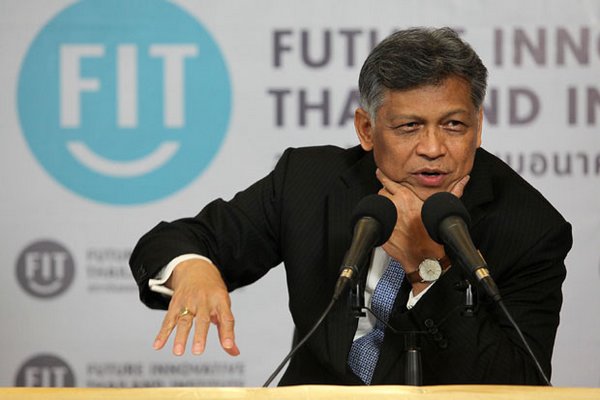
Mr Surin said the corruption problem has reached crisis point and must be tackled with urgency.
The former Democrat Party politician, who is now also chair of the Future Innovation Thailand Institute, insisted graft was scaring away investors.
The cost of corruption adds a prohibitive 30-35 per cent to any investment, he said.
Thailand is Asean’s second-largest economy after Indonesia, with diverse economic sectors. It should be one of the leading countries in the region to attract foreign investments but the reality is starkly different, he said.
Between 2007 and last year, foreign direct investment (FDI) to Asean surged 30 per cent from US$85.61 billion (about B2.7 trillion baht) to US$111.29 billion. However, the amount of FDI to Thailand shrank from US$11.35 billion in 2007 to US$8.6 billion last year, a 24 per cent drop.
Mr Surin estimates the country has lost some US$6 billion worth of investment opportunities, due mainly to corruption, in the past six years.
He said a Global Corruption Barometer 2013 survey showed foreign investors were most concerned about corruption.
The survey, he added, also says that one in six Thais admits to having paid a bribe.
Mr Surin said the findings showed political parties are one of the root causes of corruption and that the media’s watchdog role is not strong enough.
He said two recent polls conducted by Abac and Suan Dusit also provided findings which confirm that more than 60 per cent of respondents, a lot of them young people, found corruption tolerable if they gain something from it.
Mr Surin said corruption has cost the country about B100 billion a year. The money could be spent on numerous useful projects for the people instead.
Foreign investors would rather invest in other countries where there may be less economic diversity but a lower cost of doing business, because of lower levels of corruption.
Mr Surin said concerns have been raised by many quarters that graft could derail the Asean Connectivity Master Plan, which calls for the building of a regional transport system.
If problems stemming from corruption force a suspension of the linkage in Thailand, which is the geographical centre of the region, the entire system will also fall.
National competitiveness has taken a beating as corruption drains away the budget and cripples the country’s ability to develop its human resources, he said.
The so-called leakage of the budget also prevents the education system from training people to be innovative and develop the minds needed for inventing new products.
Thailand is one of the world’s leading spenders on education, he said, but the result is disappointing.
The World Economic Forum has said in one of its reports that Thailand’s quality of higher education is “abnormally low” in comparison with other Asean countries, according to Mr Surin.
The government, he said, must be bold and straightforward in enforcing the law to fight graft. It should become a signatory of the Organisation for Economic Co-operation and Development’s Anti-Bribery Convention.
The ratification of the convention would provide a clear gauge of how well the country does to combat corruption.
Mr Surin stressed the mindset of many Thais who condone corruption must change.
If the problem is allowed to persist, the country will collapse and future generations will be left in dire straits, he said.
Read the original story here.